 Primary School Profiles 2025

 Primary School Profiles 2025

| Address: | Leung King Estate, Tuen Mun, N.T. | |||
| Phone: | 24661882 | Email: | general@eclass.plkfwkc.edu.hk | |
| Fax: | 24532395 | Website: | http://www.plkfwkc.edu.hk/ | |
 School Information
 | Supervisor/ Chairman of Management Committee | : | Mr. Lam Shing Ngai |
| School Head | : | Ms. Kwok Sau Wai |
| Incorporated Management Committee been established? | : | Established |
| Percentage of School Supervisor and Managers / Chairperson and Members of School Management Committee (SMC) of Government Schools Fulfilling the Training Targets | : | 80% |
| School Type | : | Aided Whole Day |
| Student Gender | : | Co-ed |
| Sponsoring Body | : | Po Leung Kuk |
| Religion | : | Not Applicable |
| Year of Commencement of Operation | : | 1987 |
| School Motto | : | Love, Respect, Diligence, Honesty |
| Area Occupied by the School | : | About 1800 Sq. M |
| Through-train Secondary School | : | - |
| Feeder Secondary School | : | - |
| Nominated Secondary School | : | Po Leung Kuk Centenary Li Shiu Chung Memorial College, Po Leung Kuk Tung Yuk Tien College |
| Medium of Instruction | : | Chinese |
| School Bus Service | : |
- |
| Parent-Teacher Association | : | Yes |
| Past Students' Association/Alumni Association | : | Yes |
| 4Rs Mental Health Charter | : | Yes |
| Whole School Health Programme | : | Advanced School |
 2025/2026 Annual School Charges
| School Fee | : | - |
| Tong Fai | : | - |
| PTA Fee | : | $20 |
| Approved Charges for non-standard items | : | $310 (Improving school facilities and hiring foreign teachers) |
| Other Charges | : | - |
 School Facilities
 | Number of Classroom(s) | : | 24 |
| Number of School Hall(s) | : | 1 |
| Number of Playground(s) | : | 1 |
| Number of Library(ies) | : | 1 |
| Special Rooms | : | 10 special rooms including Activity Room, Start-up Lab, Visual Arts Room, Music Room, Health Education Resources Centre, Playroom, Chinese Orchestra Room, Parents Teachers Association Room, English Activity Room and School Alumni Room. |
| Facility(ies) for Supporting Students with Special Educational Needs | : | Ramp, Accessible lift and Accessible toilet. |
| Others | : | Creative Art Gallery, Garden and Chinese Culture Gallery |
 Teaching Staff Information (Including School Head) in the 2024/2025 school year
 | Number of teaching posts in the approved establishment | : | 49 |
| Total number of teachers in the school | : | 55 |
| Qualifications and professional training (%) | ||
| Had Received Teacher Training | : | 100% |
| Bachelor Degree | : | 100% |
| Master/ Doctorate Degree or above | : | 32% |
| Special Education Training | : | 67% |
| Years of Experience (%) | ||
| 0 - 4 years | : | 9% |
| 5 - 9 years | : | 18% |
| 10 years or above | : | 73% |
 Class Structure
 | 2024/25 school year | ||
| P1 Number of classes | : | 4 |
| P2 Number of classes | : | 4 |
| P3 Number of classes | : | 4 |
| P4 Number of classes | : | 4 |
| P5 Number of classes | : | 4 |
| P6 Number of classes | : | 4 |
| Total | : | 24 |
| 2025/26 school year (Based on the number of classes approved by EDB in 2025) | ||
| P1 Number of classes | : | 4 |
| P2 Number of classes | : | 4 |
| P3 Number of classes | : | 4 |
| P4 Number of classes | : | 4 |
| P5 Number of classes | : | 4 |
| P6 Number of classes | : | 4 |
| Total | : | 24 |
| Mode of teaching at different levels | ||
| Implement student support program, Gifted Education is implemented on Chinese, English and Mathematics curriculum. | ||
| Remarks | ||
| SENCO, On-site Social Worker, Speech Therapist and Educational Psychologist offer support to students and parents. | ||
 Performance Assessment
 | Applicable to P1 only | ||
| Number of test(s) per year | : | 0 |
| Number of exam(s) per year | : | 3 |
| Replace tests and examinations with diversified assessments in the first term of P1 | : | Yes |
| Applicable to P2 to P6 only | ||
| Number of test(s) per year | : | 0 |
| Number of exam(s) per year | : | 3 |
| Applicable to P1 to P6 | ||
| Formulate appropriate school-based assessment and assignment policies, inform parents of related arrangements, and collect views from teachers, students and parents regularly (at least once per school year) for ongoing review and optimisation of the school assessment and assignment policies | : | Yes |
| Upload the school-based assessment policy onto the school webpage for information of the public and stakeholders | : | Yes |
| Upload the school-based assignment policy onto the school webpage for information of the public and stakeholders | : | Yes |
| Diversified Assessment for Learning | : | 1. (ICT) assessments include skills tests and written tests. There are oral tests and written tests for Putonghua. 2. Chinese and English assessments include listening, speaking, reading and writing. Project-based learning component accounts for 5 marks in Maths exam. Project-based learning and "Little Scientist" activity each contribute 5 marks to the General Studies exam. |
| Avoid arranging tests or examinations immediately after long holidays in order to let students take more rest during the holidays | : | Yes |
| Arrange the timetable flexibly according to the school context, with a tutorial session provided in the afternoon as far as possible for students to finish some of their homework under teachers’ guidance | : | Yes |
| Streaming arrangement | : | 1. P.1 & P.2 class placement by average. 2. 2 elite classes in P.3 & P.4 for the top 70 students. 3. 1 elite class for the top 35 students, 1 advanced class for the rank between 36-70, rank after 70 will be evenly distributed into two classes in P.5 & P.6. |
 School Life
 | Number of school days per week | : | 5 |
| Number of periods per day | : | 9 |
| Duration of each normal period | : | 35 |
| School starts at | : | 8:20 AM |
| School ends at | : | 3:40 PM |
| Lunch break | : | 12:30 - 1:30 |
| Lunch arrangement | : | Provided by designated supplier and arranged by parents. |
| Healthy school life | : | 1. We obtained the Gold Award of "The Hong Kong Healthy School Award Scheme". 2. We carried out "EatSmart School Accreditation Scheme". 3. Students have lunch in the school canteen. 4. Straighten Up Hong Kong School Campaign. 5. We have morning exercises and spinal protection exercises. |
| Remarks | : | 1. We have morning assemblies, morning readings and homework lesson. 2. There are practical lessons every Wednesday after lunch and the classes finish at 2:30pm. 3. There are activity lessons and comprehensive lessons every Friday afternoon. Students can participate in different types of extra-curricular activities. |
 Life-wide Learning
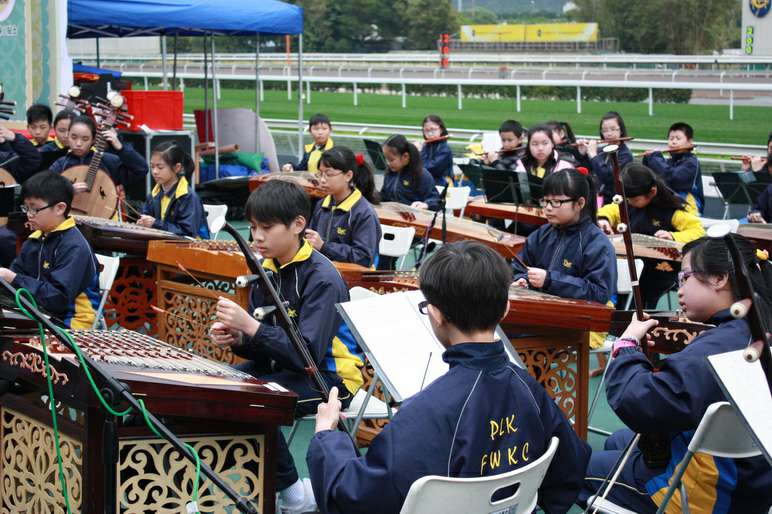
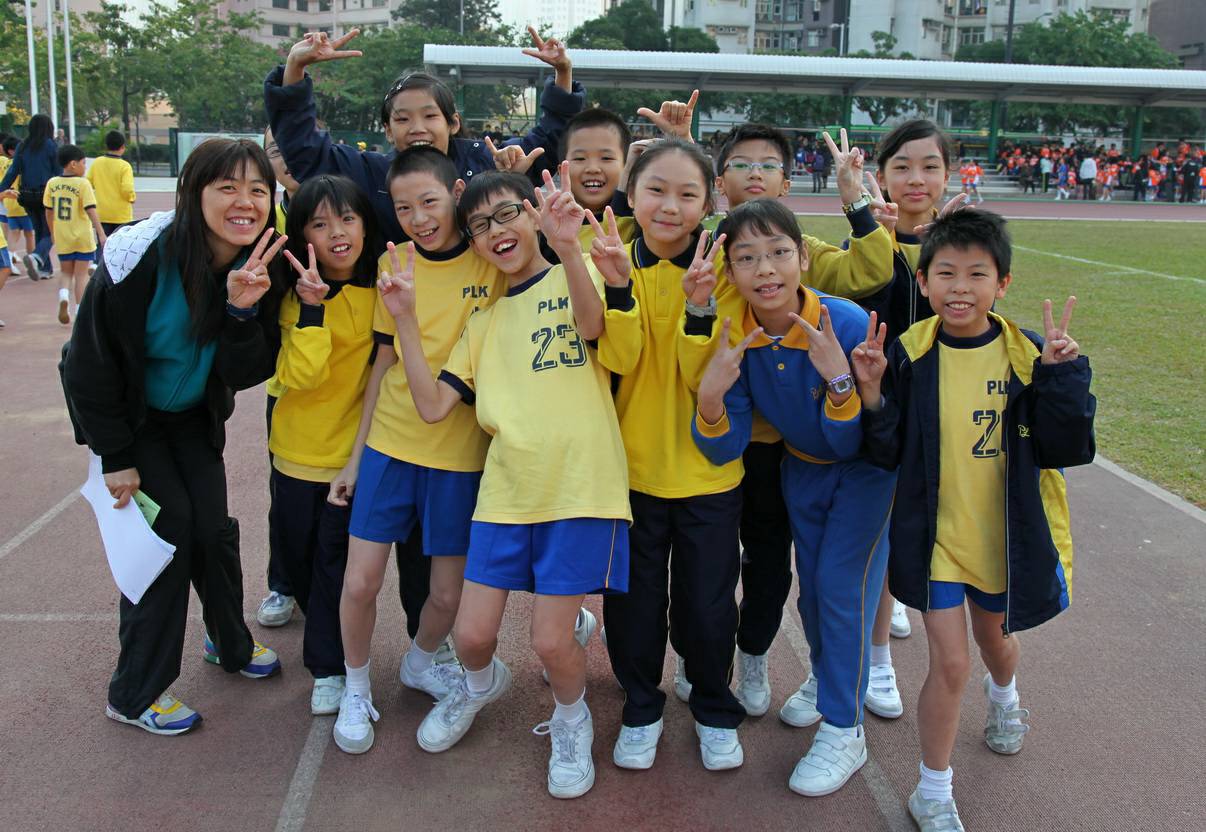
 | There are about 30 extra-curricular activities in our school, such as Service Activities: Cub Scouts, Girl Guides, Constitution and Basic Law Ambassador, Health Vanguard; Art Activities: Chinese Orchestra, Dancing, Choir, Chinese Opera, recorder, Gardening; Sports Activities: Swimming, Rugby, Badminton, Table tennis, Tchoukball, Volleyball, Track and Field, Taekwondo, Football and handball; Academic Activities: Debate Team, English Drama, Putonghua Drama, Putonghua Choral Speaking, Mathematics Olympiad Club, STEAM Club, Chinese, English, Mathematics gifted class and so on. |
 School Mission
 | Based on the objective "To nurture the students with outstanding ability", we cultivate students' minds with noble personal character and positive outlook on life in order to develop good personalities and enable them to become good citizens. |
 School Characteristics
 | School Management | ||
| School Management Organisation | : | School leadership meeting and executive meeting are held on a regular basis. The members of the leadership meeting are the principal, three vice principals and PSMCD and the members of the executive meeting, in addition to the above persons, are AM, PSM and the representative of APSM. Different working groups are established under the areas of "Management and Organization", "Teaching and Learning" and "School Ethos and Student Support" to promote quality education in our school. |
| Incorporated Management Committee / School Management Committee/ Management Committee | : | Our school's Incorporated Management Committee was established on 1st May 2013. Please refer to our school website for details. |
| School Green Policy | : | 1. There is a gardening group to green our school. 2. We place recycling bins for collecting waste paper and plastic bottles. 3. Provide less rice choice in school canteen to reduce food waste. 4. Energy saving policies. |
| School's Major Concerns | : | 1. Values education fosters holistic development. 2. Self-directed learning unlocks potential. |
| Learning and Teaching Plan | ||
| Learning & Teaching Strategies | : | To align with educational development, we comprehensively implement STEAM education, strengthen information literacy, exploration experiments, computer programming, and cross-disciplinary learning. We will use diverse teaching methods, strategies such as seminars, hands-on activities, or field trips. Special research projects in Maths, General Studies, Physical Education, and Music are arranged to cultivate students' self-learning and research abilities. At all levels, we will conduct interdisciplinary learning on the theme of health. Lively and interesting classroom activities, coursework, outdoor learning, and career planning are designed for upper primaries to enrich learning experience. |
| Development of Major Renewed Emphases of the Primary Education Curriculum | : | Our school integrates values education across all subjects. The Growth Curriculum combines positive education, moral and national education with Chinese cultural activities and programs like "A Date with the Elderly," nurturing students' positive values from personal to national levels. We embrace student diversity through differentiated strategies and tiered assignments. Special programs include gifted streams in Chinese, English and Math, foundation classes, and remedial support, with top students recommended for EDB gifted courses. We promote STEAM education and digital literacy, extending these initiatives to parents. Through various projects, we develop self-learning skills and broaden learning perspectives. Digital platforms facilitate pre-study and extension work, maximizing classroom time for student-teacher interaction and in-depth learning. These comprehensive learning experiences support whole-person development, equipping students with essential 21st-century competencies. |
| Development of Generic Skills | : | Through different group studies and learning activities, pupils' generic skills are fully developed. |
| Cultivation of Proper Values, Attitudes and Behaviours | : | 1. Promote a positive campus plan to carry out cross curricular learning to cherish gratitude from P.4 to P.6. 2. Value education: moral education in comprehensive curriculum, career planning "Ten Years of Talents", volunteer program "Star Action", Chinese Culture Day, Mindfulness courses, etc. |
| Student Support | ||
| Whole School Approach to Catering for Learner Diversity | : | Whole-school participation in catering to the diversity of students: Implement gifted education programs to train students with potential. Additionally, provide teacher support and subject-specific instructional guidance to assist students with special learning needs. |
| Whole School Approach to Integrated Education | : | Whole-school participation in inclusive education model: Our school has a "Student Support Team" with members including the Special Educational Needs Coordinator, school-based educational psychologist, school-based speech therapist, and school social worker and special educational needs support teacher, etc. The school formulates relevant policies through a three-tier support model integrates resources, and carries out diversified teaching activities to provide early identification and intervention for students with special educational needs. It also organizes various learning training groups, such as social skills, emotional skills, and concentration skill groups. Additionally, the school further develops "Individual Education Plan" for students in need. |
| Curriculum Tailoring and Adaptation | : | Teachers adapt homework content and conduct assessments based on the individual needs of students with special learning needs. They also employ various teaching strategies, such as differentiation, multi sensory teaching, and small-group instruction, to cater the diverse learning needs. |
| Home-school Co-operation and School Ethos | ||
| Home-School Co-operation | : | 1. Parents join as committees of different councils, such as commerce and trading group to the benefits of students. 2. A parent volunteer team is established to assist the school in organizing activities. |
| School Ethos | : | We emphasize effective communications between teachers and students and encourage students to participate in extra-curricular activities to unleashing their potential and build confidence. Our parent volunteers help support school and assist students in their daily lives such as lunchtime helpers, story tellers and group mentors. We implement a holistic student counseling program and an orientation day for P.1 students. |
| Future Development | ||
| School Development Plan | : | 1. Using Putonghua as the medium of instruction for Chinese in P.2-P.6. 2. English curriculum is infused with puppetry, English drama and articles of various genres as teaching content. 3. Implemented Specialised Teaching in Chinese, English and Maths for Gifted Education. 4. STEAM Education covers General Studies, Computer Studies and interdisciplinary learning. 5. Enhancement of Positive and Values Education. |
| Teacher Professional Training & Development | : | 1. Teachers' professional continuing education is encouraged. 2. Numbers of workshops for teachers. 3. Lesson co-planning and peer lesson observation are implemented. 4. Off-campus and overseas teaching exchanges and sharing. 5. Participate in teacher professional community. 6. Supported by EDB School-based support services. |
| Others | : | 1. Sport and Art Excellent Award is offered to explore students' potentials. We have carried out school-based Sports and Aesthetic curriculum. 2. Students visit schools overseas each year for professional exchange (Places visited: Beijing, Fuzhou, Taiwan, Hubei, Singapore, Xian, Seoul, Qingdao, Shanghai, Kyoto Osaka, Okinawa, New Zealand, The United Kingdom, Hangzhou, Xiamen and Shenzhen). |
 School Map
Last revision date:02 September 2025


