 Primary School Profiles 2026

 Primary School Profiles 2026
| Address: | 25 Yau Tong Road, Yau Tong, Kowloon (B2 Exit Yau Tong MTR Station) | |||
| Phone: | 23895458 | Email: | enquiry@kfps.edu.hk | |
| Fax: | 23424459 | Website: | http://www.kfps.edu.hk | |
 School Information
 | Supervisor/ Chairman of Management Committee | : | Prof. Wong Sing Wing |
| School Head | : | Mr. Lee Po Man |
| Incorporated Management Committee been established? | : | Established |
| Percentage of School Supervisor and Managers / Chairperson and Members of School Management Committee (SMC) of Government Schools Fulfilling the Training Targets | : | Not Applicable |
| School Type | : | Aided Whole Day |
| Student Gender | : | Co-ed |
| Sponsoring Body | : | The Hong Kong Council of the Church of Christ in China |
| Religion | : | Protestantism / Christianity |
| Year of Commencement of Operation | : | 1965 |
| School Motto | : | Please refer to the Chinese version. |
| Area Occupied by the School | : | About 7250 Sq. M |
| Through-train Secondary School | : | - |
| Feeder Secondary School | : | - |
| Nominated Secondary School | : | - |
| Medium of Instruction | : | Chinese(incl.: Putonghua) and English |
| School Bus Service | : | School Bus |
| Parent-Teacher Association | : | Yes |
| Past Students' Association/Alumni Association | : | Yes |
| 4Rs Mental Health Charter | : | Yes |
| Whole School Health Programme | : | Pledged School |
 2026/2027 Annual School Charges
| School Fee | : | - |
| Tong Fai | : | - |
| PTA Fee | : | $30 |
| Approved Charges for non-standard items | : | $470 |
| Other Charges | : | - |
 School Facilities
 | Number of Classroom(s) | : | 36 |
| Number of School Hall(s) | : | 1 |
| Number of Playground(s) | : | 4 |
| Number of Library(ies) | : | 1 |
| Special Rooms | : | STEAM Room, Computer Rooms, Music Rooms, Laboratory, Art Room, Studio of Campus TV, Dancing Room, English Room, etc. |
| Facility(ies) for Supporting Students with Special Educational Needs | : | Ramp, Accessible lift and Accessible toilet. |
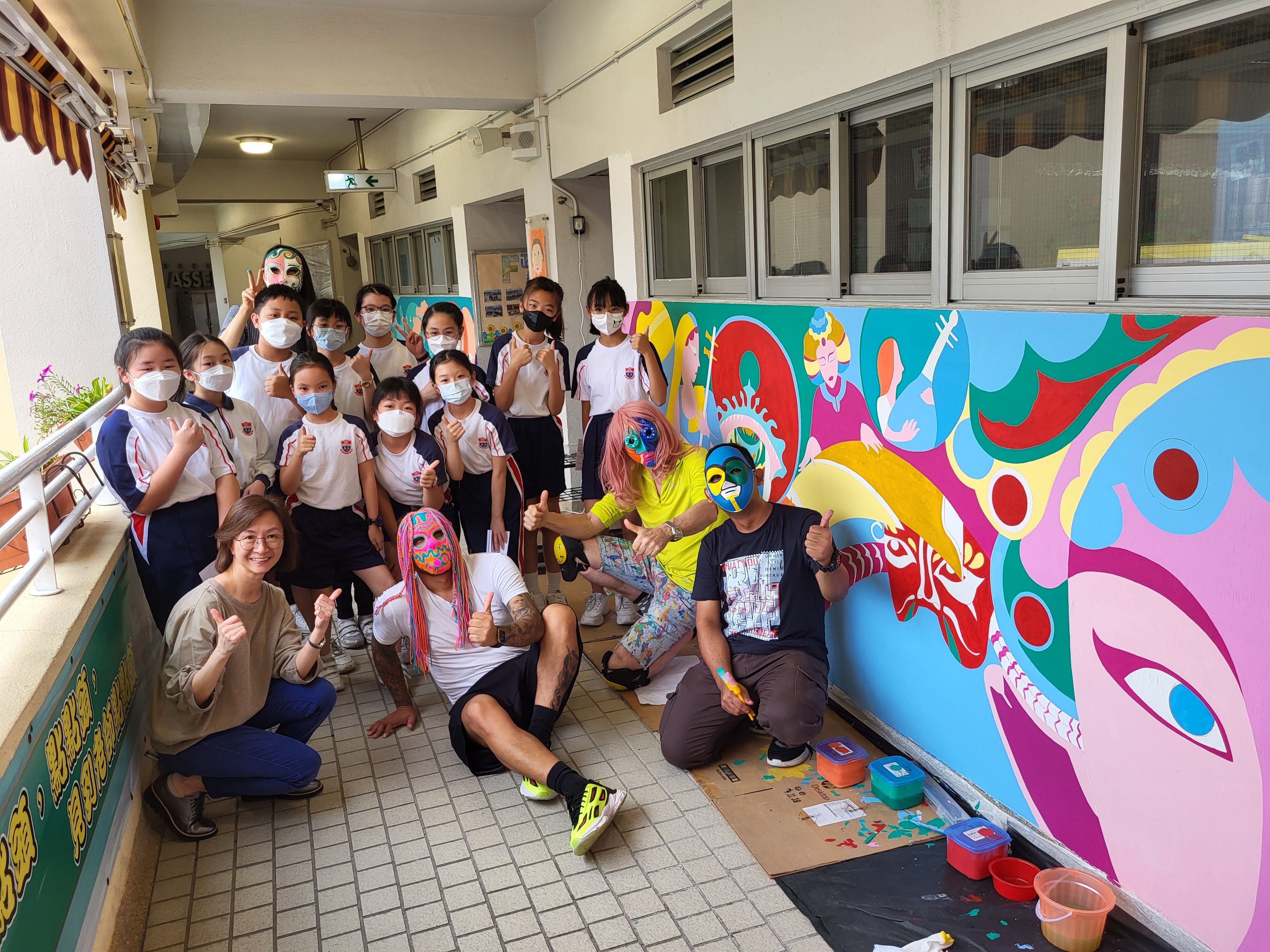
| Others | : | All classrooms have computers, projectors, and electronic whiteboards. There is a greenhouse and an art project engaging student participation. |
 Teaching Staff Information (Including School Head) in the 2025/2026 school year
 | Number of teaching posts in the approved establishment | : | 67 |
| Total number of teachers in the school | : | 67 |
| Qualifications and professional training (%) | ||
| Had Received Teacher Training | : | 100% |
| Bachelor Degree | : | 100% |
| Master/ Doctorate Degree or above | : | 54% |
| Special Education Training | : | 44% |
| Years of Experience (%) | ||
| 0 - 4 years | : | 3% |
| 5 - 9 years | : | 24% |
| 10 years or above | : | 73% |
 Class Structure
 | 2025/26 school year | ||
| P1 Number of classes | : | 6 |
| P2 Number of classes | : | 6 |
| P3 Number of classes | : | 6 |
| P4 Number of classes | : | 6 |
| P5 Number of classes | : | 6 |
| P6 Number of classes | : | 6 |
| Total | : | 36 |
| 2026/27 school year (Based on the number of classes approved by EDB in 2026) | ||
| P1 Number of classes | : | 6 |
| P2 Number of classes | : | 6 |
| P3 Number of classes | : | 6 |
| P4 Number of classes | : | 6 |
| P5 Number of classes | : | 6 |
| P6 Number of classes | : | 6 |
| Total | : | 36 |
| Mode of teaching at different levels | ||
| Lessons were designed in accordance with the principle of small class teaching in order to enhance students' participation, interaction and learning interests. School-based Gifted programmes are designed for the gifted children to develop and enrich their talents. After-school remedial classes are also arranged to cater for learner's diversity. | ||
| Remarks | ||
| - | ||
 Performance Assessment
 | Applicable to P1 only | ||
| Number of test(s) per year | : | 1 |
| Number of exam(s) per year | : | 1 |
| Replace tests and examinations with diversified assessments in the first term of P1 | : | Yes |
| Applicable to P2 to P6 only | ||
| Number of test(s) per year | : | 2 |
| Number of exam(s) per year | : | 2 |
| Applicable to P1 to P6 | ||
| Formulate appropriate school-based assessment and assignment policies, inform parents of related arrangements, and collect views from teachers, students and parents regularly (at least once per school year) for ongoing review and optimisation of the school assessment and assignment policies | : | Yes |
| Upload the school-based assessment policy onto the school webpage for information of the public and stakeholders | : | Yes |
| Upload the school-based assignment policy onto the school webpage for information of the public and stakeholders | : | Yes |
| Diversified Assessment for Learning | : | Continuous assessment forms part of overall evaluation, with some subjects partly based on daily performance. General Studies, Humanities, Science, and PE include diversified assessments in final grades. For P5–P6, Music project scores are included. Students sometimes conduct peer assessments, and parents help evaluate their children’s performance. |
| Avoid arranging tests or examinations immediately after long holidays in order to let students take more rest during the holidays | : | Yes |
| Arrange the timetable flexibly according to the school context, with a tutorial session provided in the afternoon as far as possible for students to finish some of their homework under teachers’ guidance | : | Yes |
| Streaming arrangement | : | There are elite classes from P.2 to P.6. Approximately the top 60 students in Primary 2 to 5 are evenly divided into Classes A and B, while the remaining students are distributed evenly among Classes C to F. From Primary 5 to 6, class allocation remains unchanged. |
 School Life
 | Number of school days per week | : | 5 |
| Number of periods per day | : | 9 |
| Duration of each normal period | : | 35 |
| School starts at | : | 8:10 AM |
| School ends at | : | 3:00 PM |
| Lunch break | : | 1:05 - 2:00 |
| Lunch arrangement | : | Provided by designated supplier, arranged by parents and Provided by designated supplier or prepared by parents. |
| Healthy school life | : | Our school carries out different policies and activities in order to create a healthy environment and to arouse the awareness of the health and environmental protection issues in our school. |
| Remarks | : | A wide range of over 80 extra-curricular activities is offered. A school-based positive education curriculum is implemented, enhancing students' understanding of the PERMA model of well-being and the 24 character strengths through lesson design, class management, school-based guidance activities, values education lessons, assemblies, and more. Enhancement and support programmes are conducted from 3:05 p.m. to 4:05 p.m. |
 Life-wide Learning
 | A wide range of extracurricular activities are offered, covering academics, sports and arts, as well as STEAM training, with more than 80 options available. Uniformed Groups: Flag-guards, The Boy's Brigade, Cub Scouts, Hong Kong Red Cross Junior Unit etc. School Teams: Baseball and Softball Teams, Athletics, Swimming Team, Basketball Team, Volleyball Team, Badminton Team, Table Tennis, Rugby, Choir, Chinese drum, Percussion Team, Recorder Team, Orchestra, Choral Speaking Team, STEAM drone, robotics programming and English recitation etc. Interest Classes: abacus and mental arithmetic, instrument classes, dancing class, drama class, Reading Memory Techniques Workshop etc. |
 School Mission
 | To develop students' moralities, civic sense of responsibility, intelligence, interpersonal skills, appreciation of aesthetics, and spirituality. |
 School Characteristics
 | School Management | ||
| School Management Organisation | : | Hong Kong Council of the Church of Christ in China |
| Incorporated Management Committee / School Management Committee/ Management Committee | : | Established IMC since 2006 |
| School Green Policy | : | Establishing an Eco-Friendly Lifestyle for Students in Line with the Curriculum |
| School's Major Concerns | : | Take initiative in learning and challenge oneself. Build strong values and grow happily. |
| Learning and Teaching Plan | ||
| Learning & Teaching Strategies | : | 1. Emphasize balanced education and whole-person development. 2. Develop differentiated instructional strategies to address students’ diverse learning needs. 3. Design teaching based on the six principles of small-class teaching. 4. Strengthen the school-based STEAM program to enhance students’ interest in scientific inquiry and scientific literacy, while fostering innovation, logical thinking, problem-solving, and the application of artificial intelligence. 5. Optimize lesson design by incorporating diverse teaching strategies and assessments to promote multi-perspective thinking. 6. Enhance cross-curricular reading to broaden students’ knowledge base and deepen learning, while improving self-directed learning skills. 7. Expand diverse learning experiences through multiple intelligences programs, co-curricular activities, and overseas exchanges. |
| Development of Major Renewed Emphases of the Primary Education Curriculum | : | 1. Promote national education through a whole-school participation model. 2. By studying Chinese history and classical Chinese texts, students can appreciate and understand Chinese culture. 3. Strengthen STEAM education and cross-curricular reading. |
| Development of Generic Skills | : | Foster students' generic skills (e.g. communication skills, creativity, critical thinking skills...) through promoting co-operative learning approach, project learning and cross-curricular activities. |
| Cultivation of Proper Values, Attitudes and Behaviours | : | 1. Positive Education: develop students' positive thinking skills. 2. School-based Value Education: help students develop self-discipline. |
| Student Support | ||
| Whole School Approach to Catering for Learner Diversity | : | In order to enhance the learning effectiveness of pupils with different abilities, we provide School-Based Elite Education and remedial classes. We also adopt the Whole School Approach to cater for learner diversities. |
| Whole School Approach to Integrated Education | : | Our school establishes a Student Support Team and adopts a whole-school approach to support students with special educational needs. The school has cultivated a caring culture where every student, regardless of his special needs, is being supported. To cater for these learners' diversities, after-school remedial classes, pull-out programmes, speech therapy services (group and/or individual) and services from professional organizations are arranged for students. Homework and examination accommodations are also provided. We also strengthen the communication with parents of students with SEN by discussing the strategies to support their children. |
| Curriculum Tailoring and Adaptation | : | Cross Subjects Project Learning Enrichment and Remedial Programmes |
| Home-school Co-operation and School Ethos | ||
| Home-School Co-operation | : | 1. We prioritize communication with parents, automatically enrolling all parents of new students as members of the Parent-Teacher Association. 2. The Parent-Teacher Association organizes various parent-child activities each year to strengthen family relationships, as well as a variety of seminars to promote parental education. 3. Parent volunteers actively participate in and assist with various aspects of school activities, including Chinese Culture Day, Sports Day, and the Storytellers program. Additionally, we hold annual gatherings for parent volunteers to foster connections and share experiences. |
| School Ethos | : | Adopting a whole-school participation model, we implement various support services and cross-department collaboration programs to provide comprehensive support for students. Teachers work together to cultivate positive values in students, fostering a sense of belonging to the school and creating a harmonious and orderly campus atmosphere. We organize parent seminars and Classroom Management for Primary One adaptation and peer counseling, as well as guidance and adaptation sessions for Primary Six students and their parents regarding secondary school selection. Through extracurricular activities, we aim to inspire students' potential. Our school has been awarded the 'Continuous Caring Campus' Award by the Hong Kong Christian Service. |
| Future Development | ||
| School Development Plan | : | 1. Through STEAM education and the integration of artificial intelligence technologies, cultivate students’ innovative thinking and enhance their ability to solve problems through logical reasoning. 2. Adopt diversified teaching strategies to develop students’ multi-perspective thinking skills and improve learning effectiveness. 3. Enhance cross-curricular reading to help students construct knowledge and achieve integrated and connected learning. 4. Enable students to understand their national identity, care about society, the country, and the world, and become responsible citizens. 5. Promote positive education by integrating character strengths and the PERMA elements of well-being, fostering students’ sense of happiness and well-being. |
| Teacher Professional Training & Development | : | Curriculum Research Group is formed to optimize the school-based curriculum. Teachers attend different professional training courses and experience sharing sessions in order to enhance teacher professional development. |
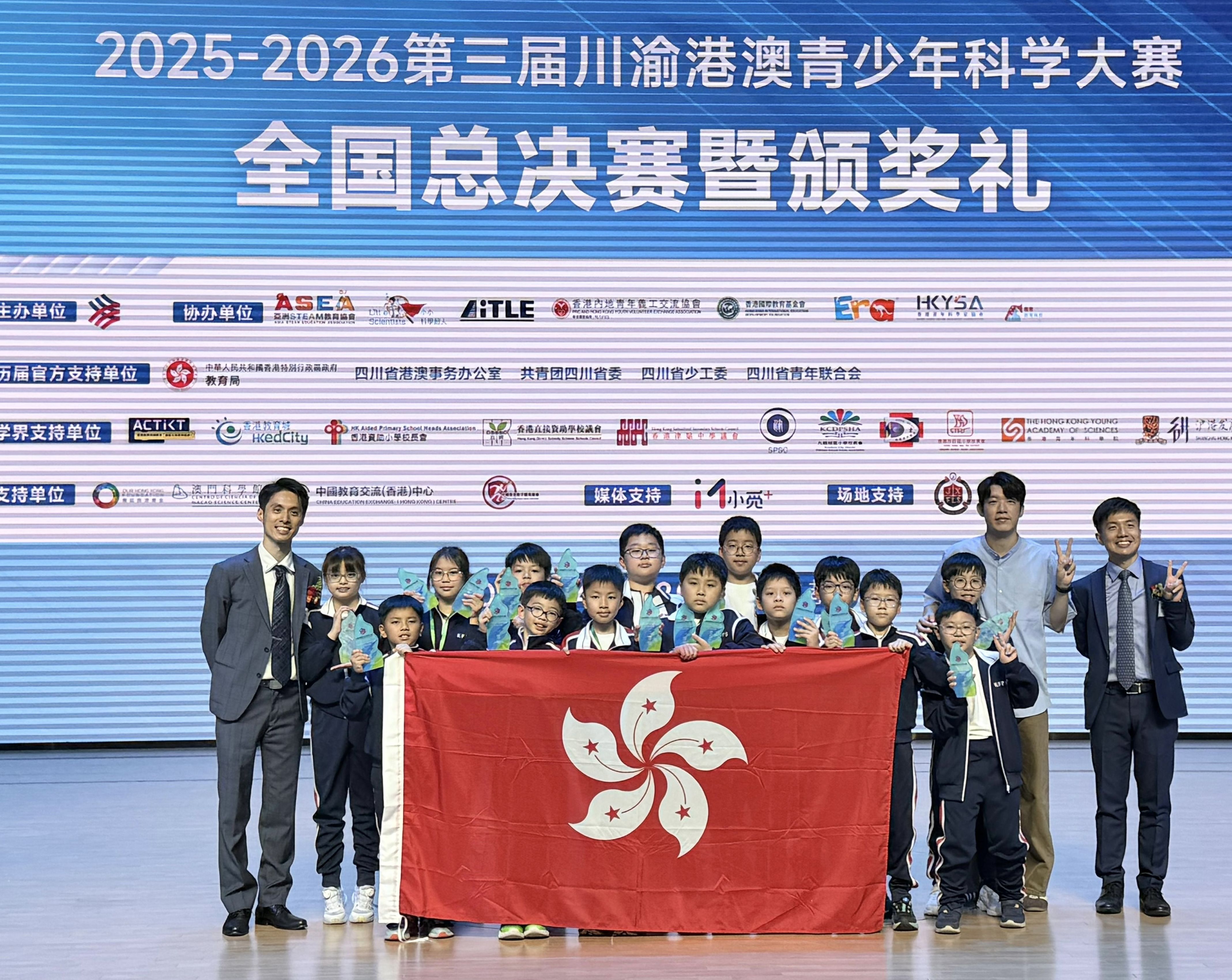
| Others | : | 2025–2026 Group Awards 1. Hong Kong STEAM Education Awards: Outstanding STEAM School, Principal Leadership Award, Teacher Award, and 5 Student Awards 2. Sichuan–Chongqing–Hong Kong–Macau Youth Science Competition: Outstanding Science School, Principal Leadership, Teacher Guidance Awards; 10+ students won National Finals First Prizes 3. FTF National Youth Drone Competition (HK Qualifiers): Champion & Runner-up (Drone Soccer); represented HK in National Finals (16th place) 4. UNSDGs English Debating Competition: Double Champion 5. 77th Hong Kong Schools Speech Festival: 3rd Place (Cantonese Choral Verse) 6. Hong Kong Red Cross Youth First Aid Competition: Champion, Runner-up & Merit Awards 7. 69th Hong Kong Sports Festival Youth Softball Championship: Runner-up |
 School Map

Last revision date:01 September 2026


