 Primary School Profiles 2026

 Primary School Profiles 2026
| Address: | 12 Ching Hong Road, Cheung Hong Estate, Tsing Yi, N.T. | |||
| Phone: | 24979288 | Email: | info@tytaps.edu.hk | |
| Fax: | 24970140 | Website: | http://www.tytaps.edu.hk/ | |
 School Information
 | Supervisor/ Chairman of Management Committee | : | Mr. Law King Shing |
| School Head | : | Ms. Mak Mei Yan |
| Incorporated Management Committee been established? | : | Established |
| Percentage of School Supervisor and Managers / Chairperson and Members of School Management Committee (SMC) of Government Schools Fulfilling the Training Targets | : | 100% |
| School Type | : | Aided Whole Day |
| Student Gender | : | Co-ed |
| Sponsoring Body | : | Tsing Yi Trade Association (Schools) Limited |
| Religion | : | Not Applicable |
| Year of Commencement of Operation | : | 1984 |
| School Motto | : | - |
| Area Occupied by the School | : | About 3000 Sq. M |
| Through-train Secondary School | : | - |
| Feeder Secondary School | : | - |
| Nominated Secondary School | : | - |
| Medium of Instruction | : | Chinese |
| School Bus Service | : | Nanny van |
| Parent-Teacher Association | : | Yes |
| Past Students' Association/Alumni Association | : | Yes |
| 4Rs Mental Health Charter | : | Yes |
| Whole School Health Programme | : | Action School |
 2026/2027 Annual School Charges
| School Fee | : | - |
| Tong Fai | : | - |
| PTA Fee | : | - |
| Approved Charges for non-standard items | : | $250 (Non-recurring maintenance fee) |
| Other Charges | : | - |
 School Facilities
 | Number of Classroom(s) | : | 24 |
| Number of School Hall(s) | : | 1 |
| Number of Playground(s) | : | 2 |
| Number of Library(ies) | : | 1 |
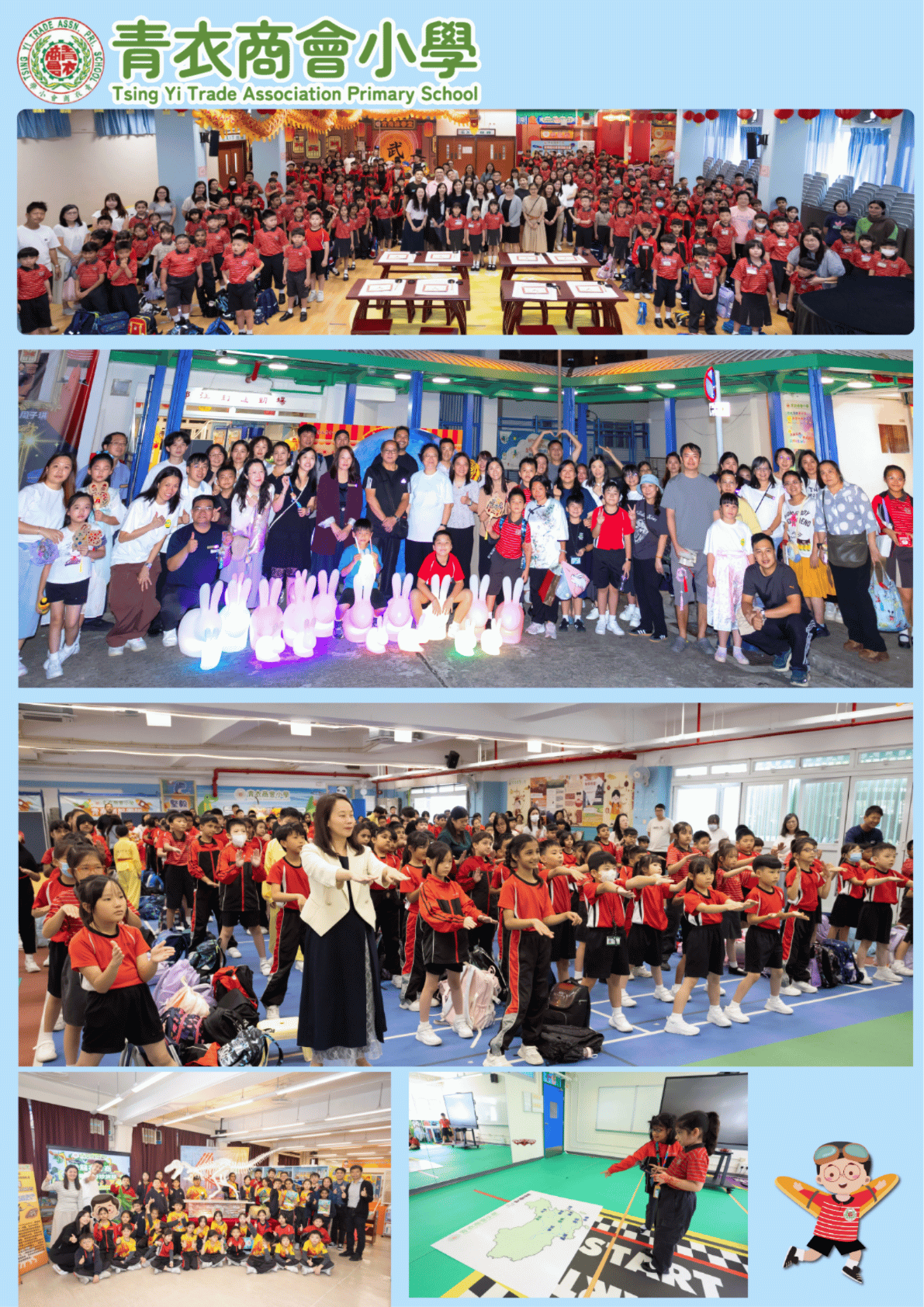
| Special Rooms | : | Dinosaur Aerospace Cabin, Dinosaur Laboratory, Immersive Classroom, Visual arts room, music room, computer room, multiple intelligence activity room, English room, speech therapy room. |
| Facility(ies) for Supporting Students with Special Educational Needs | : | Ramp, Accessible lift and Accessible toilet. |
| Others | : | The auditorium and covered playground are equipped with LED displays, Classrooms are equipped with electronic whiteboards. Library, Cafe and Immersive gallery. |
 Teaching Staff Information (Including School Head) in the 2025/2026 school year
 | Number of teaching posts in the approved establishment | : | 23 |
| Total number of teachers in the school | : | 28 |
| Qualifications and professional training (%) | ||
| Had Received Teacher Training | : | 100% |
| Bachelor Degree | : | 100% |
| Master/ Doctorate Degree or above | : | 24% |
| Special Education Training | : | 46% |
| Years of Experience (%) | ||
| 0 - 4 years | : | 50% |
| 5 - 9 years | : | 33% |
| 10 years or above | : | 17% |
 Class Structure
 | 2025/26 school year | ||
| P1 Number of classes | : | 1 |
| P2 Number of classes | : | 2 |
| P3 Number of classes | : | 1 |
| P4 Number of classes | : | 2 |
| P5 Number of classes | : | 2 |
| P6 Number of classes | : | 1 |
| Total | : | 9 |
| 2026/27 school year (Based on the number of classes approved by EDB in 2026) | ||
| P1 Number of classes | : | 1 |
| P2 Number of classes | : | 1 |
| P3 Number of classes | : | 2 |
| P4 Number of classes | : | 1 |
| P5 Number of classes | : | 2 |
| P6 Number of classes | : | 2 |
| Total | : | 9 |
| Mode of teaching at different levels | ||
| Small class sizes are used for teaching. Tutoring classes and subject tutoring groups are set up at each level, and teaching assistants are assigned to assist in P.1-P.3 to cater to individual differences. P.1-P.3 each class has at least 4 English lessons per week, taught collaboratively by 3 foreign English teachers and the English teacher. | ||
| Remarks | ||
| Primary 1 to 6 implement small class teaching. | ||
 Performance Assessment
 | Applicable to P1 only | ||
| Number of test(s) per year | : | 0 |
| Number of exam(s) per year | : | 2 |
| Replace tests and examinations with diversified assessments in the first term of P1 | : | Yes |
| Applicable to P2 to P6 only | ||
| Number of test(s) per year | : | 0 |
| Number of exam(s) per year | : | 3 |
| Applicable to P1 to P6 | ||
| Formulate appropriate school-based assessment and assignment policies, inform parents of related arrangements, and collect views from teachers, students and parents regularly (at least once per school year) for ongoing review and optimisation of the school assessment and assignment policies | : | Yes |
| Upload the school-based assessment policy onto the school webpage for information of the public and stakeholders | : | Yes |
| Upload the school-based assignment policy onto the school webpage for information of the public and stakeholders | : | Yes |
| Diversified Assessment for Learning | : | P.1 had no examination in first term, using formative assessment instead. Beyond written tests, we evaluate knowledge, skills, and values through diverse modes, with papers tailored to student needs. To support individual differences, 1–3 remedial groups are provided for Chinese, English, and Math at each level, using curriculum adaptation and varied teaching for those with academic or SEN need. |
| Avoid arranging tests or examinations immediately after long holidays in order to let students take more rest during the holidays | : | Yes |
| Arrange the timetable flexibly according to the school context, with a tutorial session provided in the afternoon as far as possible for students to finish some of their homework under teachers’ guidance | : | Yes |
| Streaming arrangement | : | Remedial groups for Chinese, English and Mathematics are arranged according to the academic performances of students. Curriculum adaptation and different teaching method will be deployed to cater for their learning diversities. |
 School Life
 | Number of school days per week | : | 5 |
| Number of periods per day | : | 9 |
| Duration of each normal period | : | 35 |
| School starts at | : | 8:15 AM |
| School ends at | : | 3:25 PM |
| Lunch break | : | 11:45 - 12:45 |
| Lunch arrangement | : | Provided by designated supplier, arranged by parents and students bring their lunch by themselves. |
| Healthy school life | : | The school prioritizes care for students and staff by joining the EDB 4Rs Mental Health Charter. We promote a caring culture through mindfulness lunches and sports like floorball and floor curling via the "Active Students, Active People" MVPA60 scheme. Cycling and hula hoops are also provided during breaks. Weekly flag-raisings, assemblies, and growth classes help nurture students into responsible citizens and promote well-being. |
| Remarks | : | Weekly morning assemblies build students' confidence and speaking skills. Sharing sessions, such as news reviews, foster a love for reading and social awareness. We also provide integrated activities and uniform group training to enrich learning experiences. These initiatives ensure balanced development and help achieve the goal of whole-person education. |
 Life-wide Learning
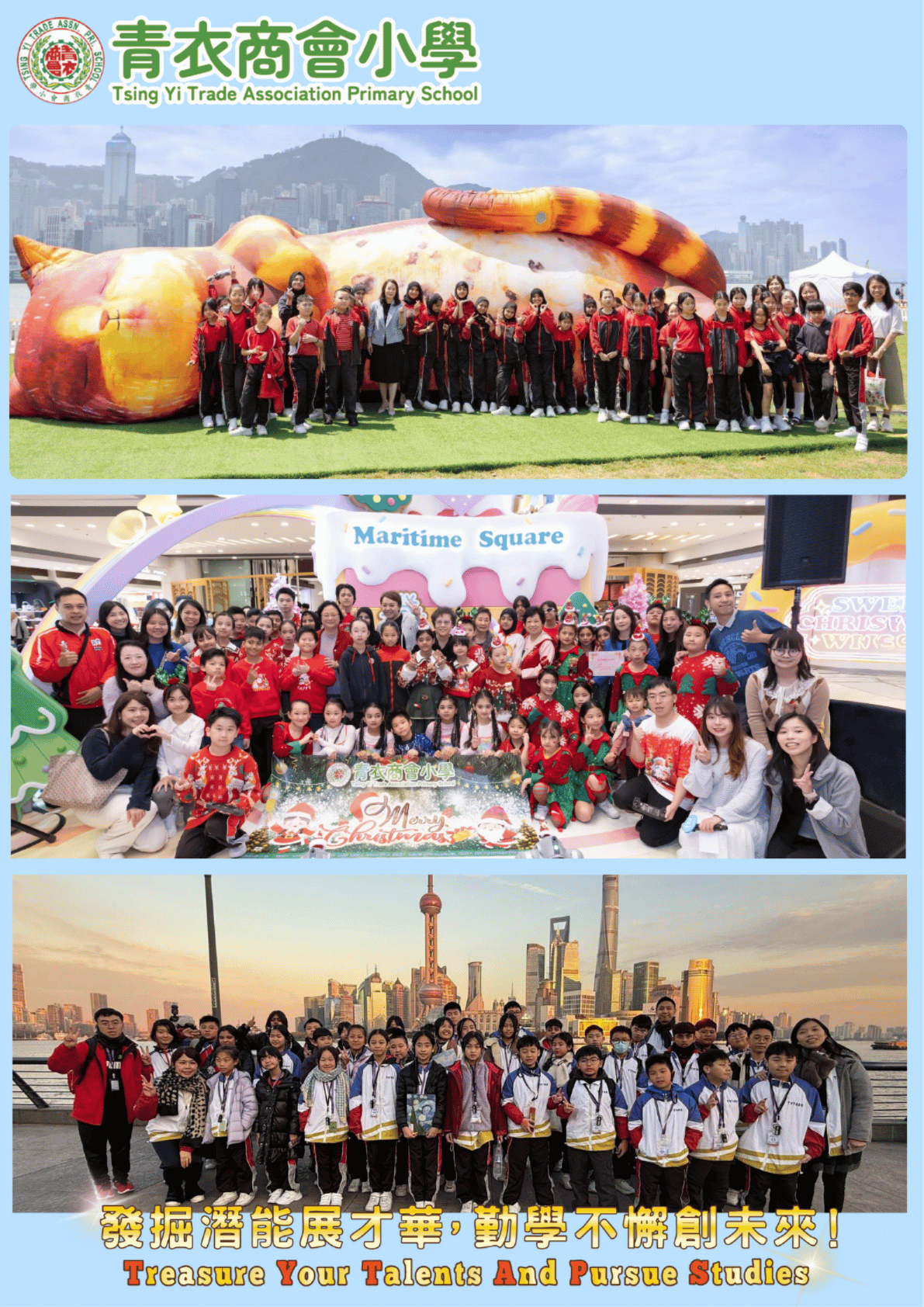
 | We offer school-wide experiential activities, uniformed groups, and elite talent programs. These include Trinity English, GAPSK Putonghua, Ballet, Chinese Dance, Hip-Hop, Pop Dance, Video Production, Drone Soccer, Percussion, Guzheng, Pastel Nagomi Art, and various school sports teams (e.g., athletics, football, and basketball). Mainland and overseas study tours are also organized annually. |
 School Mission
 | We advocate the mission of education for all. We are committed to offering quality primary education for students. We aim at nurturing the students to be responsible, patriotic and concerned members of the community. |
 School Characteristics
 | School Management | ||
| School Management Organisation | : | The school’s administrative framework is organized into six functional groups: Management & Organization, Curriculum Development, School Ethos & Student Support, Student Performance, Information Technology, and External Liaison. The Principal meets regularly with these administrative teams to monitor and advance the school's development across all domains. |
| Incorporated Management Committee / School Management Committee/ Management Committee | : | The IMC is composed of 16 managers, including sponsoring body managers, the principal, teacher managers, parent managers, alumni manager and independent manager. An IMC meeting is held once every three months to support the school development. |
| School Green Policy | : | The Green policy is introduced through environmental projects for all classes every year. We emphasize a green school life. There are guidelines for energy saving. Energy saving air-conditioners are installed. Students are encouraged to save water and use handkerchiefs instead of tissues. Using recycled ink and paper, double-sided printing have become part of our school practice. |
| School's Major Concerns | : | 1. Establish an innovative and technology-focused campus to cultivate students' self-directed learning abilities. 2. Nurture students' patriotism and love for Hong Kong, instill a sense of gratitude and appreciation, and foster care and concern for others. |
| Learning and Teaching Plan | ||
| Learning & Teaching Strategies | : | 1. Moral & Civic Education: We combine growth plans with discipline and guidance to foster positive values and behaviors. A school-based insect life education curriculum is also integrated with the 4Rs Mental Health Charter. 2. Learning from Reading: Books are widely available across campus, and newspapers are provided to every class. Through reading schemes and sharing activities, we cultivate reading habits and help students stay informed about current affairs. 3. Digital & STEAM Education: Classrooms are equipped with interactive whiteboards to support digital learning. Interactive elements and games boost motivation and peer interaction. We also offer a school-based STEAM curriculum and drone team training. 4. The third floor features the Dinosaur Aerospace Cabin, the Dinosaur Laboratory, and an immersive classroom to support the development of our school-based science curriculum. |
| Development of Major Renewed Emphases of the Primary Education Curriculum | : | Values Education and Digital Education: Our school-based values and digital education curriculum covers various learning areas, including Primary Humanities, Primary Science, Mathematics, Information Technology, and Languages. This enables students to fully understand our country's technological development, thereby enhancing their national identity, preparing them for career planning, and cultivating proper values. Activities include an AR history of China's aerospace development, drone tours of China, VR (Virtual Reality) experiences, and simulated driving. Our goal is for students to learn about national security education and strengthen their STEAM abilities through lively and engaging STEAM activities. The school also emphasizes developing students' programming skills, teaching coding starting from Primary 1 to elevate their overall digital literacy. |
| Development of Generic Skills | : | Through cooperative and interactive learning in lessons and cross-curricula activities, students are expected to develop the nine generic skills progressively. |
| Cultivation of Proper Values, Attitudes and Behaviours | : | Through subject courses and other related learning experiences, we nurture students' positive values and attitudes, helping them to recognize the values involved when facing challenges at different stages of growth. This enables them to conduct objective analyses, make reasonable judgments, and put their insights into practice, equipping them to face various challenges in future life. |
| Student Support | ||
| Whole School Approach to Catering for Learner Diversity | : | The school implements a "three-tier support model" to cater to students' diverse learning needs. The first level includes optimizing classroom teaching and implementing small class teaching and group learning. The second level offers additional support for students with lower grades and special educational needs, such as pull-out teaching and after-school homework guidance. The third level provides personalized care and learning plans for students with severe learning difficulties. |
| Whole School Approach to Integrated Education | : | The school establishes a student support team to develop support policies and hold regular parent consultation meetings to discuss student progress. The team includes the principal, special educational needs coordinator, curriculum director, section head, special educational needs support teacher, and a school-based interdisciplinary team consisting of a social worker, school-based educational psychologist, school-based speech therapist, and group tutors. Together, they provide comprehensive support for students. |
| Education Support for Non-Chinese Speaking(NCS) Students | : | Our school provides additional support for NCS students to facilitate their learning of Chinese: providing after-school support programmes in learning Chinese; appointing additional teacher(s)/teaching assistant(s) to support NCS students' learning of Chinese; arranging intensive Chinese learning and teaching mode(s), e.g. pull-out learning if necessary, split-class/group learning, etc; developing school-based Chinese Language curriculum and/or adapting learning and teaching materials; organising activities to create an inclusive learning environment in the school; and hiring additional manpower and/or translation/interpretation services to facilitate the communication with parents of NCS students. |
| Curriculum Tailoring and Adaptation | : | Through joint lesson preparation by teachers and scientific research conferences, our school formulates heterogeneous teaching strategies and adjusts learning materials, tailors courses, designs "layered worksheets" and homework for students with different abilities. Our school will provide homework, learning and assessment adjustment services for students who are assessed as having special educational needs or learning difficulties; for example, according to the situation of students who are assessed as having special educational needs, arrangements for pull-out assessment or granting extra time during the test assessment. |
| Home-school Co-operation and School Ethos | ||
| Home-School Co-operation | : | We provide bilingual school information, such as circulars, newsletters etc. Immediate translation service is also available in order to keep close connection with parents of various nationalities. There are seminars and workshops for parents as part of parent education. The PTA often organizes various activities, such as family picnics, to maintain close relationship between the school and the parents. |
| School Ethos | : | The school values moral education, committed to cultivating students' self-discipline and good character. Students are polite and well-behaved, teacher-student relations are positive, and multi-ethnic students interact harmoniously. The Discipline and Counseling team runs the "Star Catching Journey" reward scheme to help students build positive values in punctuality, discipline, appearance, schoolwork, diligence, and service. We emphasize a caring campus and a supportive environment. Students of different nationalities form a shared learning community, respecting diverse cultures and embracing individual differences. The school implements career planning to foster leadership and holistic development. Each class adopts a "One Student, One Role" scheme where everyone holds at least one duty to build a sense of responsibility. Effective class management enhances students' sense of belonging, creating a joyful learning experience for all. |
| Future Development | ||
| School Development Plan | : | 1. Deepening Character & National Pride: We integrate values education into daily life, nurturing virtues like gratitude, filial piety, and responsibility. Diverse exchange activities broaden students' horizons and foster a strong sense of belonging to our country and society. 2. Upgrading Innovation & Future Tech: By optimizing the STEAM environment and gradually introducing AI and interdisciplinary applications, we equip children with the digital literacy and innovative problem-solving skills needed for the future. 3. Promoting Positive Education & Well-being: Aligned with the "4Rs" mental health principles, the school uses love and care to build a resilient campus. We prioritize emotional needs to ensure every child grows up healthy and happy. 4. Unlocking Potential & Career Planning: To help every child flourish, we are refining career planning and self-directed learning paths for senior levels. This empowers students to discover their unique talents and confidently pursue their dreams and future possibilities. |
| Teacher Professional Training & Development | : | Subject-based and school-wide teacher development activities are held annually, and staff are encouraged to pursue external professional training tailored to their needs. Key development areas include the application of AI in teaching, national education, instructional strategies, and addressing individual learning differences. |
| Others | : | - |
 School Map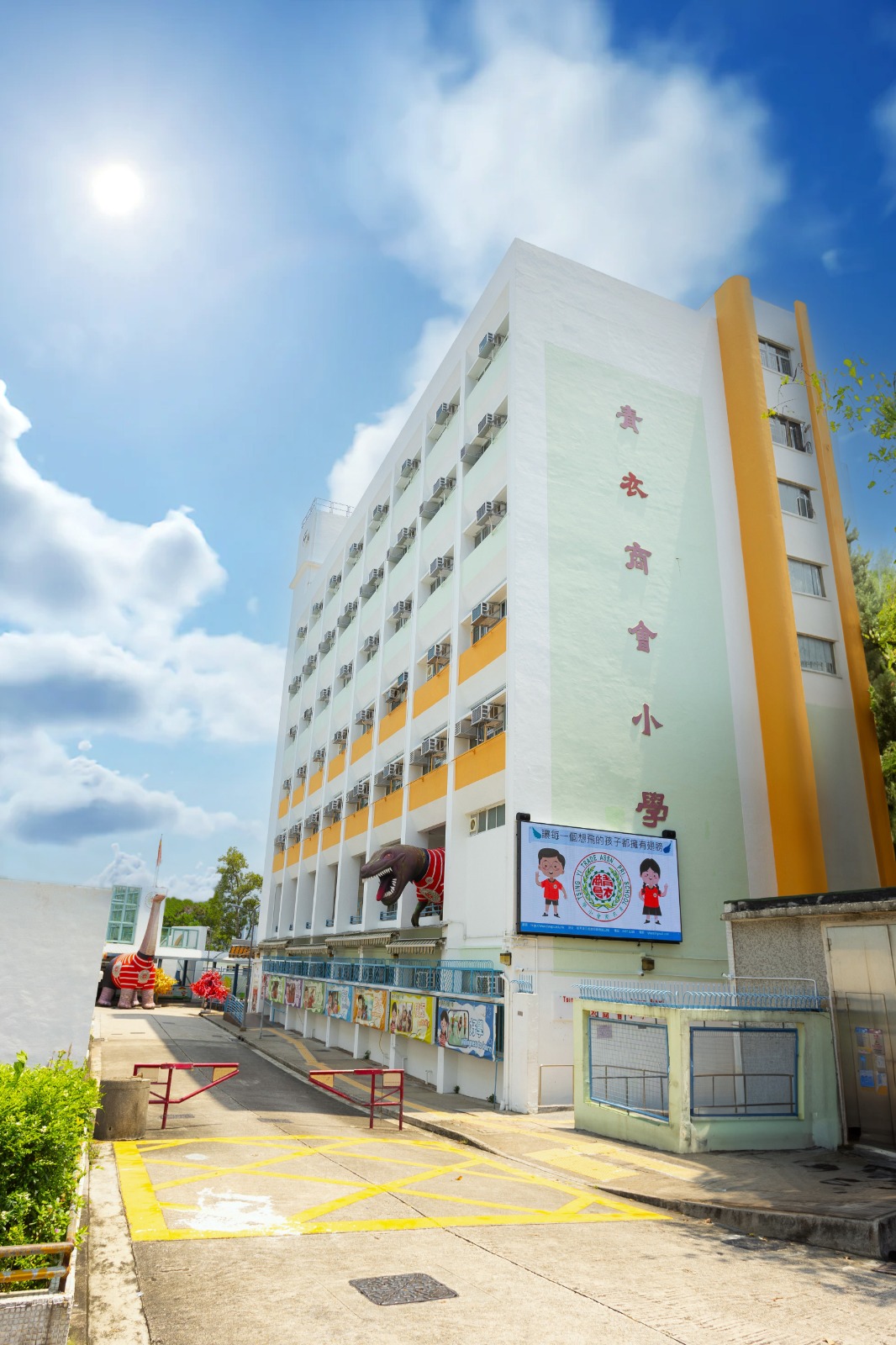
Last revision date:01 September 2026


