 Primary School Profiles 2026

 Primary School Profiles 2026
| Address: | Po Lam Estate, Tseung Kwan O, N.T. | |||
| Phone: | 27013072 | Email: | mail@lautak.edu.hk | |
| Fax: | 27016203 | Website: | http://www.lautak.edu.hk | |
 School Information
 | Supervisor/ Chairman of Management Committee | : | Ms. Wan Man Wai Rowena |
| School Head | : | Mr. Hui Chi Man |
| Incorporated Management Committee been established? | : | Established |
| Percentage of School Supervisor and Managers / Chairperson and Members of School Management Committee (SMC) of Government Schools Fulfilling the Training Targets | : | 62% |
| School Type | : | Aided Whole Day |
| Student Gender | : | Co-ed |
| Sponsoring Body | : | The Lok Sin Tong Benevolent Society, Kowloon |
| Religion | : | Not Applicable |
| Year of Commencement of Operation | : | 1989 |
| School Motto | : | Moral, Intellectual, Physical, Social and Aesthetic Education. |
| Area Occupied by the School | : | About 4520 Sq. M |
| Through-train Secondary School | : | - |
| Feeder Secondary School | : | - |
| Nominated Secondary School | : | - |
| Medium of Instruction | : | Chinese |
| School Bus Service | : | School Bus |
| Parent-Teacher Association | : | Yes |
| Past Students' Association/Alumni Association | : | Yes |
| 4Rs Mental Health Charter | : | Yes |
| Whole School Health Programme | : | Action School |
 2026/2027 Annual School Charges
| School Fee | : | - |
| Tong Fai | : | - |
| PTA Fee | : | $30 |
| Approved Charges for non-standard items | : | $300 (Specific purpose charges) |
| Other Charges | : | $600 (Teaching Affairs) |
 School Facilities
 | Number of Classroom(s) | : | 24 |
| Number of School Hall(s) | : | 1 |
| Number of Playground(s) | : | 2 |
| Number of Library(ies) | : | 1 |
| Special Rooms | : | STEM Center, Visual Arts room, Music room, I-Library & Information Technology Learning Center, Campus TV, Activity room, Ceramic Art room, English Learning Centre (E-Zone), PTA room, Wellbeing Corner, organic Farm. |
| Facility(ies) for Supporting Students with Special Educational Needs | : | Ramp, Accessible lift, Accessible toilet and Accessible public information / service counter. |
| Others | : | Solar energy system, organic farm, marine life touch pool, plant path, Chinese culture corner, basketball court, playground, running track, classroom computers, WiFi wireless network. |
 Teaching Staff Information (Including School Head) in the 2025/2026 school year
 | Number of teaching posts in the approved establishment | : | 31 |
| Total number of teachers in the school | : | 32 |
| Qualifications and professional training (%) | ||
| Had Received Teacher Training | : | 100% |
| Bachelor Degree | : | 100% |
| Master/ Doctorate Degree or above | : | 53% |
| Special Education Training | : | 90% |
| Years of Experience (%) | ||
| 0 - 4 years | : | 3% |
| 5 - 9 years | : | 19% |
| 10 years or above | : | 78% |
 Class Structure
 | 2025/26 school year | ||
| P1 Number of classes | : | 2 |
| P2 Number of classes | : | 3 |
| P3 Number of classes | : | 3 |
| P4 Number of classes | : | 2 |
| P5 Number of classes | : | 2 |
| P6 Number of classes | : | 2 |
| Total | : | 14 |
| 2026/27 school year (Based on the number of classes approved by EDB in 2026) | ||
| P1 Number of classes | : | 2 |
| P2 Number of classes | : | 2 |
| P3 Number of classes | : | 3 |
| P4 Number of classes | : | 3 |
| P5 Number of classes | : | 2 |
| P6 Number of classes | : | 2 |
| Total | : | 14 |
| Mode of teaching at different levels | ||
| Integrate diversified teaching strategies; namely self-directed learning, blended learning, collaboration and e-learning. Strengthen the interface between different key stages. Implement curriculum adaptation. A wide range of teaching strategies are adopted to cater for both gifted and high-ability students. Homework classes and remedial teaching are organized to support different learning needs. | ||
| Remarks | ||
| Small classes support children's physical and arts development. Chinese uses picture books, while English adopts Space Town and RaC. Maths utilizes the ELPS model for life-based learning. Humanities fosters national identity, and Science integrates STEAM through inquiry-based learning to enhance efficiency. | ||
 Performance Assessment
 | Applicable to P1 only | ||
| Number of test(s) per year | : | 0 |
| Number of exam(s) per year | : | 2 |
| Replace tests and examinations with diversified assessments in the first term of P1 | : | Yes |
| Applicable to P2 to P6 only | ||
| Number of test(s) per year | : | 0 |
| Number of exam(s) per year | : | 3 |
| Applicable to P1 to P6 | ||
| Formulate appropriate school-based assessment and assignment policies, inform parents of related arrangements, and collect views from teachers, students and parents regularly (at least once per school year) for ongoing review and optimisation of the school assessment and assignment policies | : | Yes |
| Upload the school-based assessment policy onto the school webpage for information of the public and stakeholders | : | Yes |
| Upload the school-based assignment policy onto the school webpage for information of the public and stakeholders | : | Yes |
| Diversified Assessment for Learning | : | To promote Assessment as Learning, we align curriculum with varied evaluation methods. Through performance tasks and constructive feedback, we strengthen self and peer assessment. Formative assessment tracks daily progress with three summative exams yearly. We foster assessment literacy to build positive values and attitudes. To support well-being and balanced growth, no tests follow long holiday. |
| Avoid arranging tests or examinations immediately after long holidays in order to let students take more rest during the holidays | : | Yes |
| Arrange the timetable flexibly according to the school context, with a tutorial session provided in the afternoon as far as possible for students to finish some of their homework under teachers’ guidance | : | Yes |
| Streaming arrangement | : | Mixed-ability classes are formed with balanced gender ratios. Small class teaching is implemented to boost interaction and address diversity through group activities. Students' potential is further developed through talent development and enrichment programs. |
 School Life
 | Number of school days per week | : | 5 |
| Number of periods per day | : | 11 |
| Duration of each normal period | : | 30 |
| School starts at | : | 8:10 AM |
| School ends at | : | 3:20 PM |
| Lunch break | : | 1:00 - 2:00 |
| Lunch arrangement | : | Provided by designated supplier and arranged by parents. |
| Healthy school life | : | To create a positive, healthy and caring school environment. To promote the physical and mental health of teachers and students, through activities such as Love for Kids scheme, Positive education activities and Physical Fitness Award Scheme. We also provide scheduled activities for overweight students to exercise regularly. |
| Remarks | : | To cater for the development and needs of the children, we arrange diversified learning activities which enrich their study life and inspire their potential. Students are encouraged to learn outside the classroom, and build up an understanding and caring for the community. In effect they are practicing what they have learned. |
 Life-wide Learning
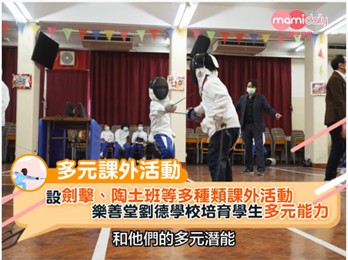
 | There are different types after school activities for students such as Acappela Dodgebee team, Fencing team , Unicycling, Speech Training, STEAM Robot Team , Ceramic art, Casting, Drama performance, Chinese dances, Hip Hop dances, Football team, Touch Rugby team, Basketball, Rope Skipping, Ukulele, Ethereal drum, Djembe, Maths Olympiad training, and Athlete team. |
 School Mission
 | Provide quality whole-person education focusing on moral, intellectual, physical, social and aesthetic areas. A happy learning environment and many opportunities provided to inspire our students' talents. We impart subject knowledge to students and cultivate positive attitudes as well as the importance of behaving responsibly in society. |
 School Characteristics
 | School Management | ||
| School Management Organisation | : | Our school is managed by the Incorporated Management Committee which was established in 2006. The administration of school affairs is under the supervision of the principal and various school administration teams: Academic Affairs, School Affairs and School promotion, Curriculum, Pedagogy, Discipline and Guidance, Reading Promotion, Teacher-Parent cooperation, Extracurricular Activities and Information Technology, Student Affairs and Student Support team. |
| Incorporated Management Committee / School Management Committee/ Management Committee | : | IMC comprises 14 members. The composition of IMC is Sponsoring Body Managers, School Principal, Teacher Managers, Parent Managers, Alumni Manager and an Independent Manager. Regular IMC meetings are held to discuss school affairs and developmental schemes. |
| School Green Policy | : | Set up recycling bins for environmental recycling activities; conduct scientific inquiry activities and project learning with environmentally friendly materials. We join different environment protecting programmes,e.g.HK Green School Award, Jockey Club "Intelligent Resource Management Programme" and BEAM Plus in schools Project. We set up photo-voltaic(PV)modules and joined the CLP Renewable Energy Connection Scheme. |
| School's Major Concerns | : | (1). Flexible learning schedule to enhance self-directed learning and life-long learning (2). With the goal of fostering moral character, we will continue to promote positive education, enhance students' self-management skills, and establish a healthy lifestyle. |
| Learning and Teaching Plan | ||
| Learning & Teaching Strategies | : | Arts Education (Pottery, Drama, Music), Service Learning, and Environmental Education are encompassed in the school curriculum, with National and National Security Education organically integrated. School-based characteristic activities and multi-sensory learning are implemented, exemplified by the "LBD" (Learning by Doing) program in lower primary and STEAM inquiry and "Dream Starter" program in upper primary. Digital Education is promoted via online platforms to strengthen the learning cycle of pre-study and extended learning. High engagement and gamified strategies are emphasized. Life-wide experiences are provided through overseas exchanges and "Let Children Shine" performances. |
| Development of Major Renewed Emphases of the Primary Education Curriculum | : | Values Education is fully implemented to nurture correct values and attitudes, with National Security Education reinforced. The development of Humanities and Science is deepened to enhance students' reading and digital literacy. Learning time is optimized through the arrangement of "Happy Learning Time" in the afternoon schedule, featuring "Activity Classes" and "Fun Fun English" to foster a relaxed learning atmosphere and promote balanced development. A wide array of potential-development courses is offered to provide rich life-wide learning experiences, including Fencing, Archery, Unicycling, A cappella, Ethereal Drum, Djembe, Lion Dance, and Drone Coding, allowing students to showcase their talents in physical arts, music, and digital technology while preparing them for future challenges. |
| Development of Generic Skills | : | Nine generic skills are systematically developed through the school-based drama curriculum, pottery arts, and cross-curricular project-based learning. Particular emphasis is placed on critical thinking, creativity, and problem-solving. Graphic organizers are utilized to guide conceptual thinking and higher-order thinking training. Through leadership programs and cross-curricular learning days, self-management, collaboration, and self-directed learning habits are fostered, integrated with correct values to lay a solid foundation for holistic development. |
| Cultivation of Proper Values, Attitudes and Behaviours | : | We nurture students' positive values and attitudes through classroom learning, assemblies, class meetings and life-wide learning activities. Moral and Civic Education theme: Promote "Positive Education" in Moral and Civic Education curriculum. Advocate self-management and learning in services via various counseling programs. |
| Student Support | ||
| Whole School Approach to Catering for Learner Diversity | : | (1). ater for learners' diversity through collaborative learning, enhancement programs, remedial classes, after-school support classes and intervention programs. (2). Adopt adaptive curriculum, homework and assessment policy. (3). Provide growth and guidance support by setting up Guidance Group, home visits, two class teachers system and the Shue Yan University counseling support program. Professional counseling services are provided by school-based professional social workers and Educational Psychologists. |
| Whole School Approach to Integrated Education | : | (1). Establish a learning support team to support students with special educational needs. (2). Set up different small group training programs, such as attention training, reading and writing programs for dyslexic students and social skills training groups. (3). Professional counseling service: school-based educational psychologist and school-based speech therapy service. (4). Set up an individual education plan. (5). Annual provision of "Summary of Support for Students" to parents of students with SEN, a mechanism for soliciting parents' views and discussing students' progress. |
| Education Support for Non-Chinese Speaking(NCS) Students | : | Our school provides additional support for NCS students to facilitate their learning of Chinese: providing after-school support programmes in learning Chinese; appointing additional teacher(s)/teaching assistant(s) to support NCS students' learning of Chinese; arranging intensive Chinese learning and teaching mode(s), e.g. pull-out learning if necessary, split-class/group learning, etc; developing school-based Chinese Language curriculum and/or adapting learning and teaching materials; and organising activities to create an inclusive learning environment in the school. |
| Curriculum Tailoring and Adaptation | : | Differentiated instruction is adopted, with learning indicators and materials tailored based on student performance. Higher-order thinking training is integrated to identify gifted students. School-based support is provided for high-ability learners, while homework classes and counseling programs are offered to those with diverse needs, ensuring learning confidence is enhanced through curriculum modification. |
| Home-school Co-operation and School Ethos | ||
| Home-School Co-operation | : | The PTA serves as a good platform for home-school communication. Parents are invited to join the IMC. Parents participate in talks and voluntary work annually. An annual picnic for teachers, parents and students is held to enhance communication among them. |
| School Ethos | : | We promote Invitational Education through "5Ps" (Policies, Programmes, People, Processes and Places). We are dedicated to developing children's self-esteem, confidence, self-management, self-reflection and self-learning abilities. We insist on building a love and caring culture, harmonic relationship and a sense of belonging among pupils and teachers through vast successful learning experiences and whole school approach programs such as English Angels, Reading Buddy Scheme, Storytelling, learning in service programs, etc. |
| Future Development | ||
| School Development Plan | : | (1). Establish a Happy Learning and Caring school. (2). Promote Gifted Education. Enhance the ability of biliteracy and trilingualism. (3). Develop the overseas study tours. (4). Further develop e-learning and self-directed learning. Develop a school-based STEAM curriculum. (5). Improve school facilities and learning environment. |
| Teacher Professional Training & Development | : | With reference to "T-standard+", we enhance teachers' professional capacity through Teacher Professional Development Days, school-based training, and collaboration with tertiary institutions. Key focus areas include assessment literacy, digital education, STEAM, and differentiated instruction. Teachers are encouraged to participate in local and overseas professional exchanges to refine their teaching quality and address emerging educational trends. |
| Others | : | (1). Scholarships donated by the school sponsoring body are awarded to students with outstanding performance in their academic results and conduct. (2). Lots of participation in inter-school sports day, speech festival, drama festival, music festival, creative story writings, study camp, field trips. (3). Organise Education camps, overseas exchange programs to broaden students' learning horizons. |
 School Map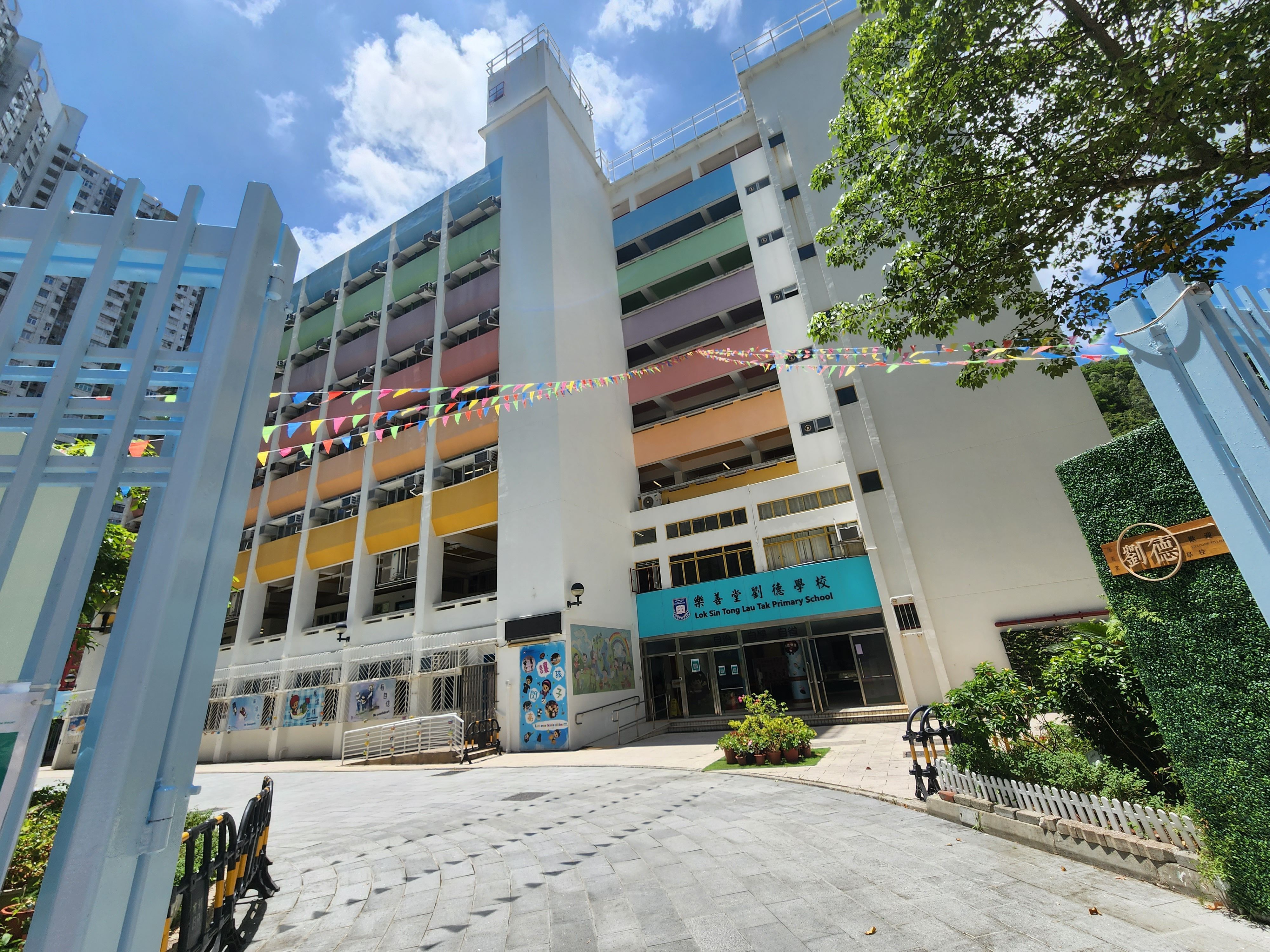
Last revision date:01 September 2026


