 Primary School Profiles 2026


 Primary School Profiles 2026

| Address: | Mei Shing Court, Tai Wai, Shatin, N.T. | |||
| Phone: | 26052868 | Email: | fmml@netvigator.com | |
| Fax: | 26022709 | Website: | http://www.fmml.edu.hk | |
 School Information
| Supervisor/ Chairman of Management Committee | : | Ms. Lee Yan Yan Yolanda |
| School Head | : | Ms. Chiu Chit Ling |
| Incorporated Management Committee been established? | : | Established |
| Percentage of School Supervisor and Managers / Chairperson and Members of School Management Committee (SMC) of Government Schools Fulfilling the Training Targets | : | Not Applicable |
| School Type | : | Aided Whole Day |
| Student Gender | : | Co-ed |
| Sponsoring Body | : | Free Methodist Mei Lam Primary School Limited |
| Religion | : | Protestantism / Christianity |
| Year of Commencement of Operation | : | 2005 |
| School Motto | : | Faith, Hope, Love |
| Area Occupied by the School | : | About 2000 Sq. M |
| Through-train Secondary School | : | - |
| Feeder Secondary School | : | - |
| Nominated Secondary School | : | - |
| Medium of Instruction | : | Chinese & English |
| School Bus Service | : | School Bus |
| Parent-Teacher Association | : | Yes |
| Past Students' Association/Alumni Association | : | Yes |
| 4Rs Mental Health Charter | : | Yes |
| Whole School Health Programme | : | Pledged School |
 2026/2027 Annual School Charges
| School Fee | : | - |
| Tong Fai | : | - |
| PTA Fee | : | $30 |
| Approved Charges for non-standard items | : | $300 (Additional Native-speaking English Teacher and improve students' learning environment and facilities) |
| Other Charges | : | - |
 School Facilities
| Number of Classroom(s) | : | 25 |
| Number of School Hall(s) | : | 1 |
| Number of Playground(s) | : | 2 |
| Number of Library(ies) | : | 1 |
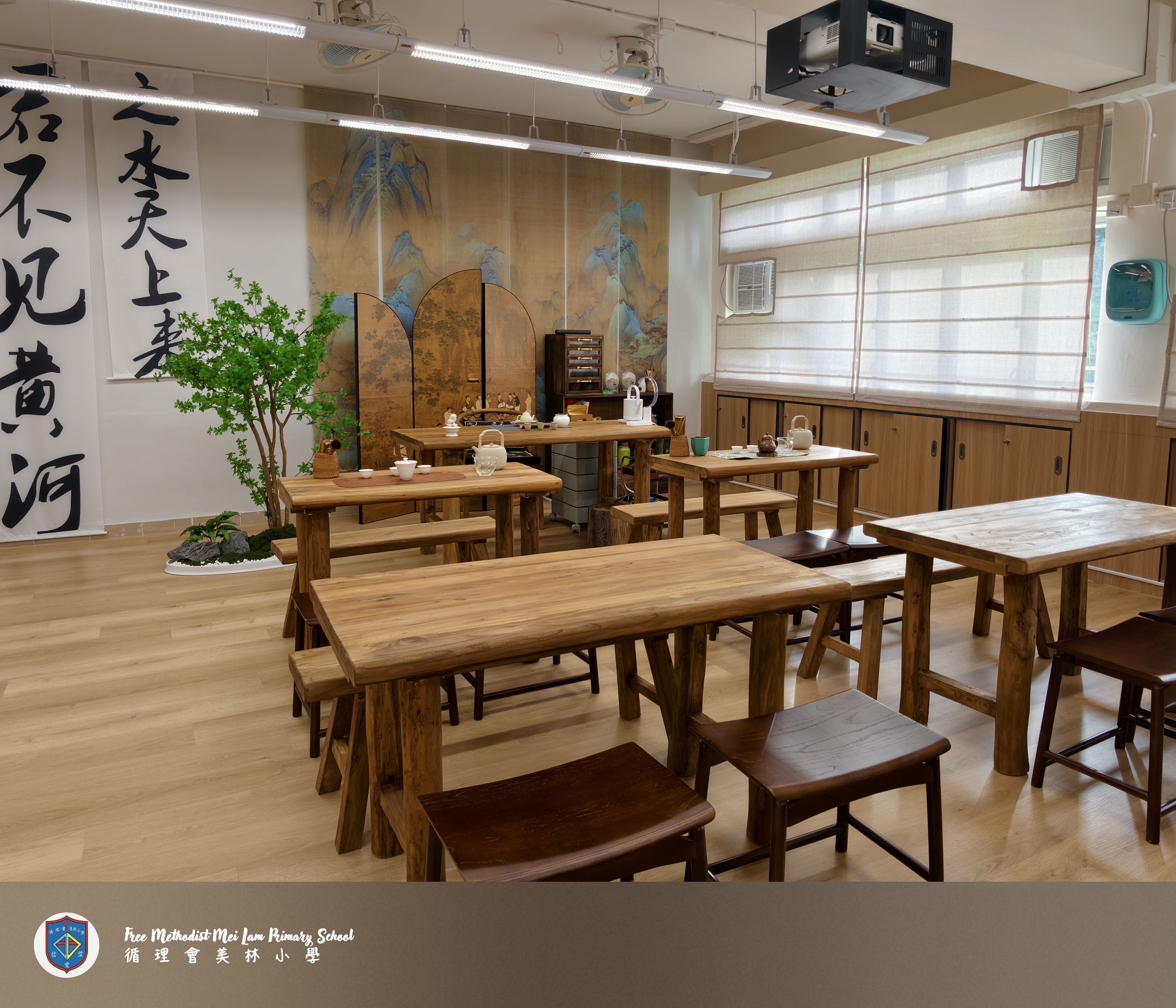
| Special Rooms | : | 9rooms (Positive Education Centre, STEM Room, Library, Campus TV, English Room, General Studies Room, Art & Craft Room, Music Room, Computer Room.) |
| Facility(ies) for Supporting Students with Special Educational Needs | : | Accessible lift and Accessible toilet. |
| Others | : | Mei Lam Ecological Park, LED high-definition display screen, School Counseling Office, Lift and whole school covered by wireless WiFi. |
 Teaching Staff Information (Including School Head) in the 2025/2026 school year
| Number of teaching posts in the approved establishment | : | 36 |
| Total number of teachers in the school | : | 45 |
| Qualifications and professional training (%) | ||
| Had Received Teacher Training | : | 100% |
| Bachelor Degree | : | 100% |
| Master/ Doctorate Degree or above | : | 42% |
| Special Education Training | : | 44% |
| Years of Experience (%) | ||
| 0 - 4 years | : | 14% |
| 5 - 9 years | : | 10% |
| 10 years or above | : | 76% |
 Class Structure
| 2025/26 school year | ||
| P1 Number of classes | : | 2 |
| P2 Number of classes | : | 2 |
| P3 Number of classes | : | 2 |
| P4 Number of classes | : | 4 |
| P5 Number of classes | : | 4 |
| P6 Number of classes | : | 4 |
| Total | : | 18 |
| 2026/27 school year (Based on the number of classes approved by EDB in 2026) | ||
| P1 Number of classes | : | 1 |
| P2 Number of classes | : | 2 |
| P3 Number of classes | : | 2 |
| P4 Number of classes | : | 2 |
| P5 Number of classes | : | 4 |
| P6 Number of classes | : | 4 |
| Total | : | 15 |
| Mode of teaching at different levels | ||
| 1. Small class teaching. 2. Diversified learning strategies, including cooperative learning, self directed learning and learning by doing to improve students' learning effectiveness. |
||
| Remarks | ||
| 1. P.5 Chinese and English, P4 Chinese divide 4 classes into 5 groups for teaching. 2. After-school tutoring is provided for P.6 Chinese and P.5 Mathematics. |
||
 Performance Assessment
| Applicable to P1 only | ||
| Number of test(s) per year | : | 0 |
| Number of exam(s) per year | : | 2 |
| Replace tests and examinations with diversified assessments in the first term of P1 | : | Yes |
| Applicable to P2 to P6 only | ||
| Number of test(s) per year | : | 0 |
| Number of exam(s) per year | : | 3 |
| Applicable to P1 to P6 | ||
| Formulate appropriate school-based assessment and assignment policies, inform parents of related arrangements, and collect views from teachers, students and parents regularly (at least once per school year) for ongoing review and optimisation of the school assessment and assignment policies | : | Yes |
| Upload the school-based assessment policy onto the school webpage for information of the public and stakeholders | : | Yes |
| Upload the school-based assignment policy onto the school webpage for information of the public and stakeholders | : | Yes |
| Diversified Assessment for Learning | : | By completing progressive assessments, students are able to review their learning performance and progress. Teachers will also provide timely feedback and support to reinforce their learning by observing students' learning performance, including assignments, group discussions, presentations and data collection activities. |
| Avoid arranging tests or examinations immediately after long holidays in order to let students take more rest during the holidays | : | Yes |
| Arrange the timetable flexibly according to the school context, with a tutorial session provided in the afternoon as far as possible for students to finish some of their homework under teachers’ guidance | : | Yes |
| Streaming arrangement | : | 1. Average class placement for P.1 to P.4, P.5 and P6 are divided into classes 2. According to students abilities, teaching students in accordance with their aptitude, and making adjustments to their courses and homework. |
 School Life
| Number of school days per week | : | 5 |
| Number of periods per day | : | 7 |
| Duration of each normal period | : | 35 |
| School starts at | : | 8:00 AM |
| School ends at | : | 3:25 PM |
| Lunch break | : | 12:45 - 1:45 |
| Lunch arrangement | : | Provided by designated supplier and arranged by parents. |
| Healthy school life | : | 1. Healthy campus (happy/green campus) 2. Healthy Eating (Healthy Snacks in the Snack Department, Fruit Week) 3. Sports Health (Morning physical activity time, morning exercises) 4. Social Wellness (Developing Emotional Intelligence) |
| Remarks | : | 1. Implement the timetable of "Morning classes, afternoon activities". 2. Afternoon activities include class management, growth classes, weekly meetings, creative arts, interest groups and Friday Fun Fun Zone. 3. Tutoring classes from Monday to Thursday. 4. During the "Fun Fun Zone" on Friday, students are free to participate in different types of fun activities. |
 Life-wide Learning
| music such as hand bell, violin, string orchestra, chorus, sports such as track and field, shuttlecock, fancy rope skipping, basketball, football, table tennis, softball, dance, active life ambassador, visual arts training, Recitation Team, Math Olympiad Team, STEAM Team, etc. A fellowship period for P.5 students to learn the truth. |
 School Mission
| Carry out the balanced development of cultivating students in spiritual, moral, intellectual, physical, social and aesthetic education. Also gives students the opportunity to understand and accept the truth of Christ, build good character, develop their potential, and lead a prosperous life. |
 School Characteristics
| School Management | ||
| School Management Organisation | : | Divided into four categories, and different working groups are established to promote the development of schools. The school has also established a self-assessment culture and made good use of stakeholder questionnaires to collect data to continuously optimize learning and teaching. |
| Incorporated Management Committee / School Management Committee/ Management Committee | : | Our school is managed by experts including church pastor, company executive, retired government executive, accountant and doctor. Besides, we also have parent, teacher and alumni managers. |
| School Green Policy | : | Aquaponics system facilities, Well# intelligent water filling station, energy-saving lighting system in classrooms (with user sensors and light-sensitive detectors), recycling of waste paper plastic bottles, and student environmental protection ambassadors. |
| School's Major Concerns | : | Root in Christ (Relationship with God), Explore the Truth (Relationship with things) Inspire the Potential (Relationship with Self: Self-Practice), Accompany in Harmony (Relationship with others) |
| Learning and Teaching Plan | ||
| Learning & Teaching Strategies | : | 1. Teachers explain and write on the blackboard the classroom teaching objectives, so that students can clearly understand the focus of daily learning, take notes, and organize the learning content. 2. Use the skills of layered ability to ask questions to inspire students to think. 3. To design diverse learning experiences for students and to inspire students' diverse potential through different learning experiences. 4. Make good use of the class hours and the principle of class hours to provide diversified and meaningful pre-class preview and after-class extension. 5. Use the learning activity of "learning by doing" to allow students to interact with the living environment and gain experience through the operation process. 6. Evidence-based review and feedback on teaching to improve teaching and learning effectiveness. |
| Development of Major Renewed Emphases of the Primary Education Curriculum | : | 1. Set up a "CAT programme" to cultivate students' abilities and interests in creativity, art and technology (STEM). 2. Utilize the class hours to achieve the campus life of class in the morning and activities in the afternoon. |
| Development of Generic Skills | : | To cultivate students' generic skills through different activities, the school-based curriculum "Creative Arts" (Creativity, Art and Technology) is designed to allow students to develop systematically in creativity, information technology skills, numeracy skills and problem-solving skills. |
| Cultivation of Proper Values, Attitudes and Behaviours | : | 1. Strengthen teachers, students and parents to understand the 6 virtues "24 character strengths", and cultivate students' six virtues including wisdom and knowledge, courage, spirituality and transcendence, benevolence, justice and temperance. 2. Promote the implementation of positive concepts in class management, discover students' character strengths, and assist them in giving full play to their personal character strengths. |
| Student Support | ||
| Whole School Approach to Catering for Learner Diversity | : | The individual differences of students will be catered to through the 3 tier support model. We support quality teaching in regular lessons and always recommend potential students to join gifted programs. We also have small group teaching, after school remedial groups and Individualized Education Program to those SEN students. Adaptation programs are provided to P.1 new comers. Additional English lessons and adaptation programs are provided to students from Mainland. |
| Whole School Approach to Integrated Education | : | We aim at building a harmonious caring campus. Our student support team plan, implement and promote whole school approach in catering students with special educational needs (SEN). We have school-based educational psychologist and school-based speech therapist to provide individual training for students in need. We also make use of the Learning Support Grant from the EDB to employ supporting teachers and buy different services to enhance students’ concentration, social and motor skills. |
| Education Support for Non-Chinese Speaking(NCS) Students | : | Our school provides additional support for NCS students to facilitate their learning of Chinese: providing after-school support programmes in learning Chinese; appointing additional teacher(s)/teaching assistant(s) to support NCS students' learning of Chinese; arranging intensive Chinese learning and teaching mode(s), e.g. pull-out learning if necessary, split-class/group learning, etc; developing school-based Chinese Language curriculum and/or adapting learning and teaching materials; organising activities to create an inclusive learning environment in the school; and hiring additional manpower and/or translation/interpretation services to facilitate the communication with parents of NCS students. |
| Curriculum Tailoring and Adaptation | : | Teachers will design tiered worksheets according to the students’ abilities, as well as make adjustments to the writing homework for SEN students, such that the amount of writing is reduced. Teachers will make adjustments to dictations for these students, such as reducing the dictation syllabus, or even changing the format of dictation, such that these students can feel more confident in preparing for dictations. On top of that, the school will arrange for students with learning difficulties to have additional time or be pulled out during examinations according to their individual needs. |
| Home-school Co-operation and School Ethos | ||
| Home-School Co-operation | : | 1. FMML has set up "Mei Lam Parent Academy", which is committed to promoting home-school cooperation and communication between parents and children. Through different activities, lectures, groups, etc., parents can explore and research together on the issue of parenting, so as to promote children's Grow up healthily and happily. 2. Cooperate with PTAs, organize parent volunteer teams, assist in organizing study weeks for various subjects, arrange campuses, and serve as parents of old children. Chinese culture week. |
| School Ethos | : | With the concept of unity of spirit, training and support, through the "Merrill Lynch Golden Elite Super Stars Electronic Award Program" and different themed activities, students are trained to have correct values, good morals and habits, and build independent and persevering lives. |
| Future Development | ||
| School Development Plan | : | 2024-2026 Three-Year Concerns 1. Cater for students' learning diversity, optimize learning and teaching, and enhance learning effectiveness. 2. Continue to develop positive education and cultivate students' good moral character and correct values. |
| Teacher Professional Training & Development | : | 1. Participate in teacher professional training, teaching exchange and sharing, understanding of positive education theory and skills in implementing positive education 2. E-learning, special learning needs and STEM teaching in various universities and education bureaus. |
| Others | : | 1. To subsidize the training, outing competitions and exchanges of school teams in music, sports, STEAM, etc., and also provide scholarships for academic, conduct and athletic achievements to students with outstanding performance. 2. "Music Campus" Award Scheme - Honor Award 3. "The First Scratch Programming Contest and Awards Ceremony" won several group, individual and technical awards |
 School Map
Last revision date:01 September 2026


