| School Management |
| School Management Organisation |
:
| The School Management Committee has established different School Development Teams, comprising teachers of different ranks and domains, to explore the direction of school development. Senior Teachers are assigned to head different administrative teams, such as school development and resource management, learning and teaching and curriculum, student affairs, self-evaluation and student support, etc. Each team leader defines clear objectives based on the school’s major concerns and scope of work, guiding team members in carrying out their duties effectively. |
| Incorporated Management Committee / School Management Committee/ Management Committee |
:
| The School Management Committee comprises a representative from Education Bureau, two Community members, the Headmistress, two parent representatives, one alumnus representative and two teacher representatives. |
| School Green Policy |
:
| Environmental Protection is incorporated into the moral and civic education curriculum to encourage students to reduce waste and cherish the resources they have. Students are encouraged to serve as Environmental Protection Ambassadors and participate in various environmental activities and competitions. In order to minimize leftover food, lunch is served in a central-allocation system, and pupils only get the required quantity of food as requested. School administration is managed through emails. Electronic notices are used to build a quick communication channel with parents which also reduces paper usage. |
| School's Major Concerns |
:
| 1. Enhance students’ digital literacy by applying artificial intelligence and promote self-directed learning ability.
2. Cultivate a positive school environment and a deep sense of national pride. |
| Learning and Teaching Plan |
| Learning & Teaching Strategies |
:
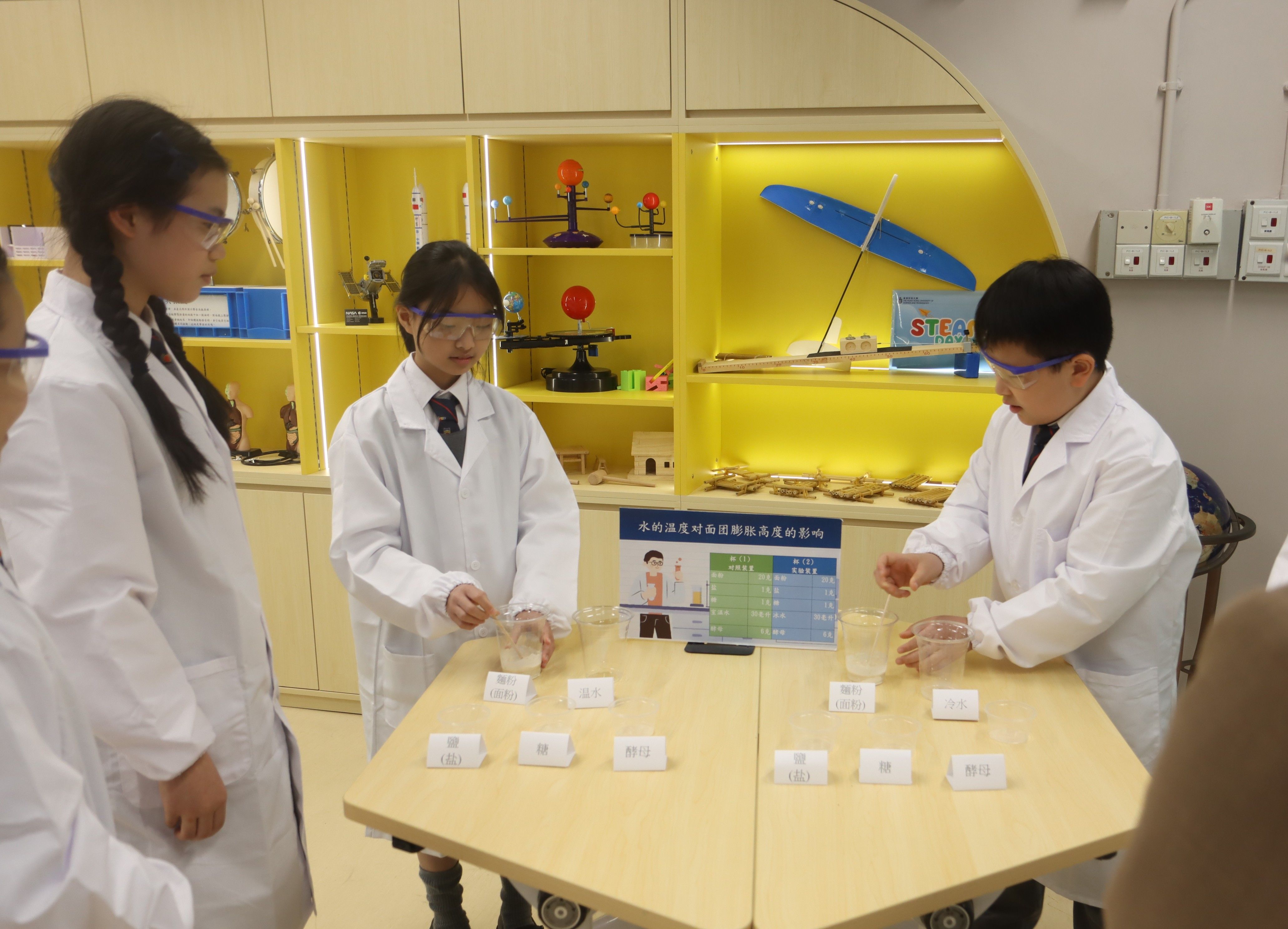
| Our school employs diverse learning activities to inspire students' motivation, cultivate active learning, and develop multi-perspective thinking skills. In Chinese Language, an integrated reading and writing approach enhances speaking and writing abilities. In English Language, students improve language proficiency by mastering high frequency words, vocabulary, phonics, and high quality authentic reading materials. Mathematics lessons are designed with the Theory of Mathematising, engaging students in the "re-invention" process and expressing ideas through mathematical language. Humanities integrates project-based learning to deepen cross-disciplinary knowledge. Science combines daily life experiences with classroom learning and experiments, fostering scientific inquiry, design and production skills, and problem-solving abilities. Our school implements a "cooperative learning" strategy, enabling students to work in groups to complete tasks, enhancing motivation, confidence, and social skills. |
| Development of Major Renewed Emphases of the Primary Education Curriculum |
:
| Our school prioritizes values education to instill proper values, national identity, law-abiding awareness, and responsibility for safeguarding national security. Through diverse materials and activities, students deepen their understanding of national conditions, Chinese culture, the Constitution, and the Basic Law. Cross-curricular reading from P.1 to P.6 enhances students' abilities by integrating thematic reading and values education across subjects. A new Humanities subject, combining history, Chinese culture, geography, and civic education, fosters societal and national understanding, national sentiment, and identity. Additionally, the school actively promotes science education and innovation, emphasizing technology learning and establishing a strong foundation in scientific knowledge and literacy. By integrating these approaches, the school aims to nurture well-rounded, informed, and responsible individuals with a passion for learning and a commitment to their community and nation. |
| Development of Generic Skills |
:
| We develop students' generic skills through Life-wide Learning Activities. Each subject also helps develop pupils' generic skills within its syllabus (in the spiral approach), so that different generic skills will be developed in each level. |
| Cultivation of Proper Values, Attitudes and Behaviours |
:
| Our school prioritizes nurturing students' positive values and attitudes as a key objective, using twelve priority values and attitudes as entry points. Taking into account the school context, student needs, and societal expectations, a positive learning atmosphere is cultivated. Through school-based Personal Growth Education, real-life examples are selected as learning materials to develop a school-based curriculum, aiming to achieve holistic development. |
| Student Support |
| Whole School Approach to Catering for Learner Diversity |
:
| Our school employs a diverse support system, fostering close collaboration among teachers and parents to create a safe and inclusive learning environment for students. In areas such as class structure, lesson planning, classroom activities and assessment mechanisms, we prioritize meeting students' diverse educational needs to ensure they receive appropriate support. |
| Whole School Approach to Integrated Education |
:
| Using a "whole-school approach" to support students with special educational needs, our school leverages the Learning Support Grant to allocate resources and provide appropriate and diversified support services. This enables students to develop their potential while fostering mutual respect for individual differences among all teachers and students, creating an inclusive school environment. |
| Education Support for Non-Chinese Speaking(NCS) Students |
:
|
Our school provides additional support for NCS students to facilitate their learning of Chinese: providing after-school support programmes in learning Chinese; appointing additional teacher(s)/teaching assistant(s) to support NCS students' learning of Chinese; arranging intensive Chinese learning and teaching mode(s), e.g. pull-out learning if necessary, split-class/group learning, etc; developing school-based Chinese Language curriculum and/or adapting learning and teaching materials; and organising activities to create an inclusive learning environment in the school.
|
| Curriculum Tailoring and Adaptation |
:
| In response to students' varying learning abilities, teachers collaboratively design school-based teaching strategies, content, and assignments during co-planning sessions. These are aligned with key learning objectives and provide appropriate feedback to address the diverse learning needs of students. |
| Home-school Co-operation and School Ethos |
| Home-School Co-operation |
:
| Our school maintains a close partnership with parents, supported by a large team of parent volunteers who assist with daily operations and school activities. The Parent-Teacher Association systematically organizes parent interest classes and helps monitor various commercial activities related to student welfare. Our school organises parent education courses, seminars and parent-child activities. Communication between the school and parents is strengthened through newsletters, bulletins, the school website and parent networks. |
| School Ethos |
:
| Our school values students' character development and potential and is committed to helping them fulfil it. Through curriculum design, service activities, talks, various activities, and competitions, a culture of care and appreciation is fostered within the campus. This helps students enhance their self-management skills while guiding them to practice gratitude, respect their teachers, encourage their peers, and live harmoniously with others, thereby developing a positive and proactive outlook on life. |
| Future Development |
| School Development Plan |
:
| Our school fosters students' creativity and problem-solving skills. By implementing cooperative learning and self-directed learning approaches, our school nurtures students to become proactive learners. Our school also strengthens students' values and attitudes, equipping them to face the changes and challenges of growth with a positive mindset and to lead a healthy and fulfilling life. |
| Teacher Professional Training & Development |
:
| All teachers at our school hold professional teaching qualifications. Our school organizes professional training activities based on school-specific and teacher development needs, while aligning with the latest trends in education and addressing students' needs. Teachers are encouraged to actively participate in external courses and seminars, bringing the latest educational insights back to the campus. External professional support is also utilized to enhance teachers' professional knowledge, enabling the development of a school-based curriculum and better supporting students' growth needs. |
| Others |
:
| - |
 Primary School Profiles 2026


 School Information
  2026/2027 Annual School Charges
 School Facilities
  Teaching Staff Information (Including School Head) in the 2025/2026 school year
  Class Structure
  Performance Assessment
  School Life
  Life-wide Learning
  School Mission
  School Characteristics
  School Map