 Primary School Profiles 2026


 Primary School Profiles 2026

| Address: | Area 3, Phase 4, Tin Shui Wai, Yuen Long, N.T. | |||
| Phone: | 24478686 | Email: | info@qbps.edu.hk | |
| Fax: | 26174488 | Website: | http://www.qbps.edu.hk | |
 School Information
| Supervisor/ Chairman of Management Committee | : | Mr. MA KANG CHING |
| School Head | : | Mr. Wu Kwok Wai |
| Incorporated Management Committee been established? | : | Established |
| Percentage of School Supervisor and Managers / Chairperson and Members of School Management Committee (SMC) of Government Schools Fulfilling the Training Targets | : | 83% |
| School Type | : | Aided Whole Day |
| Student Gender | : | Co-ed |
| Sponsoring Body | : | Q.E.S. Old Students' Association Education Promotion Organization Limited |
| Religion | : | Not Applicable |
| Year of Commencement of Operation | : | 1992 |
| School Motto | : | Vos Parate Ut Serviatis (Prepare yourselves so as to serve) |
| Area Occupied by the School | : | About 7000 Sq. M |
| Through-train Secondary School | : | - |
| Feeder Secondary School | : | - |
| Nominated Secondary School | : | - |
| Medium of Instruction | : | Chinese & English |
| School Bus Service | : | School Bus |
| Parent-Teacher Association | : | Yes |
| Past Students' Association/Alumni Association | : | Yes |
| 4Rs Mental Health Charter | : | Yes |
| Whole School Health Programme | : | Pledged School |
 2026/2027 Annual School Charges
| School Fee | : | - |
| Tong Fai | : | - |
| PTA Fee | : | $50 |
| Approved Charges for non-standard items | : | Charges and Fees for Specific Purposes $450 |
| Other Charges | : | $30 (replacement of student card) |
 School Facilities
| Number of Classroom(s) | : | 30 |
| Number of School Hall(s) | : | 1 |
| Number of Playground(s) | : | 4 |
| Number of Library(ies) | : | 1 |
| Special Rooms | : | English Room, STEAM Room, Multi-Purpose Learning Room, Counseling Room, Student Activity Centre, Campus TV Station, E+ Art Gallery, Music Room, Multi-Sensory Learning Room, Future Lab |
| Facility(ies) for Supporting Students with Special Educational Needs | : | Accessible lift and Accessible toilet. |
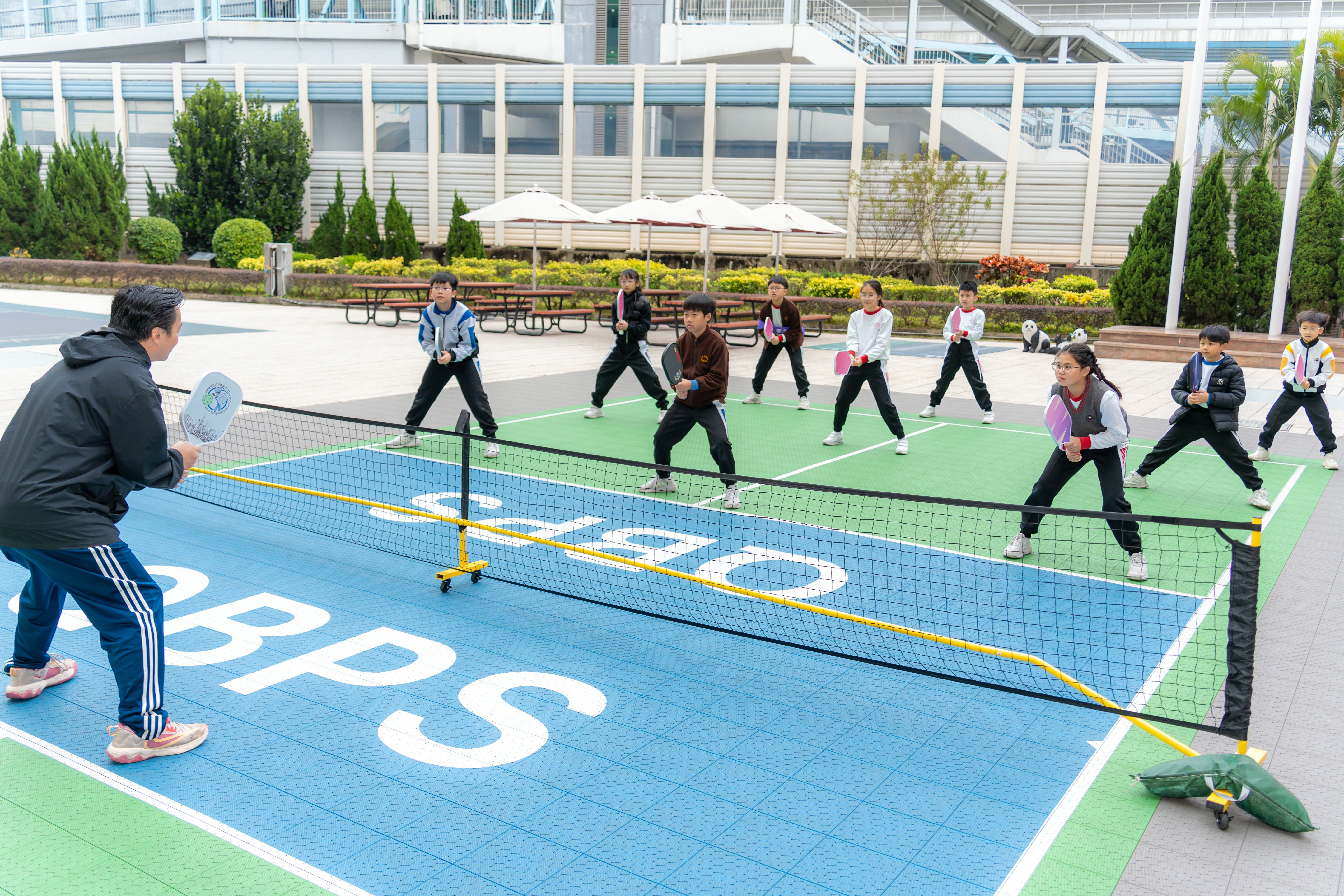
| Others | : | Rainbow Playground, Pickleball Court, Chinese Culture Pavilion, Playground, Green Park, Ecological Garden, Fish pond, Turtle pond, Garden, Theater, Climbing Wall |
 Teaching Staff Information (Including School Head) in the 2025/2026 school year
| Number of teaching posts in the approved establishment | : | 55 |
| Total number of teachers in the school | : | 60 |
| Qualifications and professional training (%) | ||
| Had Received Teacher Training | : | 92% |
| Bachelor Degree | : | 100% |
| Master/ Doctorate Degree or above | : | 22% |
| Special Education Training | : | 78% |
| Years of Experience (%) | ||
| 0 - 4 years | : | 23% |
| 5 - 9 years | : | 30% |
| 10 years or above | : | 47% |
 Class Structure
| 2025/26 school year | ||
| P1 Number of classes | : | 5 |
| P2 Number of classes | : | 5 |
| P3 Number of classes | : | 5 |
| P4 Number of classes | : | 5 |
| P5 Number of classes | : | 5 |
| P6 Number of classes | : | 5 |
| Total | : | 30 |
| 2026/27 school year (Based on the number of classes approved by EDB in 2026) | ||
| P1 Number of classes | : | 5 |
| P2 Number of classes | : | 5 |
| P3 Number of classes | : | 5 |
| P4 Number of classes | : | 5 |
| P5 Number of classes | : | 5 |
| P6 Number of classes | : | 5 |
| Total | : | 30 |
| Mode of teaching at different levels | ||
| 1. Implementing small-class teaching, emphasizing high classroom participation and multiple demonstrations to enhance students' abilities and interest in autonomous learning. 2. Embracing e-learning to enhance the effectiveness of teaching and learning. |
||
| Remarks | ||
| Through diverse advanced and remedial courses, ensuring that students with varying abilities and learning needs receive appropriate care to develop their full potential. | ||
 Performance Assessment
| Applicable to P1 only | ||
| Number of test(s) per year | : | 0 |
| Number of exam(s) per year | : | 0 |
| Replace tests and examinations with diversified assessments in the first term of P1 | : | Yes |
| Applicable to P2 to P6 only | ||
| Number of test(s) per year | : | 1 |
| Number of exam(s) per year | : | 2 |
| Applicable to P1 to P6 | ||
| Formulate appropriate school-based assessment and assignment policies, inform parents of related arrangements, and collect views from teachers, students and parents regularly (at least once per school year) for ongoing review and optimisation of the school assessment and assignment policies | : | Yes |
| Upload the school-based assessment policy onto the school webpage for information of the public and stakeholders | : | Yes |
| Upload the school-based assignment policy onto the school webpage for information of the public and stakeholders | : | Yes |
| Diversified Assessment for Learning | : | 1. Formative assessment in P.1. 2. Graduation Project Presentation in P.6. 3. Use the formative assessment model to evaluate students' attitudes. 4. Different modes of assessment: In addition to examinations and tests, project-based learning, science experiments, performance assessments, outings, diary logs, peer and self-assessments are also included. |
| Avoid arranging tests or examinations immediately after long holidays in order to let students take more rest during the holidays | : | Yes |
| Arrange the timetable flexibly according to the school context, with a tutorial session provided in the afternoon as far as possible for students to finish some of their homework under teachers’ guidance | : | Yes |
| Streaming arrangement | : | 1. Students are streamed according to their average exam results. 2. English elite classes in P.1-P.6. 3. Mathematics classes in P.5-P.6 are conducted using homogeneous grouping. |
 School Life
| Number of school days per week | : | 5 |
| Number of periods per day | : | 9 |
| Duration of each normal period | : | 35 |
| School starts at | : | 8:10 AM |
| School ends at | : | 3:15 PM |
| Lunch break | : | 1:00 - 2:00 |
| Lunch arrangement | : | Provided by designated supplier and arranged by parents. |
| Healthy school life | : | 1. Lunch is provided by a designated supplier following the "Healthy Lunch 321" principles to promote a culture of healthy eating. 2. Implementing a Healthy Campus Policy, organizing activities promoting positive psychology, healthy living, and balanced lifestyles. Various activities are offered during lunch breaks to help students develop positive, healthy, and self-disciplined habits. |
| Remarks | : | 1. P.1 to 3 and P.4(1st term) dismiss at 1:30 p.m. on Fridays, while P.4 (2nd term), P.5 and 6 dismiss at 2:30 p.m. 2. Reading sessions nurture good reading habits. 3. Theme-based learning enhances interdisciplinary skills and knowledge application. 4. School offers diverse activities showcasing students' talents. 5. "All Stars with You" lunch show for student talent display. 6. Values and attitudes developed via growth classes and management. |
 Life-wide Learning
| "Broadening Horizons, Pursuing Excellence" is the core belief of our school's wide-life learning program. We believe every child is a shining star. Through diverse learning experiences inside and outside the classroom, they can explore new horizons, enrich their knowledge, and unlock their unique potential. With a determination to excel, students are encouraged to develop their interests and talents, showcase their abilities in various activities and competitions, and grow into versatile individuals who contribute to society. |
 School Mission
| 1. To work together to create for our pupils a positive and caring environment that will enable them to have healthy and balanced physical cognitive and psycho-social development. 2. To nurture for our society a group of youths who will use "Vos Parate Ut Serviatis" as their target in life and in their studies and passionately and incessantly pursue knowledge, truth and excellence. |
 School Characteristics
| School Management | ||
| School Management Organisation | : | The Principal, working with the Vice Principals and all the administration teams whom she leads, strives to develop the school under the supervision of IMC. |
| Incorporated Management Committee / School Management Committee/ Management Committee | : | The members include: Sponsoring Body Manager, Principal, Substitute Manager, Independent Manager, Teacher Manager, Parent Manager and Alumni Manager. |
| School Green Policy | : | 1. Decide whether to turn on the air conditioning based on the temperature and humidity. 2. The luncheon provider that adopts reused and washable lunch boxes has been selected. Students have to bring their reusable eating utensils so as to avoid using disposable things. 3. Emphasize sustainable development by implementing waste sorting and recycling programs. 4. Prioritize environmental education by organizing various types of environmental activities through Green Starters environmental ambassadors to enhance students' environmental awareness and educate them on the importance of caring for the environment. |
| School's Major Concerns | : | 1. Cultivate students to become self-directed learners with a positive mindset to enhance learning efficiency. 2. Foster in students correct values and a healthy lifestyle attitude, enabling them to face growth challenges positively. |
| Learning and Teaching Plan | ||
| Learning & Teaching Strategies | : | 1. In addition to the formal curriculum, there is a personal growth period, an extra-curricular activity period, a diversified learning period and a theme-based learning period each week. 2. Emphasizing the learning experience. 3. Promoting different levels of thinking and questioning to develop students' potential. 4. Cultivating students' note-taking skills, helping them organize their learning and develop effective learning habits. 5. Cultivating students' self-directed learning abilities through reflective learning. |
| Development of Major Renewed Emphases of the Primary Education Curriculum | : | 1. Strengthening values education (covering national education [including patriotic education, national security education], life education and sex education. 2. Making good use of learning time and creating space to promote a balanced physical and mental development. 3. Strengthening reading and digital literacy to develop students' lifelong learning capabilities. 4. Enriching life-wide learning experiences and fostering whole-person development. |
| Development of Generic Skills | : | To consolidate students' mathematical and language abilities as well as develop students' critical thinking, problem solving, self-reflecting and creativity skills through interactive learning and a variety of activities in all subjects. |
| Cultivation of Proper Values, Attitudes and Behaviours | : | Through personal growth period, school-wide learning activities and classroom activities, the following goals are achieved: 1. Let students recognize, build and make good use of proper values and attitudes. 2. Let teachers use appreciation and experiencing to build students' character strengths. 3. Build positive emotions and happiness for students. |
| Student Support | ||
| Whole School Approach to Catering for Learner Diversity | : | The school has adopted a whole-school approach. The Student Support Team is responsible for coordinating policies and strategies to cater to individual differences. We provide students with different layers of support to overcome students’ learning barriers, cultivate their learning motivation and self-confidence, and develop their self-learning ability. |
| Whole School Approach to Integrated Education | : | The school embraces students’ ability differences so we develop a whole-school approach to support them. The Student Support Team cooperates with our professional teams and specialists to support students’ learning and growth. We offer differentiated assignments, assessment arrangements, individual education plan and other diversified learning activities according to the needs of the students. |
| Education Support for Non-Chinese Speaking(NCS) Students | : | Our school provides additional support for NCS students to facilitate their learning of Chinese: providing after-school support programmes in learning Chinese; appointing additional teacher(s)/teaching assistant(s) to support NCS students' learning of Chinese; and organising activities to create an inclusive learning environment in the school. |
| Curriculum Tailoring and Adaptation | : | Chinese: Children's literature has been integrated into a theme-based learning curriculum to boost students' comprehension and reading abilities. English: The school-based curriculum has been designed to support students in all aspects. For junior levels, our curriculum includes the 'Space Town' project from the Education Bureau. For senior levels, there are P.1 to P.6 English Elite Classes. Mathematics: The school-based curriculum has been designed acquire knowledge through daily practice. Humanities: The curriculum nurtures students’ thinking skills. Diversified assessment methods have been promoted. Different learning experiences help broaden students' horizons. Science: A school-based STEAM curriculum has been developed to nurture students’ inquiring minds in science and technology. |
| Home-school Co-operation and School Ethos | ||
| Home-School Co-operation | : | 1. The Parent-Teacher Association organizes a variety of activities for students and parents, such as parent-child trips, parent education seminars/workshops, and parent appreciation events for teachers. These activities help parents instill proper values in their children and promote the spirit of home-school collaboration. 2. A large team of parent volunteers supports the school in developing various activities. 3. Through programs such as "E-Fun Connection," "E-Fun Tea Gathering," and Parent Days, home-school collaboration is strengthened, and communication is enhanced. |
| School Ethos | : | 1. Building a positive and caring school environment. 2. Love is the core for pastoral care, focusing on nurturing the positive relationship among students, as well as between student-teacher and parent-child. |
| Future Development | ||
| School Development Plan | : | 1. Promoting a school-wide reading atmosphere to enhance students' ability to "learn through reading." 2. Further cultivating students' self-directed learning abilities through strategic and focused pre-lesson tasks, complemented by the effective use of learning booklets. 3. Developing students' note-taking skills to organize their learning and make it a habit. 4. Each subject group continues to deepen values education through different strategies. 5. Each subject group focuses and enhances values education (Empathy, Respect for Others, Unity, Commitment) through different strategies to promote students' holistic development. 6. Advancing national security education through "multiple approaches, mutual coordination." By guiding students towards holistic development, encourage them to leverage their strengths, enhance their sense of achievement, resilience, and adaptability. |
| Teacher Professional Training & Development | : | 1. Provide Professional Development for Teachers: Offer various professional development opportunities, including site visits, sharing sessions, and lesson demonstrations. 2. Facilitate Professional Development: Utilize lesson observations, teacher workshops, learning and teaching workshops and other strategies to enhance teachers' professional growth, ultimately improving the effectiveness of teaching and learning. |
| Others | : | Students actively participate in a variety of activities and competitions, including various subjects, STEAM, cultural arts, dancing and sports. They have achieved excellent results in many public competitions. Students of different abilities also have the opportunity to participate and showcase their talents. |
 School Map
Last revision date:09 November 2026


