 Primary School Profiles 2026

 Primary School Profiles 2026
| Address: | 4-6, Kin Tung Road, Tung Chung, N.T. | |||
| Phone: | 21091001 | Email: | mail_ps@hoyu.edu.hk | |
| Fax: | 21092002 | Website: | http://www.hoyu.edu.hk | |
 School Information
 | Supervisor/ Chairman of Management Committee | : | Mr. Siu Tak Wa |
| School Head | : | Ms. Leung Wai Fong |
| Incorporated Management Committee been established? | : | Established |
| Percentage of School Supervisor and Managers / Chairperson and Members of School Management Committee (SMC) of Government Schools Fulfilling the Training Targets | : | 100% |
| School Type | : | Aided Whole Day |
| Student Gender | : | Co-ed |
| Sponsoring Body | : | Sik Sik Yuen |
| Religion | : | Confucianism, Buddhism and Taoism |
| Year of Commencement of Operation | : | 1997 |
| School Motto | : | To act benevolently and to preach benevolence |
| Area Occupied by the School | : | About 11148 Sq. M |
| Through-train Secondary School | : | Ho Yu College and Primary School (Sponsored by Sik Sik Yuen) |
| Feeder Secondary School | : | - |
| Nominated Secondary School | : | - |
| Medium of Instruction | : | Chinese |
| School Bus Service | : | School Bus |
| Parent-Teacher Association | : | Yes |
| Past Students' Association/Alumni Association | : | Yes |
| 4Rs Mental Health Charter | : | Yes |
| Whole School Health Programme | : | Pledged School |
 2026/2027 Annual School Charges
| School Fee | : | - |
| Tong Fai | : | - |
| PTA Fee | : | $30 |
| Approved Charges for non-standard items | : | - |
| Other Charges | : | - |
 School Facilities
 | Number of Classroom(s) | : | 30 |
| Number of School Hall(s) | : | 1 |
| Number of Playground(s) | : | 4 |
| Number of Library(ies) | : | 2 |
| Special Rooms | : | Yu Zhi Sinology Room, STEMaker Room, Yu Zhi Sinology Room, Biotechnology Laboratory, Digital Library, Computer Rooms, Multi-media Learning Centre(Immersive Innovative Teaching System), Student Activity Centre, Dance Room, Home Economics Room, Auditorium. |
| Facility(ies) for Supporting Students with Special Educational Needs | : | Ramp, Accessible lift and Accessible toilet. |
| Others | : | Archery and Golf Area, Biotechnology Mobile Laboratory, Ho Yu TV Live Broadcast Studio, Nature Education Trail, Butterfly Garden, Fitness Room, etc. |
 Teaching Staff Information (Including School Head) in the 2025/2026 school year
 | Number of teaching posts in the approved establishment | : | 43 |
| Total number of teachers in the school | : | 48 |
| Qualifications and professional training (%) | ||
| Had Received Teacher Training | : | 96% |
| Bachelor Degree | : | 100% |
| Master/ Doctorate Degree or above | : | 36% |
| Special Education Training | : | 56% |
| Years of Experience (%) | ||
| 0 - 4 years | : | 46% |
| 5 - 9 years | : | 24% |
| 10 years or above | : | 30% |
 Class Structure
 | 2025/26 school year | ||
| P1 Number of classes | : | 3 |
| P2 Number of classes | : | 5 |
| P3 Number of classes | : | 4 |
| P4 Number of classes | : | 3 |
| P5 Number of classes | : | 3 |
| P6 Number of classes | : | 5 |
| Total | : | 23 |
| 2026/27 school year (Based on the number of classes approved by EDB in 2026) | ||
| P1 Number of classes | : | 3 |
| P2 Number of classes | : | 4 |
| P3 Number of classes | : | 5 |
| P4 Number of classes | : | 4 |
| P5 Number of classes | : | 3 |
| P6 Number of classes | : | 4 |
| Total | : | 23 |
| Mode of teaching at different levels | ||
| Small-class teaching, collaborative learning, and activity-based instruction are conducted. Innovative technology is employed to assist students. Differentiated learning is implemented across all levels. For P.5 and P.6, self-regulated learning is incorporated. Certain areas of General Studies are taught in English. Chinese Language classes taught in Putonghua and Cantonese are offered. |
||
| Remarks | ||
| For General Studies curriculum, high order thinking skills, science exploration, Chinese medicine and biotech elements are incorporated, and theme-based learning programme is included. Chinese classics are incorporated. Activities are conducted to promote cross-curricular learning. Reading classes are provided. |
||
 Performance Assessment
 | Applicable to P1 only | ||
| Number of test(s) per year | : | 0 |
| Number of exam(s) per year | : | 0 |
| Replace tests and examinations with diversified assessments in the first term of P1 | : | Yes |
| Applicable to P2 to P6 only | ||
| Number of test(s) per year | : | 2 |
| Number of exam(s) per year | : | 2 |
| Applicable to P1 to P6 | ||
| Formulate appropriate school-based assessment and assignment policies, inform parents of related arrangements, and collect views from teachers, students and parents regularly (at least once per school year) for ongoing review and optimisation of the school assessment and assignment policies | : | Yes |
| Upload the school-based assessment policy onto the school webpage for information of the public and stakeholders | : | Yes |
| Upload the school-based assignment policy onto the school webpage for information of the public and stakeholders | : | Yes |
| Diversified Assessment for Learning | : | Continuous assessment: emphasis is placed on students' learning progress. Students' in-class performance, homework, and project learning are part of the assessment. Thus, teachers can provide timely feedback on students' learning difficulties. There are no exams for P.1 and 2, enabling students to adapt to the new environment. Favourable conditions are provided to enhance self-motivation to learn. |
| Avoid arranging tests or examinations immediately after long holidays in order to let students take more rest during the holidays | : | Yes |
| Arrange the timetable flexibly according to the school context, with a tutorial session provided in the afternoon as far as possible for students to finish some of their homework under teachers’ guidance | : | Yes |
| Streaming arrangement | : | Class allocation is made according to students' abilities and personal traits. In addition, cooperation and creativity are enhanced through team work, with the aim of achieving synergistic learning efficiency. |
 School Life
 | Number of school days per week | : | 5 |
| Number of periods per day | : | 7 |
| Duration of each normal period | : | 40 |
| School starts at | : | 8:30 AM |
| School ends at | : | 3:30 PM |
| Lunch break | : | 12:35 - 1:40 |
| Lunch arrangement | : | Provided by designated supplier and arranged by parents. |
| Healthy school life | : | The School participates in the "EatSmart@school.hk" Campaign, formulates environmental protection policies, and adopts various measures for energy conservation to help students build the good habit of green healthy living. In addition, the School regularly organizes a wide range of aerobic exercises to boost students' health and wellness. |
| Remarks | : | Various activities are arranged for students during lunch break. Following the lunch break, a mindfulness session is scheduled for students to concentrate and cultivate inner peace. |
 Life-wide Learning
 | There are special activities including those offered by various clubs and societies: Little Programmer, Little Doctor of Science, Drama Club, Debating Reporter, Reading Club, Choir, Wind Instrument Class, Marching Band, Snare Drum Team, Chinese Drum, Guzheng, Hand-bell, Kin-ball, Dancing, Archery, Golf, Rock Climbing, Swimming Team, iSmart Fitness Scheme, Chinese-style Flag-guards, Gardening & Farming and Scout. |
 School Mission
 | In observance of the guiding principle of Sik Sik Yuen, "To act benevolently and to preach benevolence", which is also our School Motto, together with the teachings of Confucianism, Buddhism, and Taoism, our School teaches and instills in our students a strong sense of probity, benevolence and civic duty. We emphasize a balanced development for our students through moral, intellectual, physical, social and aesthetic education, leading to the enhancement of abilities for independent thinking, self-learning and life-long learning. |
 School Characteristics
 | School Management | ||
| School Management Organisation | : | Supervised by the Incorporated Management Committee (IMC), the school operates its primary and secondary education in a "through-train" mode, and establishes various divisions such as School Administration Team, Learning and Teaching, and Student Development for the implementation and management of the 12-year continuum curriculum to achieve the mission of whole-person education. |
| Incorporated Management Committee / School Management Committee/ Management Committee | : | The IMC of our school is composed of the Sponsoring Body Manager, School Principal, Teacher as well as Parents Representatives. |
| School Green Policy | : | The school was proud to be recognised with the Gold Awards of the "Cherish Water Campus" Integrated Education Programme - Primary School in school years (2020-2021 to 2023-2024), for its active promotion of water conservation and realisation of an eco-friendly campus. We have been awarded the "Food For Good @Campus – Active Participation Award." |
| School's Major Concerns | : | Extend the dimensions of self-directed learning to accommodate the diversity of learning. Strengthen value education to cultivate students into good citizens. |
| Learning and Teaching Plan | ||
| Learning & Teaching Strategies | : | For P.1 and P.2, the "DEAR" Learning Program is implemented to help students establish reading habits, build vocabulary, develop positive values, and boost health through four major missions. The "DearLand" reading platform is also established to enhance students' reading and information literacy, and digital reading abilities. For P5 and P6, self-regulated learning is fostered to bridge the admission to secondary one. The "Matatalab Coding Elite Program" is introduced at lower primary levels to help students develop basic programming concepts and enhance logical thinking to reinforce the learnt English words. School-wide theme-based activities, such as Reading Week, STEAM Week, Chinese Culture Week and Mental Health Week, are also organised to deepen students' understanding of the themes. |
| Development of Major Renewed Emphases of the Primary Education Curriculum | : | In accordance with the "Primary Education Curriculum Guide", our school adopts the theme "Cultivate Values for Leaders of Tomorrow Create Space to Foster Whole-person Development". We uphold the importance of nurturing a sense of belonging to our country, the Chinese culture, values education, active learning, STEAM education, media and information literacy, a healthy lifestyle and balanced physical and mental development. In consideration of our school vision, development priorities and students' needs, we holistically review the school curriculum for formulation of a whole-school curriculum plan. |
| Development of Generic Skills | : | Student's knowledge and generic skills are developed through life-wide learning, exchange activities outside HK and project learning. |
| Cultivation of Proper Values, Attitudes and Behaviours | : | The school was honoured with the "Action Award", "Innovation Award", "Connection Special Award", "Enhancement Award", "Interpersonal Connectivity Award" and "Intellectual Engagement Award" for seven consecutive years of the "Hi-Five Student Engagement Award Scheme" respectively. Putting great emphasis on students' moral character and mental health, the school launches various initiatives comprising the Sik Sik Yuen Joint-School Moral Education Programme and a series of other schemes, with the aim of cultivating students' positive values and resilience. |
| Student Support | ||
| Whole School Approach to Catering for Learner Diversity | : | Students' learning needs are fully catered for through group learning, learning circle, after-school support and curriculum accommodations. The diverse potential of students is discovered through artificial intelligence, an immersive learning system and development of a talent pool. |
| Whole School Approach to Integrated Education | : | Comprehensive accommodations and therapy services are provided to students with special educational needs to help them adapt to the learning environment. Inclusion activities are organized to foster a culture of inclusion. |
| Education Support for Non-Chinese Speaking(NCS) Students | : | Our school provides additional support for NCS students to facilitate their learning of Chinese: providing after-school support programmes in learning Chinese; appointing additional teacher(s)/teaching assistant(s) to support NCS students' learning of Chinese; arranging intensive Chinese learning and teaching mode(s), e.g. pull-out learning if necessary, split-class/group learning, etc; developing school-based Chinese Language curriculum and/or adapting learning and teaching materials; organising activities to create an inclusive learning environment in the school; and hiring additional manpower and/or translation/interpretation services to facilitate the communication with parents of NCS students. |
| Curriculum Tailoring and Adaptation | : | Advanced courses for gifted students are offered. For English Language, the Primary Literacy Programme – Reading and Writing ("PLP-R/W") is implemented. This programme is jointly taught by NET teachers and English teachers with the aim of catering for students' language learning needs in a comprehensive manner. |
| Home-school Co-operation and School Ethos | ||
| Home-School Co-operation | : | The Parent-Teacher Association and the school jointly organize various activities to achieve home-school co-operation: AGM of the PTA, Parent-child bonding trips, Story-Telling Parents, the School Uniform Recycling Campaign, interests classes and workshops. With the active participation and support of parent volunteers, parents are encouraged to engage in school activities to develop a closer home-school relationship. |
| School Ethos | : | Our School emphasizes and develops a loving and caring culture for everyone on campus - a culture that is strict yet loving, and harmonious yet well-disciplined. Students learn and grow healthily in harmony achieved through the close interaction between Home and School, teachers and students and the senior and junior students. |
| Future Development | ||
| School Development Plan | : | Optimize teaching methods, self-learning notes, diverse assessments and other adaptive strategies to enhance students' learning ability and confidence. Organize various cross-curricular learning activities, service learning, and career development activities to further cultivate students' generic skills. Create a reading atmosphere to enhance students’ Chinese and English proficiency and reading literacy. Enhance positivity education, life education and values education to foster students' awareness of mental well-being, appreciation for life, commitment to the society and admiration for the country. Promote traditional Chinese culture and virtues to enhance students' civic literacy. Maintain students’ physical health through diverse activities. |
| Teacher Professional Training & Development | : | Teachers are encouraged to pursue professional development. Peer Teaching Observation for teachers, induction and guidance for new teachers as well as teaching experience sharing with affiliated schools are arranged. |
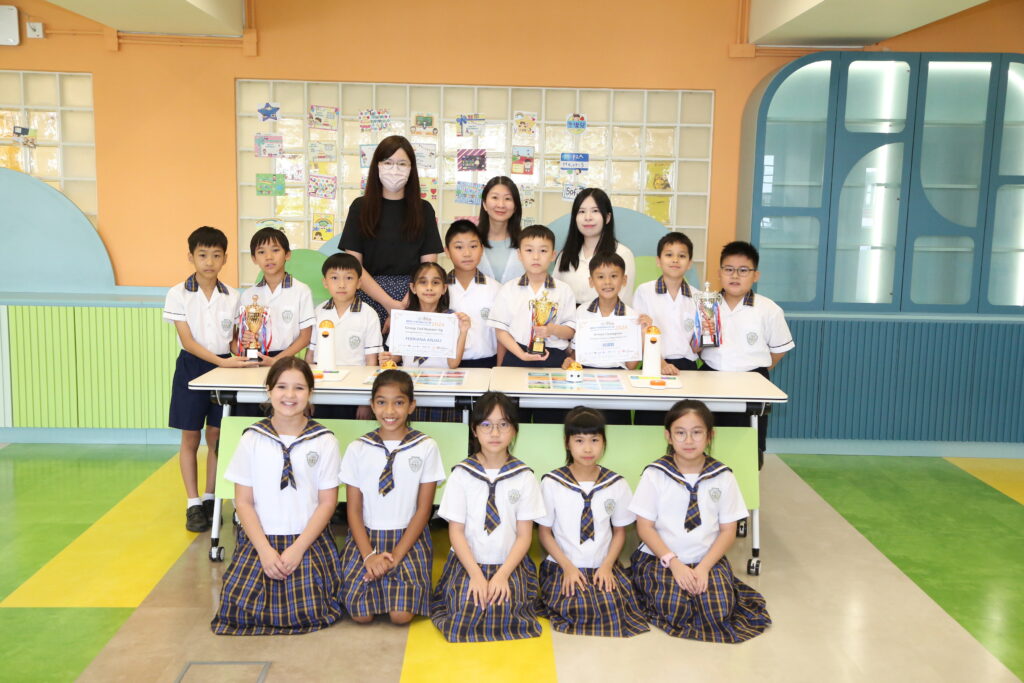
| Others | : | In English, our students achieved remarkable success, winning five top-three awards in the Speech Festival. Both the junior and senior primary groups claimed championships, marking the best results in recent years. We also earned the Champion and Merit Award in the territory-wide "Green" English Reading Report Competition. In STEAM, our students excelled in mathematics competitions, securing multiple awards. The teaching team was honored with two Al Education Awards. The Primary 5 "Electric Aircraft Carrier Launcher" project received recognition from the University of Hong Kong, where students used Gemini to establish assessment criteria and strengthen Al literacy. Additionally, our students captured multiple championships, as well as second- and third-place awards in the Youth STEAM Competition, and were invited to represent Hong Kong in the Foshan Coding Competition. In Music, both the school's wind band and guzheng ensemble won gold medals at the “JSMA Joint-School Music Competition 2025". |
 School Map
Last revision date:01 September 2026


