 Secondary School Profiles 2025/2026


 Secondary School Profiles 2025/2026

| Address: | Cheung Ching Estate Tsing Yi | |||
| Phone: | 24953363 | Email: | info@ykn.edu.hk | |
| Fax: | 24339009 | Website: | http://www.ykn.edu.hk | |
School Mission
In line with the spirit of Buddhist education, to meet the needs of the times, we provide students with a sound learning environment and balanced education opportunities.
 School Information
 | District | : | Kwai Tsing |
| Other District(s) | : | Sham Shui Po, Islands |
| Supervisor / Chairman of School Management Committee | : | Ven. Sik Hin Hung |
| Principal (with Qualifications / Experiences) | : | Mr. Lam Chi Wai, Jimmy (BSc, PGDE, MA) |
| School Type | : | Aided |
| Student Gender | : | Co-ed |
| Area Occupied by the School | : | About 8000 Sq. M |
| Name of Sponsoring Body | : | The Hong Kong Buddhist Association |
| Incorporated Management Committee | : | Established |
| Percentage of School Supervisor and Managers / Chairperson and Members of School Management Committee (SMC) of Government Schools Fulfilling the Training Targets | : | 80% |
| Religion | : | Buddhism |
| Year of Commencement of Operation | : | 1978 |
| School Motto | : | To Illumine Wisdom and Manifest Compassion |
| Parent-Teacher Association | : | Yes |
| Student Union / Association | : | Yes |
| Past Students’ Association / School Alumni Association | : | Yes |
| 4Rs Mental Health Charter | : | Yes |
| Whole School Health Programme | : | Action School |
 Chargeable Fees (2025/2026)
| School Fee ($) | Tong Fai ($) | ||
| S1 | - | - | |
| S2 | - | - | |
| S3 | - | - | |
| S4 | - | $300 | |
| S5 | - | $300 | |
| S6 | - | $300 | |
| Parent-Teacher Association Fee (Annual) ($) | : $20 | ||
| Student Union / Association Fee ($) | : - | ||
| Approved Charges for Non-standard Items (Annual)($) | : - | ||
| Other Charges / Fees ($) | : Charges and fees for specific purposes include approved charges ($450) for non-standard items, which will be used to improve school facilities to enhance our education quality. | ||
 School Facilities
 | Number of Classroom(s) | : | 29 |
| School Facilities | : | There are altogether 1 newly furnished hall, 28 standard classrooms, 27 special rooms including theatre, library, STEM Activity Room, Orchid Pavilion, Chinese Learning Zone, special rooms for different subjects, laboratories, a Buddhism retreat, computer rooms, English Corner, English Reading Corner, supportive education rooms, fitness centre, Mathematics Teaching Centre, student activity centre, teacher resource centre, student union activity room, self-study room, speech therapy room, etc. in the New and Old Wings. Facilities for the disabled are also available. All classrooms and special rooms are air-conditioned and installed with computers and projectors. The whole school has Wifi connection and a wireless network to enhance the implementation of e-learning. Teachers and students can teach and learn with IT equipment to raise learning efficiency. |
| Facility(ies) for Supporting Students with Special Educational Needs | : | Accessible lift, Accessible toilet and visual fire alarm system. |
 Teaching Staff Information (Including School Head) in the 2025/2026 School Year
 | Number of Teaching Posts in the Approved Establishment | : | 61 |
| Total Number of Teachers in the School | : | 65 |
| Qualifications and Professional Training | : | Percentage of Teaching Staff (%) |
| Had Received Teacher Training | : | 97% |
| Bachelor Degree | : | 100% |
| Master / Doctorate Degree or above | : | 52% |
| Special Education Training | : | 72% |
| Years of Experience | : | Percentage of Teaching Staff (%) |
| 0-4 Years | : | 17% |
| 5-9 Years | : | 10% |
| 10 Years or above | : | 73% |
 2025/2026 Class Structure
 | Number of Classes | ||
| S1 | : | 4 |
| S2 | : | 4 |
| S3 | : | 4 |
| S4 | : | 4 |
| S5 | : | 4 |
| S6 | : | 4 |
 Subjects Offered
 | Subjects Offered in the 2025/2026 School Year | : | S.1 - S.3 |
| Chinese as the Medium of Instruction | : | Chinese Language, Mathematics, Buddhist Studies, Science*, Chinese History, Computer Literacy, Aesthetic Development, Physical Education, Geography, History, Citizenship, Economics and Society*; S.1 and S.2: Home Economics*, Design & Technology, Putonghua |
| English as the Medium of Instruction | : | English Language |
| Adopt a Different Medium of Instruction by Class or by Group / School-based Curriculum | : | School-based Curriculum: Value Education, Life Planning, Moral and Civic Education; STEAM Education (S.3) |
| Subjects Offered in the 2025/2026 School Year | : | S.4 - S.6 |
| Chinese as the Medium of Instruction | : | Chinese Language, Mathematics (Compulsory Part), Mathematics Extended Part (Module 2), Citizenship and Social Development, Geography, Economics, Chinese History, History, Tourism & Hospitality Studies, Ethics & Religious Studies, Physics, Chemistry, Biology, Information & Communication Technology, Business, Accounting & Financial Studies, Visual Arts, Buddhist Studies, Aesthetic Development, Physical Education |
| English as the Medium of Instruction | : | English Language |
| Adopt a Different Medium of Instruction by Class or by Group / School-based Curriculum | : | School-based Curriculum: Value Education, Life Planning, Life-wide Learning (S.4 and S.5) |
| Subjects to be Offered in the 2026/2027 School Year | : | S.1 - S.3 |
| Chinese as the Medium of Instruction | : | Chinese Language, Mathematics, Buddhist Studies, Science*, Chinese History, Computer Literacy, Aesthetic Development, Physical Education, Geography, History, Citizenship, Economics and Society*; S.1 and S.2: Home Economics*, Design & Technology, Putonghua |
| English as the Medium of Instruction | : | English Language |
| Adopt a Different Medium of Instruction by Class or by Group / School-based Curriculum | : | School-based Curriculum: Value Education, Life Planning, Moral and Civic Education; STEAM Education (S.3) |
| Subjects to be Offered in the 2026/2027 School Year | : | S.4 - S.6 |
| Chinese as the Medium of Instruction | : | Chinese Language, Mathematics (Compulsory Part), Mathematics Extended Part (Module 2), Citizenship and Social Development, Geography, Economics, Chinese History, History, Tourism & Hospitality Studies, Ethics & Religious Studies, Physics, Chemistry, Biology, Information & Communication Technology, Business, Accounting & Financial Studies, Visual Arts, Buddhist Studies, Aesthetic Development, Physical Education |
| English as the Medium of Instruction | : | English Language |
| Adopt a Different Medium of Instruction by Class or by Group / School-based Curriculum | : | School-based Curriculum: Value Education, Life Planning, Life-wide Learning (S.4 and S.5) |
*Subjects with Extended Learning Activities (ELA) in English
 Secondary One Admission, Orientation Activities & Healthy School Life
 | Secondary One Admission | : | Our school will accept discretionary places. Our school will participate in the Secondary School Places Allocation System through central allocation stage (Applicable for admission to S.1 in September 2026 ).S.1 Discretionary Places Admission Criteria include: academic results (30%), conduct (30%), extra-curricular activities (20%) and performance in interview (20%). |
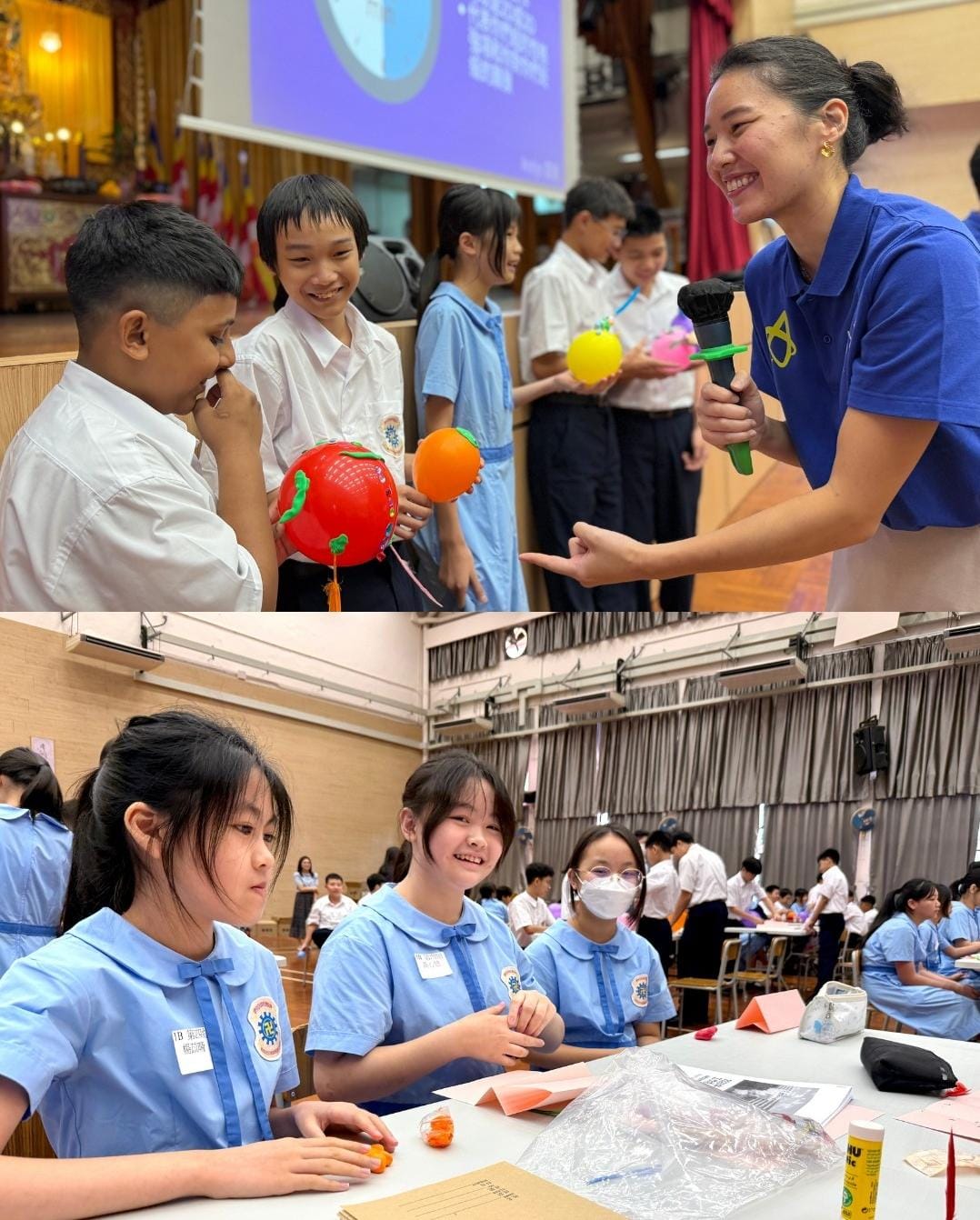
| Orientation Activities and Healthy Life | : | Our school organizes an array of orientation activities, including the Get-Set-Go Camp for S.1 students and an English Orientation Day Camp, to help them adapt to the new learning environment and ensure a smooth transition into secondary school life. Additionally, we offer summer bridging courses to assist students in adjusting to changes in the curriculum. We emphasize the importance of personal development and a healthy lifestyle. To achieve our goal of a "Healthy Campus," we promote personal hygiene and mental well-being through assemblies and posters, instilling good habits in our students. |
 School Characteristics
 | School Management | ||
| (1) School's Major Concerns | : | Live a wonderful life, achieve the ideal; create a harmonious world, self-discipline and self-respect. The focus is on "Enrich students' experience, cultivate a positive learning attitude, and meet the needs of the new era" and "Improve students' self-confidence, cultivate positive values, and lead a healthy and prosperous life". |
| (2) School Management Organisation | : | School-based management is implemented by the Incorporated Management Committee; the administration of the school is led by the Principal with the assistance of the vice-principal and assistant principals; all teachers belong to different functional committees to assist the Principal with planning, implementation and evaluation of school policies. |
| (3) Incorporated Management Committee / School Management Committee / Management Committee | : | Incorporated Management Committee is established and composed of representatives from the School Sponsoring Body, teachers, parents and alumni and the independent manager. |
| (4) School Green Policy | : | Our school actively disseminates environmental conservation information to the students to cultivate their values through various school activities. In response to climate change, our school promotes energy-saving practices and supports the government's Energy Saving Charter, and promises to set energy-saving goals and a timetable, which effectively ensures the transparency of our progress. |
| Learning and Teaching Plan | ||
| (1) Whole-school Language Policy | : | Chinese is the medium of instruction of our school but places great emphasis on improving students’ Chinese and English skills. Chinese and English enhancement courses are offered and small-class teaching is adopted to cater for students’ diverse needs. For S.1 to S.6, the four classes are divided into five groups to accommodate students’ learning differences. Our school also implements the Extensive Reading Scheme to improve the language capacity of students. After-school English oral courses have been set up as well. We help students enhance their language proficiency and bilingual communication skills through the NET Scheme, English Week, English Ambassador training, reading schemes, the Speech Festival, presentations during morning assemblies and project-based learning. Bi-literate and trilingual training are emphasized. The Language Learning Support Section of the Education Bureau provides on-site professional support to strengthen the holistic planning of the school-based English Language curriculum. |
| (2) Learning and Teaching Strategies | : | Our school promotes the virtues of diligence and nurtures students’ positive values. Through contemplating Buddhist thoughts, students can gradually acquire positive life values, allowing them to differentiate wrong from right, thus fulfilling the Buddhist ideas of doing good to others. Finally, they are able to give back to our society. Teaching and learning are student-centered. Through the school-based COMPASS Programme, we bring international educational standards into our local campus, integrating cutting-edge educational innovations into the classroom to enhance teaching quality. This aligns with the school’s mission to create a joyful learning experience for students, balancing academic excellence with their physical and mental well-being, and preparing the younger generation for the future. In addition, the school values students’ learning differences and designs courses based on their abilities and interests while offering practical subjects in response to societal needs. To further enhance learning effectiveness, the school provides tutorial classes to offer appropriate guidance, helping students grasp knowledge more effectively. |
| (3) School-based Curriculum | : | 1. Electives: 2X. 13 elective subjects as well as Applied Learning courses are offered to our students. 2. Curriculum highlights: Curriculum adjustment and co-operative learning are adopted to cater for the diverse needs, interests and abilities of students. Others include teaching and learning in Information Technology, development of Generic Skills, Other Learning Experiences and so on. |
| (4) Major Renewed Emphases in the School Curriculum | : | 1.S1 & S2 COMPASS Programme: COMPASS Programme introduces international educational standards using innovative teaching and interactive classrooms. In collaboration with institutions like MIT, Oxford, and Harvard, we design courses that motivate students and foster independent learning, incorporating service learning to enhance social responsibility. 2.Reading to learn: morning reading schemes, Chinese and English Extensive Reading Schemes, book fair, authors' talks and teachers' reading sharing are held regularly to develop students' reading habits and widen their knowledge base. 3.Information Technology for Interactive Learning: all classrooms are equipped with wireless network coverage to support the use of e-textbooks and e-learning resources. Electronic whiteboards are installed in S.1 to S.3 classrooms. In addition to emphasizing STEAM elements in the curriculum, we have established a STEAM Society, which offers a series of workshops on drones, robotics, and 3D printing. 4.Project Learning: Cross-disciplinary project learning and life-wide learning activities are carried out regularly. A 'spiral' curriculum mode of learning is adopted in project learning at junior levels so as to nurture students' generic skills. 5.Moral and Civic Education: incorporate moral and civic education" into all subjects and implement character education during weekly assemblies and other activities, using diverse channels to foster students' positive values and proactive attitudes. |
| (5) Life Planning Education | : | The objective is to help students understand their goals as early as possible, which will benefit their future selection of subjects for further studies or employment. Life planning courses are arranged for junior-level students, guided by teachers to enable them to explore their personal aptitudes, interests, abilities, and social needs. This allows students to reflect on their futures. In the senior levels, our school strives to provide a diverse range of activities both within and outside the school, allowing students to understand different pathways for future studies and potential career prospects. Regarding admission to higher education, the school will hold talks on further studies. For employment, the school will collaborate with various institutions, organizing activities such as "Workshops on Interviewing Skills," "Job Shadowing Programs," and other visits to encourage students to learn more about different industries. |
| Student Support | ||
| (1) Whole School Approach to Catering for Learner Diversity | : | Our school values the diversity of student learning. By flexibly adjusting teaching methods, we aim to stimulate students’ intrinsic motivation, helping them realize their potential and cultivate their interest in learning. This approach allows both gifted students and those with varying abilities to showcase their strengths. To accommodate students with different language learning capabilities, we implement a class-based teaching strategy. Enhancement classes in Chinese and English are offered for S.1, S.2, and S.3 students. For S.4, S.5, and S.6, we provide after-school English conversation classes and additional English enhancement classes to improve language learning outcomes. Additionally, other subjects also adopt a class-based teaching strategy and assessment model, divided into fundamental and extended levels, ensuring that students of varying abilities can tackle appropriate and challenging learning tasks. The entire school is involved in this effort, dedicated to addressing student diversity and providing personalized learning support for each student, promoting their overall development. |
| (2) Whole School Approach to Integrated Education | : | As for integrated education, the school has set up a ‘Student Support Team' with members including the Special Educational Needs Coordinator (SENCO), educational psychologist, counselors, counselling teachers and school social workers. The team organizes regular meetings to discuss the appropriate support for students with special education needs (SEN). Our school not only understands students' education needs through classroom management meetings, but also implements small-group teaching by introducing language bridging courses of various types. In addition, our school will hold regular seminars to enhance teachers' understanding of integrated education, and also encourage school staff to attend the professional development course on 'Catering for Diverse Learning Needs' organized by the Education Bureau. The school also adopts diverse support models, including the flexible utilization of the 'Learning Support Grant', outsourcing professional support services such as training for developmental dyslexia, speech therapy and occupational therapy. For non-Chinese SEN students, the school also provides appropriate after-school support and individual counselling follow-up. Our school places great value on home-school cooperation, such as talks and seminars regarding students with SEN are held regularly for parents to be updated on their children’s learning progress and support their children’s learning development together with the school. |
| (3) Education Support for Non-Chinese Speaking (NCS) Students | : | Our school provides additional support for NCS students to facilitate their learning of Chinese: providing after-school support programmes in learning Chinese; appointing additional teacher(s)/teaching assistant(s) to support NCS students’ learning of Chinese; arranging intensive Chinese learning and teaching mode(s), e.g. pull-out learning if necessary, split-class/group learning, etc.; developing school-based Chinese Language curriculum and/or adapting learning and teaching materials; and organising activities to create an inclusive learning environment in the school. |
| (4) Measures to Provide Adaptation for Learning and Assessment | : | Three uniform academic assessments are organized each year; continuous assessments include classroom assessments, project learning throughout the whole year and multi-dimensional assessment for learning. |
| Home-School Co-operation and School Ethos | ||
| (1) Home-School Co-operation | : | To strengthen the parent-school relationship, the PTA organizes a wide variety of activities including parent-child tour, interest classes, workshops on parental education and so on. |
| (2) School Ethos | : | Our school is renowned for our ethos of simplicity and modesty. We advocate active participation with a spirit of mutual respect and love through a wide variety of programs for students with "living a fabulous life of fulfillment; achieving peaceful world of self-discipline and self-respect" as the thematic slogan. For example, they include: Pre-S.1 Adaptation Challenging Camp, Fun-filled Corner, Campus Radio, Social Skills Group, "Peer Mediation Service", "Big-Brother-Big-Sister Scheme", "Matchstick Men Scheme", "Good Student Award Scheme" and so on to encourage students to play an active role in school life and serve the community. |
| Future Development | ||
| (1) School Development Plan | : | The Three-year School Development Plan includes: "Enrich students' experience, cultivate a positive learning attitude, and meet the needs of the new era” and "Improve students' self-confidence, cultivate positive values, and lead a healthy and prosperous life". |
| (2) Teacher Professional Training and Development | : | To keep up with various school development policies on effective teaching and school planning and to enhance competence and professionalism of our teachers, strategies have been implemented by the Staff Development Team. Various seminars and workshops are held to enhance teachers' techniques in teaching, thus catering for students' diverse academic needs, counseling and self-evaluation. Joint-school seminars are also organized to improve our teaching strategy. Lesson observations and collaborative lesson planning are promoted among teachers for more exchanges and professional developments. |
| Life-wide Learning (Including Five Essential Learning Experiences to be Provided through Key Learning Areas, Extra-curricular Activities, Co-curricular Activities, etc.) | : | Our school provides a wide range of extra-curricular activities including academic societies, interest groups, sports/art groups and service and uniformed groups. Inter-house competitions are held regularly to encourage active participation. Our students’ performances in academic achievements, Speech and Drama Festivals, music, dance, inter-school ball games and other art competitions are impressive. Through participating in different community services, our students are able to build up a sense of belonging to society. The "One Student One Service" Scheme for S.1 and S.2 students is also established, which enhances a strong sense of responsibility and belonging. Through extra-curricular activities, we encourage students to explore and develop their interests in various fields, build connections with the community, and promote personal growth. |
| Others | : | 1. Scholarships: Students are encouraged to apply for scholarships and award schemes such as the Sir Edward Youde Memorial Prize, Outstanding Student Award of Tsuen Wan, Kwai Chung and Tsing Yi Districts, Jinan University Scholarship offered by The Glorious Sun Enterprises Limited and other scholarships organised by the Hong Kong Buddhist Association. 2. Awards: Open and inter-school competition awards (Please refer to the Chinese version). 3. Exchange programs and excursions to China, Singapore, Malaysia and Japan: Students gain golden opportunities to visit the local universities and secondary schools, helping them equip themselves and plan ahead. |
| Direct Public Transportation to School | : | Near Cheung Ching Bus Terminus; Bus routes: 41, 42, 42A, 42C, 43, 43A, 43B, 43C, 43M, 243M, 249M, 242X, A32; Mini-bus routes: 88D, 88M, 405. |
| Remarks | : | Senior form students can apply for Applied Learning courses. Our school provides other learning experiences in different areas. |
 School Map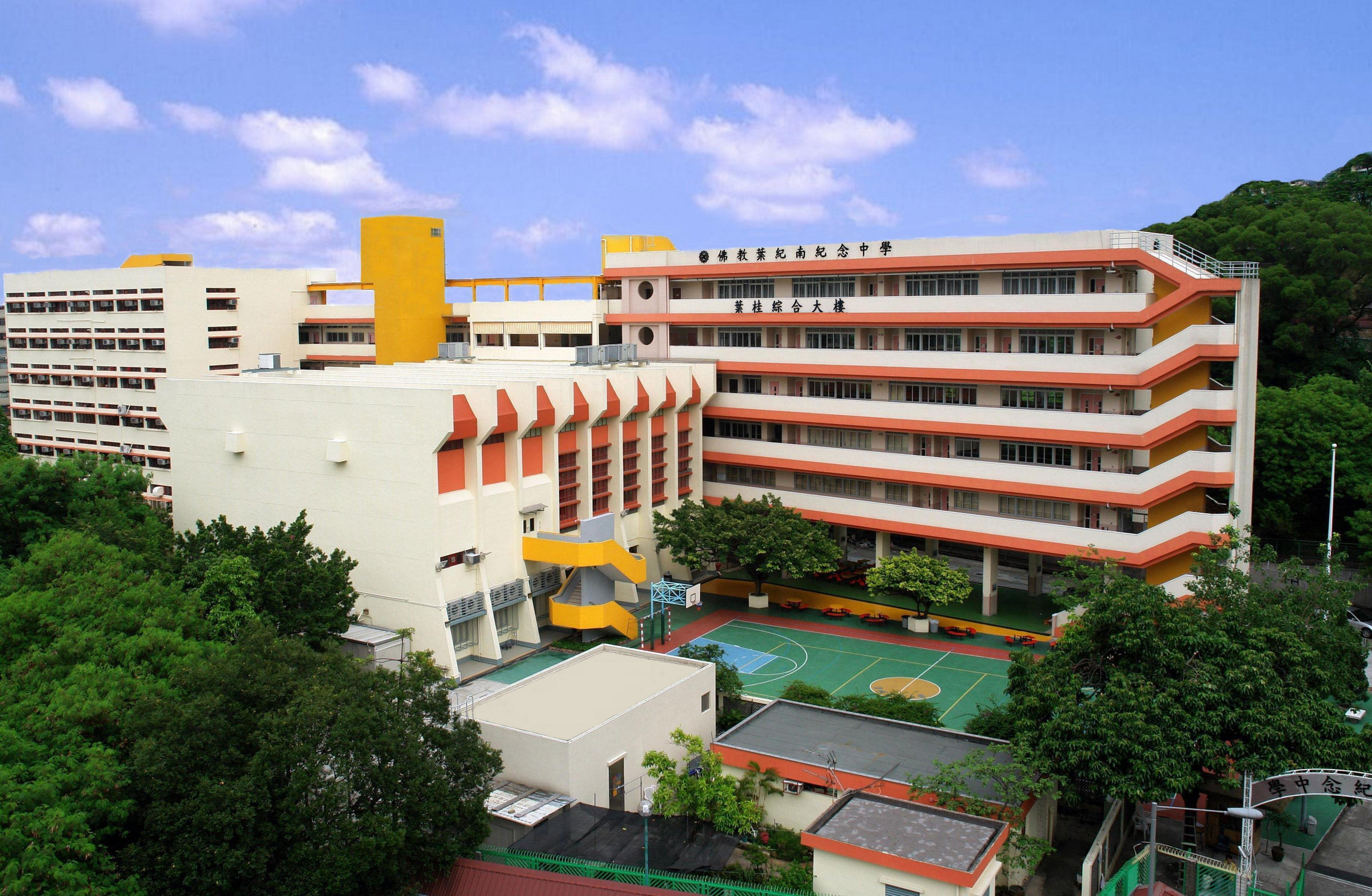

Last revision date: 5/12/2025


