 Secondary School Profiles 2025/2026


 Secondary School Profiles 2025/2026


| Address: | 9-13 Kennedy Road Wan Chai Hong Kong | |||
| Phone: | 25872700 | Email: | sfcc@sfcc.edu.hk | |
| Fax: | 25291758 | Website: | http://www.sfcc.edu.hk | |
School Mission
Through the Gospel values of Truth in Love, we form women of dignity, instilling in them love for learning, commitment and compassion.
 School Information
 | District | : | Wan Chai |
| Other District(s) | : | Islands |
| Supervisor / Chairman of School Management Committee | : | Sister Fok Wai Man Veronica |
| Principal (with Qualifications / Experiences) | : | Mr. Law Kan Chung, Kenneth |
| School Type | : | Aided |
| Student Gender | : | Girls |
| Area Occupied by the School | : | About 11000 Sq. M |
| Name of Sponsoring Body | : | Canossian Daughters of Charity |
| Incorporated Management Committee | : | Established |
| Percentage of School Supervisor and Managers / Chairperson and Members of School Management Committee (SMC) of Government Schools Fulfilling the Training Targets | : | Not Applicable |
| Religion | : | Catholicism |
| Year of Commencement of Operation | : | 1869 |
| School Motto | : | Live by the Truth in Love |
| Parent-Teacher Association | : | Yes |
| Student Union / Association | : | Yes |
| Past Students’ Association / School Alumni Association | : | Yes |
| 4Rs Mental Health Charter | : | Yes |
| Whole School Health Programme | : | Action School |
 Chargeable Fees (2025/2026)
| School Fee ($) | Tong Fai ($) | ||
| S1 | - | $160 | |
| S2 | - | $160 | |
| S3 | - | $160 | |
| S4 | - | $350 | |
| S5 | - | $350 | |
| S6 | - | $350 | |
| Parent-Teacher Association Fee (Annual) ($) | : $100 | ||
| Student Union / Association Fee ($) | : $80 | ||
| Approved Charges for Non-standard Items (Annual)($) | : $300 | ||
| Other Charges / Fees ($) | : - | ||
 School Facilities
 | Number of Classroom(s) | : | 44 |
| School Facilities | : | All classrooms, special rooms and School Hall are air-conditioned and provided with Internet and Wi-Fi access. Each classroom is equipped with a visualiser and a smart TV. Special rooms, which include Computer Room, STEAM Room and School Library, are equipped with computer facilities. The school historical archive “Memory Gallery” has been established to document the school’s history and serve as a testament to alumni’s collective memory. |
| Facility(ies) for Supporting Students with Special Educational Needs | : | Ramp, Accessible lift, Accessible toilet, tactile guide path and accessible public information / service counter. |
 Teaching Staff Information (Including School Head) in the 2025/2026 School Year
 | Number of Teaching Posts in the Approved Establishment | : | 52 |
| Total Number of Teachers in the School | : | 59 |
| Qualifications and Professional Training | : | Percentage of Teaching Staff (%) |
| Had Received Teacher Training | : | 90% |
| Bachelor Degree | : | 100% |
| Master / Doctorate Degree or above | : | 58% |
| Special Education Training | : | 69% |
| Years of Experience | : | Percentage of Teaching Staff (%) |
| 0-4 Years | : | 22% |
| 5-9 Years | : | 19% |
| 10 Years or above | : | 59% |
 2025/2026 Class Structure
 | Number of Classes | ||
| S1 | : | 4 |
| S2 | : | 4 |
| S3 | : | 4 |
| S4 | : | 4 |
| S5 | : | 4 |
| S6 | : | 4 |
 Subjects Offered
 | Subjects Offered in the 2025/2026 School Year | : | S.1 - S.3 |
| Chinese as the Medium of Instruction | : | Chinese Language, Putonghua, Chinese History, Religious & Moral Education, Information Literacy (S.1) |
| English as the Medium of Instruction | : | English Language, Mathematics, History, Geography, Citizenship, Economics and Society (S.1 & S.2), Life & Society (S.3), Integrated Science (S.1 & S.2), Science (Biology) (S.3), Science (Chemistry) (S.3), Science (Physics) (S.3), Information Technology, Technology & Living (S.1 & S.2), Visual Arts, Music, Physical Education |
| Adopt a Different Medium of Instruction by Class or by Group / School-based Curriculum | : | - |
| Subjects Offered in the 2025/2026 School Year | : | S.4 - S.6 |
| Chinese as the Medium of Instruction | : | Chinese Language, Chinese History, Religious & Moral Education (non-DSE subject), Physical Education (non-DSE subject) |
| English as the Medium of Instruction | : | English Language, Mathematics, Mathematics Extension Module 1 (Calculus and Statistics) and Module 2 (Algebra and Calculus), Citizenship and Social Development, Economics, Geography, History, Biology, Chemistry, Physics, Business, Accounting and Financial Studies, Information and Communication Technology, Music (S.4 & S.5 non-DSE subject)) |
| Adopt a Different Medium of Instruction by Class or by Group / School-based Curriculum | : | - |
| Subjects to be Offered in the 2026/2027 School Year | : | S.1 - S.3 |
| Chinese as the Medium of Instruction | : | Chinese Language, Putonghua, Chinese History, Religious & Moral Education, Information Literacy (S.1) |
| English as the Medium of Instruction | : | English Language, Mathematics, History, Geography, Citizenship, Economics and Society, Integrated Science (S.1 & S.2), Science (Biology) (S.3), Science (Chemistry) (S.3), Science (Physics) (S.3), Information Technology, Technology & Living (S.1 & S.2), Visual Arts, Music, Physical Education |
| Adopt a Different Medium of Instruction by Class or by Group / School-based Curriculum | : | - |
| Subjects to be Offered in the 2026/2027 School Year | : | S.4 - S.6 |
| Chinese as the Medium of Instruction | : | Chinese Language, Chinese History, Religious & Moral Education (non-DSE subject), Physical Education (non-DSE subject) |
| English as the Medium of Instruction | : | English Language, Mathematics, Mathematics Extension Module 1 (Calculus and Statistics) and Module 2 (Algebra and Calculus), Citizenship and Social Development, Economics, Geography, History, Biology, Chemistry, Physics, Business, Accounting and Financial Studies, Information and Communication Technology, Music (S.4 & S.5 non-DSE subject) |
| Adopt a Different Medium of Instruction by Class or by Group / School-based Curriculum | : | - |
 Secondary One Admission, Orientation Activities & Healthy School Life
 | Secondary One Admission | : | Our school will accept discretionary places. Our school will participate in the Secondary School Places Allocation System through central allocation stage (Applicable for admission to S.1 in September 2026 ).The School considers academic performance, conduct, other achievements and interview performance as the criteria for S1 Admission. (For details, please refer to the school website.) |
| Orientation Activities and Healthy Life | : | Summer Bridging Programme, which includes introduction to PSHE and Science subjects, and extra-curricular activities, is held for Form 1 students and parents in late August. Our school aims at providing a healthy and safe environment for students. We value the whole person development of the students and encourage them to adopt a balanced lifestyle. Sports week and inter-house basketball competitions are organized to enhance the well-being of students. The Health Education Team helps to promote the benefits of healthy eating and regular exercise. Activities like cooking classes, cooking competitions, aerobic exercise classes and "Joyful Fruit Day" are organized regularly. |
 School Characteristics
 | School Management | ||
| (1) School's Major Concerns | : | Please refer to school website. |
| (2) School Management Organisation | : | School management teams include: School Administration Team, School Middle Management Committee, Academic Team, Student Support Coordinating Team, Examination Section and Staff Development Team. |
| (3) Incorporated Management Committee / School Management Committee / Management Committee | : | With constant commitment to quality and emphasis on continuous development, our school has adopted a transparent and accountable approach to decision-making. The participatory and collaborative framework, involving the Incorporated Management Committee (IMC), the School Administration Team (SAT), the Middle Management Committee and the general staff, provides a forum for the views of different key stakeholders and caters for the holistic development of the entire school community. |
| (4) School Green Policy | : | The Green Ambassadors Union, established in 2023, aims to promote environmental friendliness and sustainability within the school community. There are recycling bin at school for collection of recycled paper, alumnium cans and plastic bottles. Additionally, second-hand items are collected for donation to support the principles of the 3Rs (reuse, recycle and reduce).Besides, the Social Science Union organizes whole-school activities such as "One-Person-One-Flower Scheme" to promote environmental conservation. |
| Learning and Teaching Plan | ||
| (1) Whole-school Language Policy | : | English is used as the medium of instruction in all subjects except Chinese Language, Chinese History, Putonghua, Information Literacy and Religious & Moral Education. The school aims at developing trilingual and biliterate competence in students. Apart from regular English classes, students are given the opportunity to enjoy language activities at the English Cafe outside class time. The English Ambassadors Union was set up in 2022 and English Ambassadors are recruited every year to engage students in the building of a conducive English-speaking environment at school. Annual events, such as English Fun Weeks and Fun Days, are held to provide opportunities to showcase students' exemplary work and develop interest in language learning beyond the classroom through exhibitions and interactive games. |
| (2) Learning and Teaching Strategies | : | The school adopts student-centred inquiry-based approach to teaching and fosters independent learning. Teachers motivate students to learn by means of questioning, group interaction, experiments and use of IT. Students are also encouraged to take the initiative to acquire knowledge and seek the truth. Taking into account students’ interests, the school curriculum is constantly revised to meet the needs of society. Through the adoption of the school-based Integrated Science curriculum, project learning and Language Across the Curriculum, students' generic skills such as creative thinking, critical thinking and communication skills can be enhanced. The Drop Everything And Read (DEAR) reading programme aims at broadening students' scope of knowledge, enhancing their Chinese and English language proficiency and promoting reading in students' leisure time. In order to facilitate eLearning, the school has implemented the Bring Your Own Device (BYOD) initiative for S.1 to S.5. |
| (3) School-based Curriculum | : | 1. Electives: 2X and 3X. Every S.4 student is required to take three electives so as to gain knowledge from various disciplines. The school has also systematically introduced the Other Learning Experiences (OLE) and Applied Learning that align with the New Academic Structure to complement academic learning. 2. Curriculum highlights: Through the adoption of the school-based Integrated Science and Information Literacy curricula at junior level, as well as project learning and reading across the Curriculum, students' generic skills such as creative thinking, critical thinking and communication skills can be enhanced. |
| (4) Major Renewed Emphases in the School Curriculum | : | (1) Our school prioritizes the moral development of students, instilling Canossian and other positive values through both formal and non-formal curriculum to achieve seven learning goals. (2) We promote national education through organic integration, natural connection, diverse strategies, mutual coordination, learning inside and outside the classroom, and whole-school participation. (3) A school-based Information Literacy curriculum is developed with a focus on media and information literacy education. (4) We embrace learner diversity by fostering self-directed learning and promoting learner autonomy through school-based initiatives. |
| (5) Life Planning Education | : | The Careers Guidance Team aims to foster students' self-understanding, personal planning, goal setting and reflective habits of mind. By helping students to understand their own career and academic aspirations, they can make career decisions in accordance with their interests, abilities and orientations. Starting this academic year, the Careers and Guidance Team is participating in the three-year HYAB JC Scheme for Youth Life Planning (2025–28), organized by Side by Side. Besides, students can meet with our Careers Teachers to seek careers support and advice in the Careers Room. The Careers Room contains a repertoire of resources on career life planning, further education and career opportunities. Every year, the Careers Guidance Team holds seminars for parents and students as well as sharing by alumni. Also, with the implementation of a mentorship programme, students will be given opportunities to connect with our alumni with the aim of fostering positive work value and preparing them for their future careers. In addition, the team partners with companies from the business sector provide different learning opportunities for our students. Students can thus develop the competencies needed for progression or entry into the next educational or occupational level. |
| Student Support | ||
| (1) Whole School Approach to Catering for Learner Diversity | : | Each subject department has devised their own strategies to cater for learner diversity, for instance, the introduction of elite classes in S.1-S.3 and the streaming of S.2 and S.3 students according to their level of proficiency in the Chinese language and the English language. Students in each of these two levels are assigned to five different English and Chinese classes. Tiered handouts are also introduced. These arrangements allow for a more tailored approach to meet individual learning needs. |
| (2) Whole School Approach to Integrated Education | : | We adopt the whole school approach to integrated education for students with special educational needs (SEN) and provide specific measures for these students to enhance their learning and personal development. The Inclusive Education Team caters to the needs of the SEN students by means of classroom seating arrangement, homework accommodation, examination arrangements and provision of counselling service by the school social worker, as well as collaboration with educational psychologist, class teachers and parents. Tutorials and training courses to strengthen interpersonal skills and mental health management are organised with the EDB Learning Support Grant and the EDB Grant for Supporting Non-Chinese Speaking Students with Special Educational Needs. |
| (3) Education Support for Non-Chinese Speaking (NCS) Students | : | Our school provides additional support for NCS students to facilitate their learning of Chinese: providing after-school support programmes in learning Chinese; appointing additional teacher(s)/teaching assistant(s) to support NCS students’ learning of Chinese; arranging intensive Chinese learning and teaching mode(s), e.g. pull-out learning if necessary, split-class/group learning, etc.; developing school-based Chinese Language curriculum and/or adapting learning and teaching materials; and organising activities to create an inclusive learning environment in the school. Our school provides pull-out Chinese language support to non-Chinese speaking students. The curriculum is devised according to their Chinese language proficiency and personal preference. |
| (4) Measures to Provide Adaptation for Learning and Assessment | : | One exam in each term, tests and quizzes throughout the term, Continuous assessment of students' learning attitude and daily performance in S.1-S.6. |
| Home-School Co-operation and School Ethos | ||
| (1) Home-School Co-operation | : | The school places a lot of importance on parent education. The Parent-Teacher Association (PTA) always plays an active role in the parent education. With the concerted effort of the PTA, parents' seminars for different levels are held every year. Workshops on parent-child relationship and communication skills are organized. Parents work as volunteers assisting in school functions, for example the Sports Day and the school picnic, etc. PTA newsletters are published regularly with the aim of strengthening ties between the school and parents. |
| (2) School Ethos | : | The school has an ethos of simplicity. The Student Support Coordinating Team oversees various school programmes for fostering students' whole person development held by the Counselling Team, the Careers and Life Planning Education Coordinating Team, the Civic Education Team and the Health Education Team. |
| Future Development | ||
| (1) School Development Plan | : | Major Concerns (2025-2028): 1. To embrace learner diversity by fostering self-directed learning. 2. To promote learner autonomy and foster holistic development through diverse life-wide opportunities 3. To enhance student learning through refining school administration. |
| (2) Teacher Professional Training and Development | : | To enhance teaching and learning, the school provides school-based development programmes that align closely with the school's major concerns for teachers. They are also encouraged to attend various seminars and workshops to keep abreast of latest education trends. Learning circles are set up to explore new teaching strategies to enhance the effectiveness on student learning by using BYOD for assessment literacy. |
| Life-wide Learning (Including Five Essential Learning Experiences to be Provided through Key Learning Areas, Extra-curricular Activities, Co-curricular Activities, etc.) | : | Extended learning days and OLE Fridays provide opportunities to students in experiential learning to broaden their interests and enhance their generic skills, e.g. leadership and communication. 4 houses, 16 clubs which fall into 4 categories: School Teams, Religious Groups, Service and Uniform Groups, and Cultural & Interest Groups. In order to cultivate a spirit of service and a stronger sense of responsibility, every S1 student is required to join one of the uniform / service groups. |
| Others | : | Please refer to the school webpage. |
| Direct Public Transportation to School | : | Buses: 6, 10, 109, 113; MTR: Wan Chai Station (Exit D); Green public light bus: 28. |
| Remarks | : | Our school adopts EMI policy. Every S.4 student is required to take three electives so as to gain knowledge from various disciplines. |
 School Map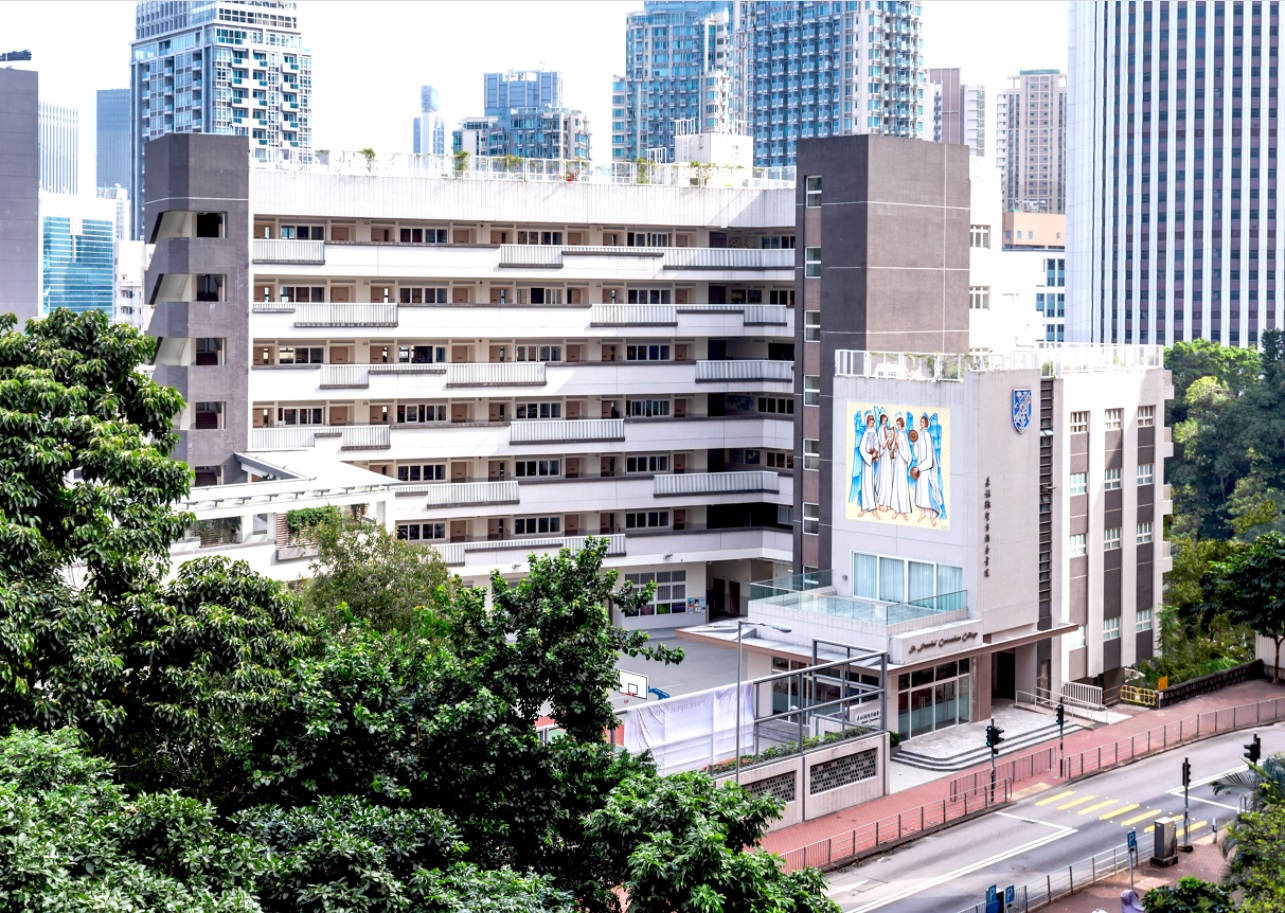
Last revision date: 5/12/2025


