 Secondary School Profiles 2025/2026


 Secondary School Profiles 2025/2026

| Address: | 2 To Yuen Street Sham Shui Po | |||
| Phone: | 27775117 | Email: | mail@mfs.edu.hk | |
| Fax: | 27785871 | Website: | https://www.mfs1.edu.hk | |
School Mission
The school adopts a Whole School Approach to promote the holistic development of our students, tailored to their individual interests and abilities, and guided by Christian values of charity and service. Our aim is to nurture students' growth across moral, intellectual, physical, social, aesthetical, and spiritual dimensions.
 School Information
 | District | : | Sham Shui Po |
| Other District(s) | : | |
| Supervisor / Chairman of School Management Committee | : | Ms. Agnes Garman Yeh |
| Principal (with Qualifications / Experiences) | : | Ms. Sung Hoi Yan (BSc, M.Ed, Professional Diploma in Counselling) |
| School Type | : | Aided |
| Student Gender | : | Co-ed |
| Area Occupied by the School | : | About 6039 Sq. M |
| Name of Sponsoring Body | : | The Catholic Diocese of Hong Kong |
| Incorporated Management Committee | : | Established |
| Percentage of School Supervisor and Managers / Chairperson and Members of School Management Committee (SMC) of Government Schools Fulfilling the Training Targets | : | 100% |
| Religion | : | Catholicism |
| Year of Commencement of Operation | : | 1957 |
| School Motto | : | Truth and Loyalty |
| Parent-Teacher Association | : | Yes |
| Student Union / Association | : | Yes |
| Past Students’ Association / School Alumni Association | : | Yes |
| 4Rs Mental Health Charter | : | Yes |
| Whole School Health Programme | : | Pledged School |
 Chargeable Fees (2025/2026)
| School Fee ($) | Tong Fai ($) | ||
| S1 | - | - | |
| S2 | - | - | |
| S3 | - | - | |
| S4 | - | $340 | |
| S5 | - | $340 | |
| S6 | - | $340 | |
| Parent-Teacher Association Fee (Annual) ($) | : $60 | ||
| Student Union / Association Fee ($) | : - | ||
| Approved Charges for Non-standard Items (Annual)($) | : Charges and Fees for Specific Purposes: $340 (S.1 – S.5); $170 (S.6) | ||
| Other Charges / Fees ($) | : - | ||
 School Facilities
 | Number of Classroom(s) | : | 24 |
| School Facilities | : | School Facilities include: school hall, prayer room, 24 classrooms, 8 small group teaching rooms, multimedia language learning room, computer room, STREAM laboratory, Spiritual Corner, physics laboratory, chemistry laboratory, biology laboratory, two IT workshops, visual arts room, two integrated science laboratories, geography room, two music rooms, library, study room, student activity room, campus television station, English corner, Multipurpose Study Room, print room, dance room, Student Union and four houses room, two basketball courts, small football field, fitness center, counselling room, two social work rooms, conference room, Parent-Teacher Association room, tuck shop, medical room, garden, and student recreation areas. Changing rooms are equipped with solar water heaters. Drinking fountains are installed throughout the campus. Optical fiber networks and interactive electronic whiteboards are installed in all classrooms. Wireless network covers the entire school, and campus TV is broadcast digitally. |
| Facility(ies) for Supporting Students with Special Educational Needs | : | Ramp, Accessible lift, Accessible toilet, tactile guide path and accessible public information / service counter. |
 Teaching Staff Information (Including School Head) in the 2025/2026 School Year
 | Number of Teaching Posts in the Approved Establishment | : | 53 |
| Total Number of Teachers in the School | : | 55 |
| Qualifications and Professional Training | : | Percentage of Teaching Staff (%) |
| Had Received Teacher Training | : | 89% |
| Bachelor Degree | : | 100% |
| Master / Doctorate Degree or above | : | 39% |
| Special Education Training | : | 55% |
| Years of Experience | : | Percentage of Teaching Staff (%) |
| 0-4 Years | : | 38% |
| 5-9 Years | : | 18% |
| 10 Years or above | : | 44% |
 2025/2026 Class Structure
 | Number of Classes | ||
| S1 | : | 4 |
| S2 | : | 4 |
| S3 | : | 4 |
| S4 | : | 4 |
| S5 | : | 4 |
| S6 | : | 4 |
 Subjects Offered
 | Subjects Offered in the 2025/2026 School Year | : | S.1 - S.3 |
| Chinese as the Medium of Instruction | : | Chinese Language; Chinese History; Putonghua; Ethics / Religious Education; Physical Education; Visual Arts |
| English as the Medium of Instruction | : | English Language; Integrated Science; Mathematics |
| Adopt a Different Medium of Instruction by Class or by Group / School-based Curriculum | : | Computer Literacy*; Music (S.1-S.2); Citizenship, Economics and Society*; Geography*; History*; Elementary Business Management (S.3)* |
| Subjects Offered in the 2025/2026 School Year | : | S.4 - S.6 |
| Chinese as the Medium of Instruction | : | Chinese Language; Chinese History; Ethics / Religious Education; Physical Education; Visual Arts; Music; Design and Applied Technology; Applied Learning (S.5-S.6) |
| English as the Medium of Instruction | : | English Language; Mathematics (Core and M2); Economics; Geography; History; Physics; Chemistry; Biology; Business, Accounting and Financial Studies; Information and Communication Technology |
| Adopt a Different Medium of Instruction by Class or by Group / School-based Curriculum | : | Citizenship and Social Development; Japanese; French; Korean; Spanish |
| Subjects to be Offered in the 2026/2027 School Year | : | S.1 - S.3 |
| Chinese as the Medium of Instruction | : | Chinese Language; Chinese History; Putonghua; Ethics / Religious Education; Physical Education; Visual Arts |
| English as the Medium of Instruction | : | English Language; Integrated Science; Mathematics |
| Adopt a Different Medium of Instruction by Class or by Group / School-based Curriculum | : | Computer Literacy*; Music (S.1-S.2); Citizenship, Economics and Society*; Geography*; History*; Elementary Business Management (S.3)* |
| Subjects to be Offered in the 2026/2027 School Year | : | S.4 - S.6 |
| Chinese as the Medium of Instruction | : | Chinese Language; Chinese History; Ethics / Religious Education; Physical Education; Visual Arts; Music; Design and Applied Technology; Applied Learning (S.5-S.6) |
| English as the Medium of Instruction | : | English Language; Mathematics (Core and M2); Economics; Geography; History; Physics; Chemistry; Biology; Business, Accounting and Financial Studies; Information and Communication Technology |
| Adopt a Different Medium of Instruction by Class or by Group / School-based Curriculum | : | Citizenship and Social Development; Japanese; French; Korean; Spanish |
*Subjects with Extended Learning Activities (ELA) in English
 Secondary One Admission, Orientation Activities & Healthy School Life
 | Secondary One Admission | : | Our school will accept discretionary places. Our school will participate in the Secondary School Places Allocation System through central allocation stage (Applicable for admission to S.1 in September 2026 ).Criteria for admission via Discretionary Places: Interview 20%, Academic Performance in Primary School 25%, EDB Rank Order 25%, ECA & Conduct 20%, Connections (Religious & Relationship with our school) 10%. |
| Orientation Activities and Healthy Life | : | After the S.1 registration in July, a briefing session will be held for parents of new students to inform them about school policies. New students will participate in a week-long bridging programme designed to help them become familiar with the new environment and smoothly adapt to school life. To foster students’ sense of belonging and encourage regular consumption of wholesome meals, S.1 and S.2 students are required to stay at school for lunch. They may bring packed lunches or order lunch boxes from the school’s caterer. During lunch breaks, students have access to a variety of co-curricular activities to participate in. |
 School Characteristics
 | School Management | ||
| (1) School's Major Concerns | : | Major Concerns for 2024-2027: 1. Cater to learner diversity. 2. Basing on a comprehensive school-based Whole Person Development Framework developed according to Catholic values, equip students with skills and attitudes needed in the 21st century. 3. Foster a vibrant and supportive school culture. |
| (2) School Management Organisation | : | Adopting a school-based management model, the school’s policies and development are guided by an Incorporated Management Committee (“IMC”) and carried out by the principal and vice principals in collaboration with the School Administration Board. The management structure is organized into three main areas: Learning and Teaching Development, School Management and Sustainable Development, and Student Whole-person Development & Support. Parents, students, and teachers are encouraged to share their views on school policies through various organizations and channels, such as the Parent-Teacher Association, Student Union, and Teacher-Management Consultative Committee, to help improve school operations. |
| (3) Incorporated Management Committee / School Management Committee / Management Committee | : | Ms. Agnes Garman YEH; Ms. SUNG Hoi Yan, Idy; Dr. HO Nga Yi, Fiona; Ms. LEE Yuen Yee, Stella; Ms. LIU Pui Shan, Sisi; Mr. LO Wai Man, Horace; Dr. TAM Man Kei; Ms. YEUNG Mei Hay, May; Ms. CHENG Yuk Ching, Iris; Ms. WONG Ching Yin; Mr. LEE Wing Keung; Ms. CHAN Shuk Ying Edith; Ms. SIU Tsz Mei; Ms. WONG Hiu Chong. |
| (4) School Green Policy | : | Environmental protection measures at our school guide and encourage students to actively participate in protecting the environment. These include inter-class recycling competitions, no air-conditioning days, hydroponic farming projects, donation drives for old school uniforms, and efforts to green the campus. The school participates in the Jockey Club Green Building Evaluation Scheme and is recognized as a "Green School" under the scheme, reflecting our commitment to sustainable campus development. |
| Learning and Teaching Plan | ||
| (1) Whole-school Language Policy | : | In junior secondary, most classes use English as the medium of instruction (“MOI”) (please refer to subject offerings on our school website). Other classes adopt an “allocation of time to subjects” arrangement where Mathematics and Science are taught in English to help improve students' English proficiency. Small class teaching is implemented to provide individualized guidance and enhance teaching effectiveness. The Language across the Curriculum (“LAC”) Group supports students in learning other subjects confidently in English. Practical Use of English is integrated into the LAC curriculum, supplemented by activities such as an English Corner and English Days to facilitate students' language learning. |
| (2) Learning and Teaching Strategies | : | 1. Learning and Teaching: We focus on addressing learner diversity by emphasizing subject-based learning strategies and skills. Assignments are designed to support varied learning experiences. Our approach centers on student-focused, small-class teaching, collaborative learning, and the integration of e-learning and AI advancements to enhance effectiveness. 2. Junior Secondary After-School Consolidation Program: After each assessment, consolidation courses in Chinese, English, and Mathematics are offered to help students build a solid foundation and prepare early for the DSE. 3. Gifted Education: We have established a talent pool to help students realize their potential through participation in special programs, such as science research or English drama. |
| (3) School-based Curriculum | : | 1. Electives: 3X and 4X. Please refer to school web page (https://www.mfs1.edu.hk/curriculum.php). 2. Curriculum highlights: The school-based curriculum is tailored to support each student’s unique ability. S.1 and S.2 students are grouped according to their English proficiency for English lessons and taught in small groups that enhance interaction between teachers and students. To strengthen support for gifted students, the school offers elite courses to help students to develop their potential. |
| (4) Major Renewed Emphases in the School Curriculum | : | 1. Promote Self-regulated Learning: Encourage students to set goals and plans, and effectively utilize subject-based learning strategies to take control of their own learning process. 2. School-Based Whole-Person Development Framework: A comprehensive six-year school-based whole-person development framework is established to help students acquire essential values and skills for the future society, while recognizing and appreciating Catholic values. 3. Interdisciplinary Collaborative Experiential Learning: The junior secondary curriculum emphasizes STREAM, integrating Science, Technology, Research, Engineering, Arts, and Mathematics to apply knowledge to real-life situations. 4. Interactive Learning Using Information Technology: A Bring Your Own Device (“BYOD”) program is implemented to enhance the use of electronic teaching tools and promote interactive learning. 5. National, Moral, and Civic Education: The school promotes life education aimed at character building, including education on the Basic Law and the National Security Law. |
| (5) Life Planning Education | : | The Life Planning Education and Career Guidance Team is committed to helping students understand their interests, abilities, and career pathways, providing them with a broader and deeper understanding of further education and employment opportunities. In addition to regularly inviting representatives from various professions to share their experiences and insights, we have developed a comprehensive six-year guidance program tailored to students at different levels: S.1: "Understanding Myself" – Introduction to career planning through class teacher lessons and other learning experiences (“OLE”). S.2: "Exploring Different Professions and Potentials" – Continuing career exploration within OLE. S.3: "Subject Selection Guidance" – Assisting students in making informed subject choices. S.4: "Facing the Future, Understanding Myself" – Workshops conducted in collaboration with external career planning organizations to help students position themselves for future studies. S.5: "Exploring Diverse Pathways and Gaining Workplace Experience" – Continued workshops and activities to broaden students' career perspectives. S.6: "Soaring High" – Co-hosting seminars and mock interview workshops with external career planning organizations, arranging alumni sharing sessions on subject selection, and providing individual consultations for students. |
| Student Support | ||
| (1) Whole School Approach to Catering for Learner Diversity | : | The school provides bespoke materials and learning experiences to cater for learning diversity. At the junior secondary level, English is taught in small class of split streams based on learning ability to accommodate different learning needs. |
| (2) Whole School Approach to Integrated Education | : | In accordance with the Education Bureau's "Three-Tier Support Model" and "Whole-School Participation" approach, the school is committed to addressing the needs of students with special educational needs (“SEN”). We strive to create an inclusive culture by supporting these students through a whole-school participation model. The Student Support Team, led by a senior teacher serving as the Special Educational Needs Coordinator (SENCO”), includes the SEN Coordinator, Special Educational Needs Support Teachers, and Teaching Assistants. This team coordinates the provision of appropriate examination arrangements, develops tailored Individual Education Plans (“IEP”s), deploys additional teaching assistants, and utilizes the Learning Support Grant to purchase professional services to cater to students’ special needs. |
| (3) Education Support for Non-Chinese Speaking (NCS) Students | : | Our school provides additional support for NCS students to facilitate their learning of Chinese: providing after-school support programmes in learning Chinese; appointing additional teacher(s)/teaching assistant(s) to support NCS students’ learning of Chinese; arranging intensive Chinese learning and teaching mode(s), e.g. pull-out learning if necessary, split-class/group learning, etc.; developing school-based Chinese Language curriculum and/or adapting learning and teaching materials; and organising activities to create an inclusive learning environment in the school. |
| (4) Measures to Provide Adaptation for Learning and Assessment | : | 1. Continuous Assessment: We design assignments, quizzes, and tests at different levels aligned with teaching progress to encourage students to regularly review and reflect on their individual learning journey. 2. Challenging Questions in Junior Secondary Exams: Exams for junior secondary students include challenging questions aimed at identifying students’ diverse learning needs. 3. Biannual Assessments and Examinations: After each assessment, we conduct performance analysis and track data to enhance teaching approaches and improve learning effectiveness. |
| Home-School Co-operation and School Ethos | ||
| (1) Home-School Co-operation | : | The Parent-Teacher Association (“PTA”) works closely with the school to promote effective communication among parents, students, and the school. The PTA organizes activities such as excursions, interest classes, professional talks, and movie screenings to foster collaboration and build a strong school community. PTA council members actively provide feedback on school policies and work to strengthen partnership and collaboration with the school. |
| (2) School Ethos | : | Students are meek, humble, honest, thrifty, righteous, and charitable. They uphold strict self-discipline and consistently maintain a dignified and neat appearance. The school implements a dual-class teacher system and utilizes “sunshine phone calls” to maintain close communication with parents. Daily class teacher time and morning assemblies are incorporated to nurture good character and spiritual formation in students. |
| Future Development | ||
| (1) School Development Plan | : | The theme of the school’s new three-year plan is "Unleash full potential. Collaborate in Synodality," which reflects our commitment to recognizing and developing the unique talents of every student and staff member. • Unleash full potential: We strive to support everyone in discovering and realizing their strengths by fostering confidence and motivation. • Collaborate in Synodality: We emphasize the importance of working together as a community. Synodality invites us to listen to one another, share ideas, and accompany each other on our journeys. We aim to create an inclusive environment where every voice is valued. Key goals include: 1. Cater to Diverse Learning Needs: Foster a collaborative school environment that motivates and builds confidence in students of varied talents and abilities to enhance learning effectiveness. 2. Develop a Holistic Framework Based on Catholic Values: Establish a school-based framework for holistic development where parents and teachers work together to nurture students into individuals with strong values, traits, and skills. 3. Cultivate a vibrant and supportive school culture by enhancing collaboration among staff and nurturing strong relationships with parents and alumni. |
| (2) Teacher Professional Training and Development | : | The Teacher Development Team aligns its professional development activities with the school’s overall development plan. It organizes workshops addressing learner diversity, the use of AI to enhance teaching and learning, and the “Following Thy Way” spiritual programme. We regularly invite industry leaders and professional experts to conduct training sessions. Additionally, our experienced teachers share their insights and best practices at the Learning and Teaching Expo, enhancing our staff’s collective expertise. |
| Life-wide Learning (Including Five Essential Learning Experiences to be Provided through Key Learning Areas, Extra-curricular Activities, Co-curricular Activities, etc.) | : | Diverse Development: Students have the opportunity to join any of the school’s 22 co-curricular activity groups, which include religion, academic, interest, service, and uniformed teams. These activities nurture holistic development by cultivating students’ interests, teaching valuable skills, and enhancing social interactions, a sense of responsibility, and teamwork. S.1 students are encouraged to participate in specially designed programs during Other Learning Experiences (“OLE”) lessons, such as learning a musical instrument, engaging in sports, exploring visual arts, dance, science and technology, or taking foreign language courses. Leadership Skills: Students develop leadership by participating in the Student Union, house teams, prefect team, and by serving as peer counsellors, student ambassadors, academic prefects, and librarians. These roles help them learn collaboration, problem-solving, resilience, confidence building, and effective communication. Other Major Activities: The school offers a range of events such as Life-wide Learning Day, Countryside Learning Day, Sister School Exchange Program, Fun Fair Day, Overseas Excursions, Sports Day, Singing Competitions, and the S.5 Cheering Camp to enrich students’ learning experiences beyond the classroom. |
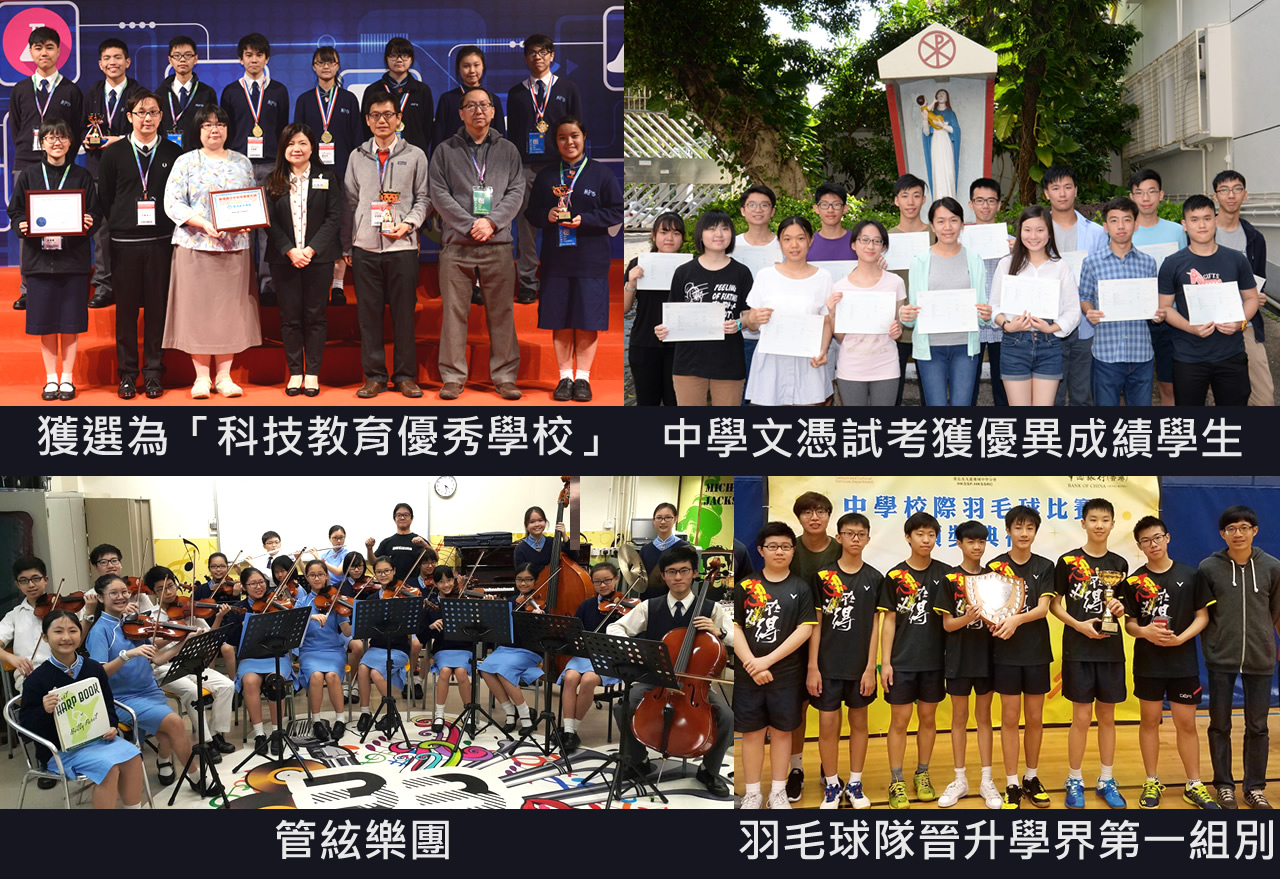
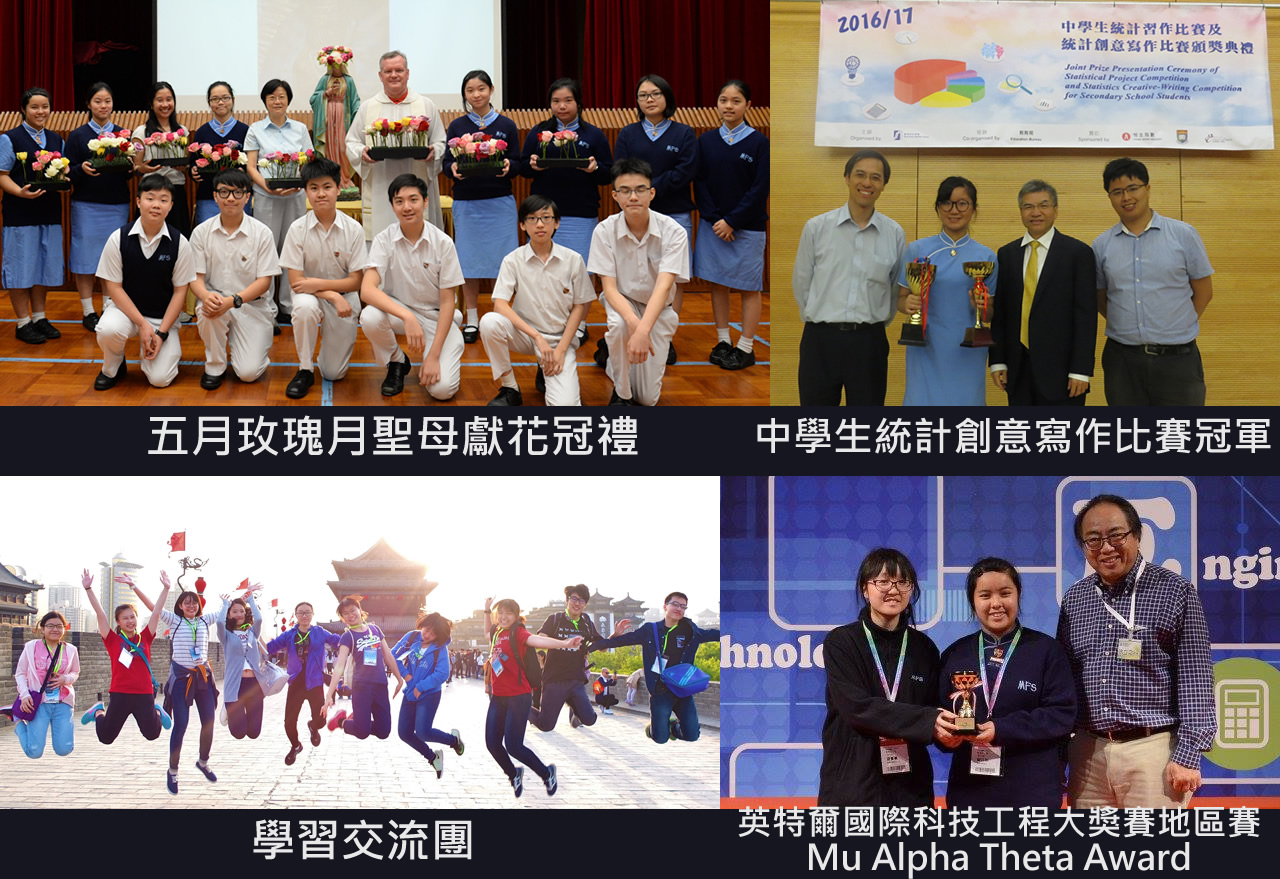
| Others | : | Leaders: Awards received include Sham Shui Po District Outstanding Students’ Award; Catholic Education Prize; Ng Teng Fong Scholarship; Sir Edward Youde Memorial Award Schemes and Methodist Study Trust, etc. STREAM: Our students have demonstrated exceptional performance in the STREAM domain, earning numerous awards in major territory-wide competitions. Highlights include: 2024 Sichuan-Hong Kong-Macau Youth Science Competition – Second Prize and Third Prize. 2025 HKIIT Spatial World Design Challenge: Imagine My Future City – Gold Award. World Reimagined - Global STEAM Public Speaking Competition 2025 (Junior Secondary) – Best Prototype Award. Hong Kong InnoHealth Cup organized by HKU – Second Runner-up and Best School Participation Award. Fun Science Competition organized by the Science Museum – First Prize and Best Design Award. These accomplishments showcase our students’ potential and innovative capabilities in the field of science. Physical Education: Our students have achieved outstanding results in various inter-school sports competitions, including swimming, athletics, and badminton. Notably, they won the championship at the 16th Golden Cup Open Competition of the China Southern & Northern Traditional Martial Arts / Tai Chi and Weapons, organized by the China Hong Kong Southern and Northern Martial Art Federation. Additionally, our students performed exceptionally well in the 2024-2025 Inter-School Dodgeball Competition. Mathematics: Received include first, second and third class awards in the Hong Kong Mathematical Olympiad Association’s Hua Xia Cup Mathematics Olympic Invitation Competition, Promotion Competition, and Final competition. Visual Arts: Champion of a territory-wide drawing competition promoting community awareness, cultural heritage, and sustainable development; Redress Student Ambassador The school organizes and participates in exchange programs that offer students direct personal experiences to learn local languages, understand different cultures, and interact with peers from around the world. Destinations visited include diverse and inspiring locations such as the Antartica, Finland, Italy, and the Greater Bay Area. These exchange opportunities help broaden students’ global perspectives and foster independence and cultural appreciation. |
| Direct Public Transportation to School | : | MTR: Kowloon Tong Station Exit C1 or H (to HKPC Building or Parc Oasis); Shek Kip Mei Station Exit B2 (to Nam Shan Estate). Bus: Kowloon Motor Bus route 203C, First Bus route 702 |
| Remarks | : | The school has established Additional Learning Experience ("OLE") lessons to provide students with a broad and balanced education, supporting their well-rounded development in moral, intellectual, physical, social, aesthetic, and spiritual aspects. These lessons are delivered through various activities, including experiential learning, talks, leadership training, volunteer services, and more. |
 School Map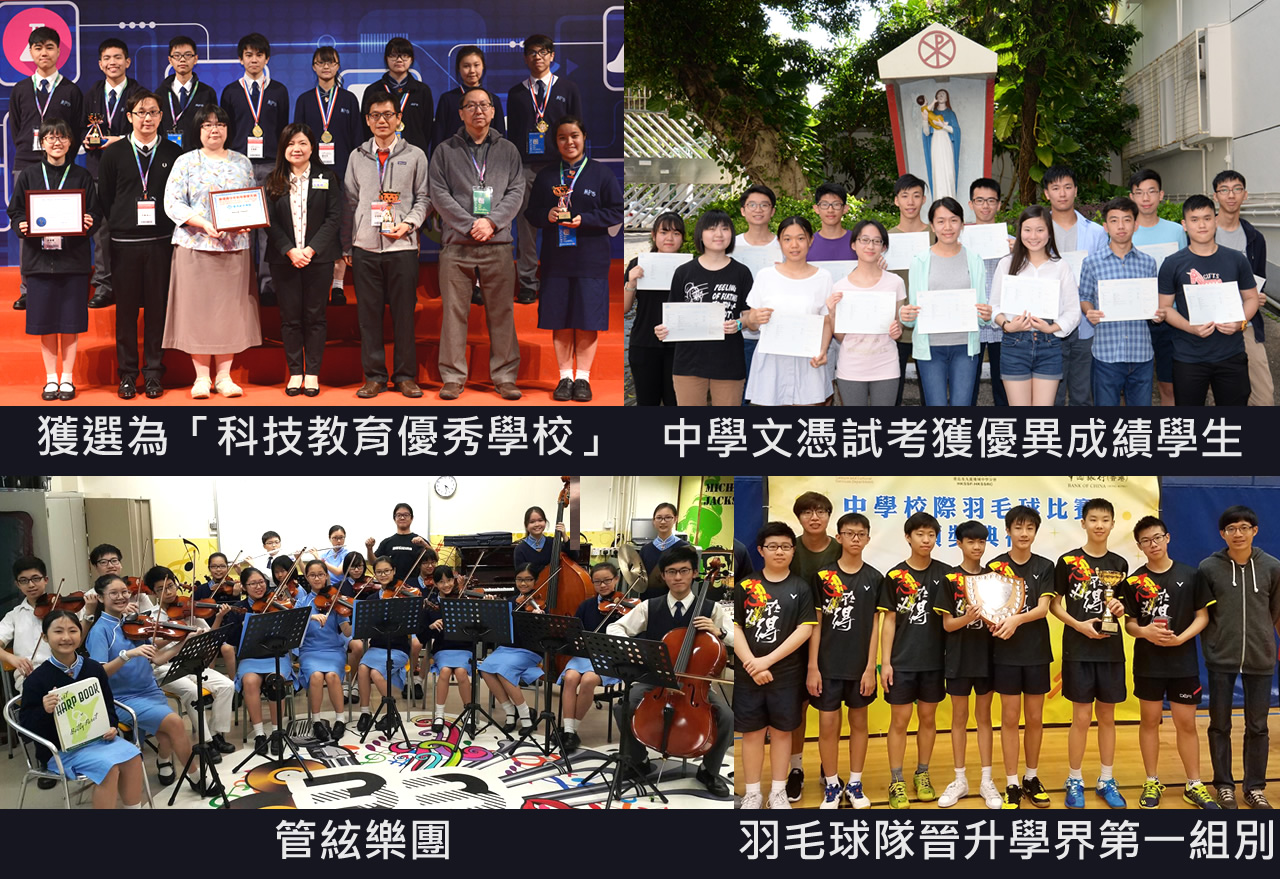
Last revision date: 5/12/2025


