 Secondary School Profiles 2025/2026


 Secondary School Profiles 2025/2026
| Address: | 20 Tin Shing Road NT | |||
| Phone: | 24478123 | Email: | mail@sphrc.edu.hk | |
| Fax: | 24478242 | Website: | http://www.sphrc.edu.hk | |
School Mission
We aim to provide students with a distinctive holistic education. By fostering a culture of love and discipline, we seek to develop students’ academic potential and life-learning skills, expand their knowledge, support their moral development and encourage positive attitudes in them.
 School Information
 | District | : | Yuen Long |
| Other District(s) | : | North |
| Supervisor / Chairman of School Management Committee | : | Mr. Leung Chi Fung, Nicky |
| Principal (with Qualifications / Experiences) | : | Ms Liu Siu Lin (BA(Hon), Dip Ed, MEd) |
| School Type | : | Aided |
| Student Gender | : | Co-ed |
| Area Occupied by the School | : | About 6180 Sq. M |
| Name of Sponsoring Body | : | SPHRC School Ltd. |
| Incorporated Management Committee | : | Established |
| Percentage of School Supervisor and Managers / Chairperson and Members of School Management Committee (SMC) of Government Schools Fulfilling the Training Targets | : | 90% |
| Religion | : | Not Applicable |
| Year of Commencement of Operation | : | 1996 |
| School Motto | : | - |
| Parent-Teacher Association | : | Yes |
| Student Union / Association | : | Yes |
| Past Students’ Association / School Alumni Association | : | Yes |
| 4Rs Mental Health Charter | : | Yes |
| Whole School Health Programme | : | Action School |
 Chargeable Fees (2025/2026)
| School Fee ($) | Tong Fai ($) | ||
| S1 | - | - | |
| S2 | - | - | |
| S3 | - | - | |
| S4 | - | $340 | |
| S5 | - | $340 | |
| S6 | - | $340 | |
| Parent-Teacher Association Fee (Annual) ($) | : $40 | ||
| Student Union / Association Fee ($) | : - | ||
| Approved Charges for Non-standard Items (Annual)($) | : SMI fee: $400 (F.1-F.5), $200 (F.6) | ||
| Other Charges / Fees ($) | : - | ||
 School Facilities
 | Number of Classroom(s) | : | 27 |
| School Facilities | : | 1. The Science Park which cost $3.3 million to build includes the following: DNA Research Laboratory, Plant Tissue Culture Room, Greenhouse, Aquaponics 2.0, Orchid Court, Orchid Garden, Organic Orchard, Soilless Culture Room, Freshwater Stream Habitat, Wetland Plant Display, Intelligence Botanical Garden and Robotic Laboratory. 2. Facilities for self-directed learning are provided including a self-study room, study areas, the English Learning Centre and the library. 3. Two IT learning centres have been established. Wi-Fi can be accessed at the campus, Apple TVs have been installed in each classroom and an electronic whiteboard system has been set up. Students can borrow tablets for interactive learning in the classroom. |
| Facility(ies) for Supporting Students with Special Educational Needs | : | Ramp, Accessible lift and Accessible toilet. |
 Teaching Staff Information (Including School Head) in the 2025/2026 School Year
 | Number of Teaching Posts in the Approved Establishment | : | 57 |
| Total Number of Teachers in the School | : | 62 |
| Qualifications and Professional Training | : | Percentage of Teaching Staff (%) |
| Had Received Teacher Training | : | 80% |
| Bachelor Degree | : | 100% |
| Master / Doctorate Degree or above | : | 45% |
| Special Education Training | : | 69% |
| Years of Experience | : | Percentage of Teaching Staff (%) |
| 0-4 Years | : | 26% |
| 5-9 Years | : | 8% |
| 10 Years or above | : | 66% |
 2025/2026 Class Structure
 | Number of Classes | ||
| S1 | : | 4 |
| S2 | : | 4 |
| S3 | : | 4 |
| S4 | : | 4 |
| S5 | : | 4 |
| S6 | : | 5 |
 Subjects Offered
 | Subjects Offered in the 2025/2026 School Year | : | S.1 - S.3 |
| Chinese as the Medium of Instruction | : | Chinese Language, Citizenship, Economics and Society*, Computer Literacy*, Geography*, Chinese History, History*, Integrated Commerce (F.3)*, Music*, Visual Arts*, D&T*, Physical Education, Putonghua, Life Education |
| English as the Medium of Instruction | : | English Language |
| Adopt a Different Medium of Instruction by Class or by Group / School-based Curriculum | : | Mathematics*, Science (F.1 – F.2)*, Science (including Physics, Chemistry, Biology in F.3) |
| Subjects Offered in the 2025/2026 School Year | : | S.4 - S.6 |
| Chinese as the Medium of Instruction | : | Chinese Language, Mathematics, Mathematics Extended Part Module 2, Citizenship and Social Development, Geography, Chinese History, History, Economics, Physics, Chemistry, Biology, BAFS, ICT, Physical Education, Life Education, Music, Visual Arts |
| English as the Medium of Instruction | : | English Language |
| Adopt a Different Medium of Instruction by Class or by Group / School-based Curriculum | : | Mathematics, Physics, Chemistry, Biology |
| Subjects to be Offered in the 2026/2027 School Year | : | S.1 - S.3 |
| Chinese as the Medium of Instruction | : | Chinese Language, Citizenship, Economics and Society*, Computer*, Geography*, Chinese History, History*, Integrated Commerce (F.3)*, Music*, Visual Arts*, D&T*, Physical Education, Putonghua, Life Education |
| English as the Medium of Instruction | : | English Language |
| Adopt a Different Medium of Instruction by Class or by Group / School-based Curriculum | : | Mathematics*, Science (F.1 – F.2)*, Science (including Physics, Chemistry, Biology in F.3) |
| Subjects to be Offered in the 2026/2027 School Year | : | S.4 - S.6 |
| Chinese as the Medium of Instruction | : | Chinese Language, Mathematics, Mathematics Extended Part Module 2, Citizenship and Social Development, Geography, Chinese History, History, Economics, Physics, Chemistry, Biology, BAFS, ICT, Physical Education, Life Education, Music, Visual Arts |
| English as the Medium of Instruction | : | English Language |
| Adopt a Different Medium of Instruction by Class or by Group / School-based Curriculum | : | Mathematics, Physics, Chemistry, Biology |
*Subjects with Extended Learning Activities (ELA) in English
 Secondary One Admission, Orientation Activities & Healthy School Life
 | Secondary One Admission | : | Our school will accept discretionary places. Our school will participate in the Secondary School Places Allocation System through central allocation stage (Applicable for admission to S.1 in September 2026 ).EDB's rank order list: 40%, Interview performance: 30%, Conduct: 20%, Extra-curricular activities and awards: 10%. |
| Orientation Activities and Healthy Life | : | Orientation: July & August: held for 8 days in July and August and includes the Pre-F1 bridging course in Chinese, English, Mathematics, Life and Society, Integrated Science, Computer together and self-regulated learning strategies with English reading activities and student growth support activities. August: F.1 Orientation Day Whole year: Training programmes for F.1 students Healthy life program: 1. Optimize the class schedule to enrich students' learning experiences. 2. Allow students to use sports facilities freely and build an IT fitness room for students to work out remotely from home. 3. Organize various form-based activities, such as signing the 4RS Mental Health Charter and holding stress-relief activities, such as mindfulness practices. Also, we provide a shared piano for students to use freely. |
 School Characteristics
 | School Management | ||
| (1) School's Major Concerns | : | 1. To enhance the curriculum for self-directed learning to improve the effectiveness of teaching and learning. 2. To develop diverse information technology-based learning strategies to enhance students’ learning effectiveness. 3. To strengthen peer interaction to enhance students’ sense of belonging to the school. |
| (2) School Management Organisation | : | Coordinating with different school departments, the School Administration Board, the Academic Development Board and the Student Development Board oversee and devise plans to improve teaching and learning, as well as facilitating students’ growth. |
| (3) Incorporated Management Committee / School Management Committee / Management Committee | : | An incorporated management committee is in place. |
| (4) School Green Policy | : | 1. Greening the school and establishing the Science Park which consists of several environmental protection facilities. 2. Recipient of a golden award from the Sustainable Development School Award Programme. 3. Infusion of environmental education into formal and informal curriculum. |
| Learning and Teaching Plan | ||
| (1) Whole-school Language Policy | : | 1. Allocating more resources into improving English results: Each class is taught by 2 English teachers. 2. Enhancing the English atmosphere: a) One more NET has been hired to run different English activities. b) Various English activities are organised, e.g. English drama and English Ambassador Scheme. c) Different English courses are offered, e.g. KET and PET Courses and Saturday English Enrichment Course. d) An English award scheme has been set up to award outstanding and hardworking students in English. 3. Strengthening training in biliteracy and trilingualism: Our students have won the 1st runner-up, 2nd runner-up and Best Performance in Language awards in the One-minute Video Production Competition for the Biliteracy and Trilingualism Campaign over the past two years. 4. Enriching the reading environment at school: a) Students are encouraged to join extra reading activities, e.g. Harvard Book Prize and Teen’s Reading Clubs. b) More outstanding pieces of writing are included in the school curriculum to increase students’ exposure. c) Extra reading lessons are conducted to enhance students’ English reading skills. d) A cross-curricular English reading scheme is implemented. e) Films are used as a medium to promote reading and enhance students' interest in it. 5. Improving students' interest and standards in Chinese language: Various Chinese activities are held, e.g. Chinese writing group, author talk and theme-based book fair. |
| (2) Learning and Teaching Strategies | : | 1. To develop diverse information technology-based learning strategies to enhance students’ learning effectiveness: The 'BYOD' scheme has been implemented in the school and all students are equipped with IT devices. 2. Developing STEAM education: a) Our Science Park features 19 learning spots and serves as a unique platform to promote STEAM. b) A centre called 'STEM+ Innovation Centre' has been set up. The Science Park's Elite Program is in place to nurture young talents in engineering and digital technology engineering. 3. Enhancing self-directed learning and improving learning atmosphere: a) Our teachers receive professional support from CUHK and EdUHK to adopt self-directed learning strategies and conduct cross-disciplinary lesson observations. b) A workshop conducted by lecturers from the EdUHK about self-directed learning strategies is held for Form one students. c) The school’s Math, Science and D&T departments have received about $300,000 from the QEF to promote self-directed learning and facilitate classroom teaching and learning. A resources platform has been set up for students to access cross-curricular teaching videos and engage in self-learning. d) Students are encouraged to form study groups and utilise the self-study room and the learning materials in the room. |
| (3) School-based Curriculum | : | 1. Electives: 2X and 3X. Students can also choose to take Applied Learning courses and certificate courses. 2. Curriculum highlights: a) Most subjects have their school-based curriculum with themes, activities and assessments that can match the curriculum objectives and facilitate students’ learning. b) A cross-curricular school-based curriculum is implemented. For example, a kalimba STEAM program is jointly launched by Physics, Mathematics, D&T and Music. |
| (4) Major Renewed Emphases in the School Curriculum | : | 1. Values Education: a) Our school instills the 12 core values in students through the collaborative efforts of the Life Education Department, the Life Education Committee, and the Form Teacher Association. b) Life Education has been developed as part of the formal curriculum. c) Encouraging students to participate in service learning: Our school has received several outstanding awards in Hong Kong. d) Positive education is promoted to develop students' positive outlook. e) Students are given chances to develop their leadership skills. Some became the Orbis Student Ambassadors and won the Gold Award at the 'iTeen Leadership Programme for Senior Secondary School Students'. f) Flag-raising ceremonies and national anthem playing and singing are held every week to enhance students' sense of national identity and sense of belonging towards our country. g) Some students are encouraged to take part in the ‘Constitution and Basic Law Student Ambassadors Training Scheme’. 2. Reading to learn/Cross-curricular reading: a) There are 2 online reading platforms for students to access Chinese and English books. b) Different reading schemes are implemented. Activities like book fair and writing class are organised. c) Reading activities focusing on particular renowned writers and themes are held. 3. Project learning: Students have to work on a cross-curricular project in Humanities subjects. 4. Information technology for interactive learning: a)Diverse information technology-based learning strategies have been developed to improve students’ learning effectiveness. b)A 'Blended Learning' approach is adopted to integrate the use of tablets and e-learning platforms in the lessons. 5. Enhancing gifted education: A three-tier framework—comprising whole-class instruction, pull-out programs, and off-site support—has been implemented across various subjects. 6. Strengthening Students’ Learning of Chinese History and Culture: a) Study tours have been organized or recommended for students to participate in. b) A variety of workshops have been conducted for students. |
| (5) Life Planning Education | : | 1. The ‘Whole School Approach’ is adopted to implement the ‘Life Planning Education Programme’. Through courses and activities, students can understand themselves, learn how to set goals, broaden their vision and plan their future in different stages. For example, by joining the ‘Greater Bay Area Career Exploration Tours' run by the EDB, students could understand more about business models, latest developments and future trends of various industries. 2. Alumni are invited to give talks about their university life and tips for career success. Visits to 9 universities and other higher education institutions are also held. 3. Students are encouraged to participate in the Yuen Long District Student Value-added Programme to deepen their understanding of the district and better prepare them for the future. 4. Various interest classes and summer internship programmes are offered to students. |
| Student Support | ||
| (1) Whole School Approach to Catering for Learner Diversity | : | 1.Chinese, English and Mathematics enhancement and remedial courses are provided. 2. Supplementary classes are conducted after school, on Saturdays and during holidays. 3. Homework guidance classes are offered. 4. Various interest classes and certificate programmes are offered to students. |
| (2) Whole School Approach to Integrated Education | : | 1. Our school’s Student Support Team is responsible for planning, implementing and reviewing the support for integrated education and formulating a school-based integrated education policy. This team consists of the Principal, the Vice Principals, the Heads of the Discipline Team, the Student Counselling Team, and the Academic and Administration Team respectively, the Special Educational Needs Coordinator, panel heads, the school social workers and the counsellor. 2. With the Learning Support Grant, a speech therapist is hired to offer students with SEN one-on-one training. A counsellor and teaching assistants are employed to provide them individual counselling, social skills training, and to conduct small group activities. 3. Meetings are held among our school-based educational psychologist, social workers, counsellor, teachers and parents to monitor their learning progress. |
| (3) Education Support for Non-Chinese Speaking (NCS) Students | : | Our school provides additional support for NCS students to facilitate their learning of Chinese: providing after-school support programmes in learning Chinese; appointing additional teacher(s)/teaching assistant(s) to support NCS students’ learning of Chinese; and organising activities to create an inclusive learning environment in the school. The teacher assistant helps them apply for relevant Chinese examination. |
| (4) Measures to Provide Adaptation for Learning and Assessment | : | 1. Summative assessments: 3 examinations are held every school year. 2. Formative assessments: Varied assessments are conducted on a regular basis to evaluate students' learning progress. Special arrangements are made for students with SEN. |
| Home-School Co-operation and School Ethos | ||
| (1) Home-School Co-operation | : | Parents' Day, Parents' Nights, talks for parents and interest classes for parents are organised. |
| (2) School Ethos | : | 1. Our school is dedicated to creating a school culture which emphasizes love and discipline by combining disciplining and counselling of students. 2. A whole-school approach is adopted to implement a number of programs. For example, positive education is included in our curriculum and activities are held to facilitate students' health, growth and well-being as well as help them build a good social network. We also have the 'Form One Students Training Program' which includes marching drills and the Assignment Award Scheme to help them build good learning habits, interpersonal skills and proper values. 3. Small counselling groups are organized to help students improve interpersonal relationships, adapt to the new environment, improve their communication skills, etc. Also, post-secondary school students are hired to tutor students after school. |
| Future Development | ||
| (1) School Development Plan | : | 1. Learning and teaching: a) To continue to refine teaching and assessment policies and improve students' learning strategies to boost their academic results. b) To promote diversified teaching and learning strategies and strengthen junior form students' foundation. 2. Students' growth: a) To enrich students’ learning exposure and develop their desire to improve themselves. b) To nurture a positive attitude in students and create a caring and proactive culture at school. |
| (2) Teacher Professional Training and Development | : | 1. New teacher training and subject-based training programmes are organised, e.g. sharing sessions and workshops. 2. Professional sharing is strengthened among teachers through regular co-lesson planning, lesson observations and evaluations, etc. |
| Life-wide Learning (Including Five Essential Learning Experiences to be Provided through Key Learning Areas, Extra-curricular Activities, Co-curricular Activities, etc.) | : | 1. The Life-wide Learning Day is designed to enrich students' experiences and help them develop their potential through various activities like Failure Day and Greater Bay Area Career Exploration Tours. 2. Our school understands the importance of critical thinking and has encouraged our students to join Mock Trial Competitions where they are coached by lawyers. We have won The Best Lawyer Award and The Best Witness Award several times. Also, our students have done well in Inter-School Debating Competitions. 3. Mainland or overseas exchange tours to places like Japan, Singapore and Shanghai are recommended or organised for students. 4. Various school teams and clubs such as sport teams, dance team and school band are organised. 5. Students are encouraged to participate in leadership training programmes held or recommended such as the Hong Kong Palace Museum Student Cultural Ambassadors and the Immigration Department Youth Leadership Team. 6. Our school offers various uniformed groups, such as the Girl Guides, the Civil Aid Service, and the Red Cross. We also have service teams like the Community Youth Club and Junior Police Call, encouraging students to give back to society. 7. From interest classes to certificate programs and career planning: a) Various interest classes ar provided to students, e.g. magic course, Chinese acrobat course, anime characters drawing course, drama course, balloon twisting course, etc. b) Locally recognised certificate programs are offered, e.g. professional stage makeup program, foundation certificate program in medical care, etc. for students to explore their strengths and understand job requirements, and improve their competitiveness. |
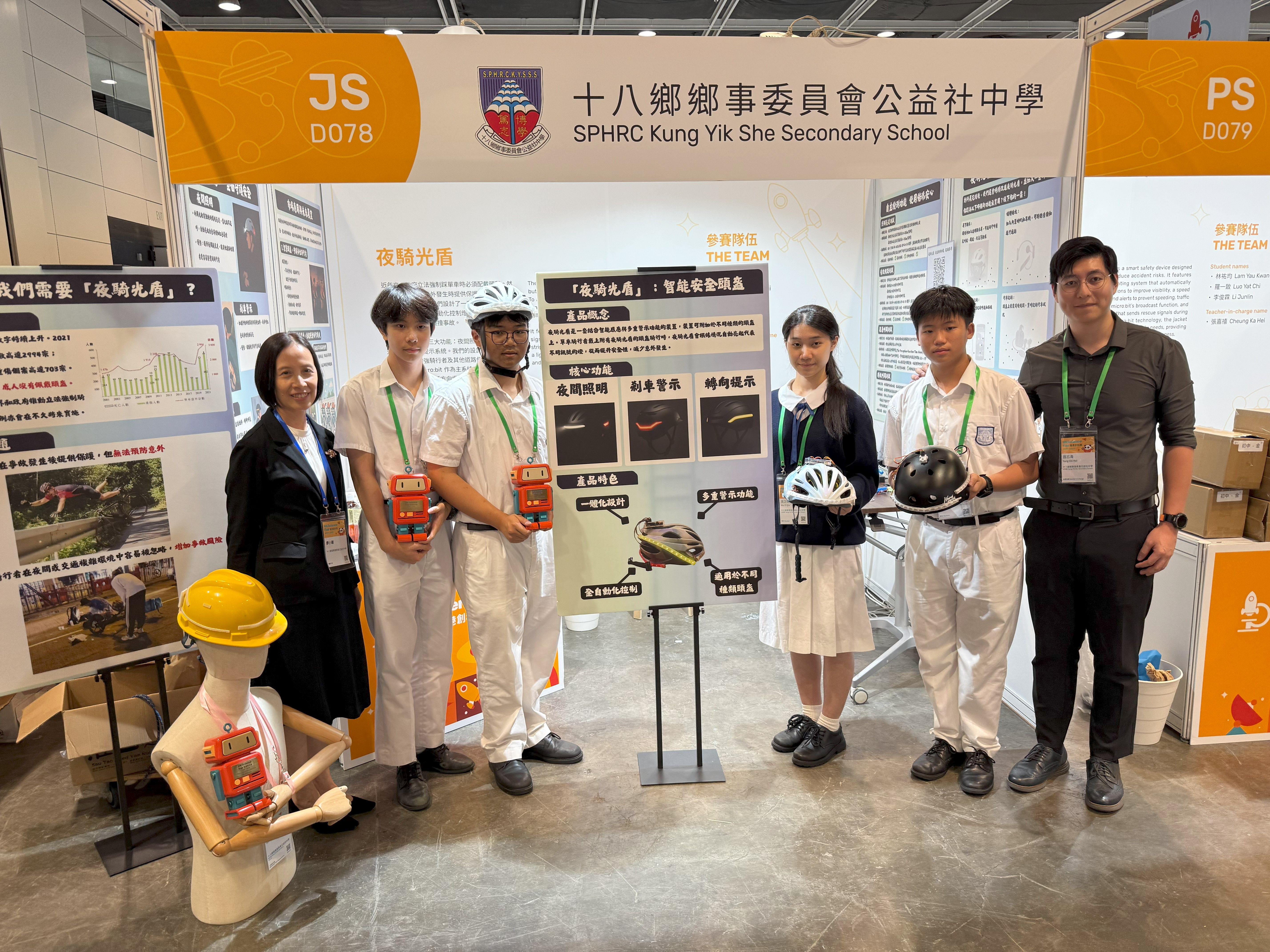
| Others | : | 1. Our students have won a total of 181 championships and runners-up awards in inter-school science and technology competitions. 2. Four students were successfully selected for the ‘Young Astronaut Training Camp’ organized by the Hong Kong Space Museum. They travelled to Beijing and Jiuquan to participate in an astronaut experience course. 3. Outstanding performance in water rocket competitions a) Our students set a Guinness World Record for launching 693 water rockets simultaneously in 2011 and broke that record in 2013 by launching 1056. b) Students performed well in the 2014, 2015 and 2016 inter-school water rocket competitions, winning championships, runners-up and merit awards in both secondary school and open sections and the best design award in the open section. 4. Achievements in STEAM a) At the Hong Kong Science Fair, our students developed a smart bicycle helmet and won the Gold Award. They will represent Hong Kong at the Geneva International Exhibition of Inventions. b) In “My Green Space” Student Competition, our students won the 1st runner-up in the senior secondary division. c) Our school has won first place awards in the Fun Science Competition for 18 years. In the 2025 competition named 'Marble, Paper, Scissors’, our school won two first place awards. d) Our school was awarded the champion in the 'Young Inventor Competition 2021'. e) In the ‘Mathematics and Science Competition' organized by the Hong Kong Polytechnic University, our students received a total of 239 certificates including high distinction certificates from 2012 to 2019. f) In the 'CityU Science Challenges 2021', a competition launched by the City University of Hong Kong, our students won merit and satisfactory awards in physics, chemistry and biology. g) Our students have been chosen to represent Hong Kong in the International Robotic Olympiad for 17 consecutive years, winning 9 championships, 10 first runners-up and 25 second runners-up in total. In the Hong Kong Robotic Olympiad, our students have won more than 120 championships and runners-up awards. h) In STEM coding competitions, our school won the championships of the Quality STEM Education Award and the Outstanding Team Award in 2021. 5. Outstanding performance in flower and plant exhibit competitions a) Our school has won the Hong Kong Flower Show Award (School Section) in the Hong Kong Flower Show's Plant Exhibit Competition three times. We have received over 200 championships and runners-up awards since 2005. Our school has won the Secondary School Potted Plant Growing/Nursing Cup for five times. b) Our school has won nearly 380 championships and runners-up awards in Hong Kong’s large-scale flower competitions since 2003. Our school has won the Secondary School Challenge Cup for five times. 6. Media coverage: Our school’s strengths have been featured on TVB, Cable TV, Metro Radio, and HOY TV. TVB, for example, interviewed us in its programme 'A Closer Look’, focusing on aerospace technology and gifted education. Also, our students were interviewed multiple times by newspapers such as Hong Kong 01, Ming Pao, and Sing Tao Daily." |
| Direct Public Transportation to School | : | Bus: Take bus nos. K73, 265B, 269B, 269C, 269M, 276B or E34A and get off at Lynwood Court. West Rail: Transfer to LRT at Tin Shui Wai Station LRT: Get off at Tin Wing Station |
| Remarks | : | - |
 School Map
Last revision date: 5/12/2025


